


Robert Lederman, B.Sc. (Hons), MCOptom FOVDR
Optometrist and Director, LedermanVision, Jerusalem, Israel
When I lecture to Optometrists, I sometimes point to my eyes and head and say: “Please raise your hand if you think all of this exists so that we can see small things from far away.”
Nobody raises a hand.
I then ask: “What do we call good vision?”
“20/20,” they answer, almost in unison.
Both answers cannot comfortably be true at once. No one believes the visual system exists chiefly to read letters on a chart six metres away. Yet that measurement has become shorthand for “vision is fine”, inside the profession as readily as outside it.
This is not an argument against visual acuity. It is one of our most useful and best-validated measurements. The question is what happens when normal findings in the relatively small number of functions we routinely examine are allowed to stand in for the visual system as a whole.
I sometimes take the discussion one step further. We receive information through the eyes and process it throughout the visual system until we construct an internal representation of the world outside us.
“What do we call that internal representation of external reality?” I ask.
I usually get a variety of answers.
My answer is: “Our life.”
We do not respond directly to external reality, but to our experience of it. If, while looking for something on a shelf, an inaccurate saccade skips the item, the person may quite reasonably say, “It is not there.” The ketchup has not disappeared. It simply never entered that person’s visual experience of the shelf. Attention or other factors may also be responsible, of course. Our role is to make sure poor visual function is not one of them.
That makes the purpose of an eye examination a larger question than whether a patient can resolve letters on a chart.
I want to argue that our profession should occasionally step back from the individual tests, measurements and technologies that make up the modern eye examination and ask a more fundamental question: what are we actually trying to find out when we examine someone’s eyes?
Are We Examining Parts or Assessing Function?
Effective visual function depends on many aspects of the visual system working adequately: visual acuity, accommodation, vergence and binocular coordination, ocular motor control, visual perception, and the optical and refractive factors that influence them.
We have become extraordinarily sophisticated at examining the structures of the eye. Tear film, cornea, lens, vitreous and retina can now be inspected with a level of detail that would have been unimaginable when many of us qualified. That is an extraordinary advance.
But detailed examination of the eye is not the same thing as assessment of visual function.
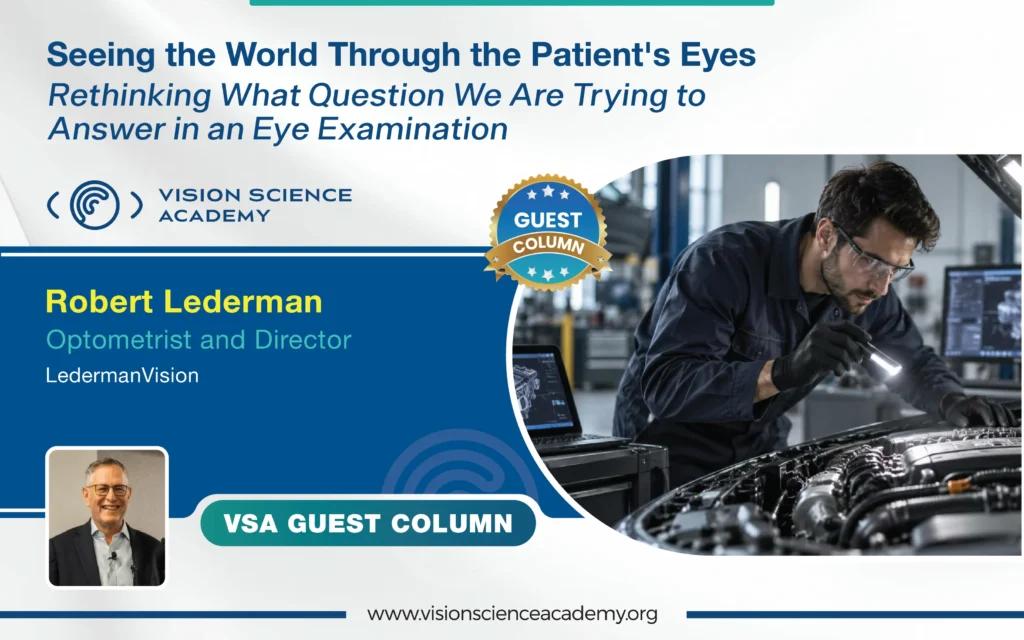
Imagine taking a car for a roadworthiness test. The technician examines every component with the latest equipment: powerful illumination, magnified video imaging, sensors and software capable of flagging the smallest deviation from normal. Every visible part is inspected in extraordinary detail. Everything comes back normal.
There remains one striking omission.
Nobody switches on the engine.
The problem is not that the inspection was too sophisticated. It is that sophistication was applied to only one kind of question.
A brake that appears intact at rest still has to work when the vehicle is moving. Steering and suspension have to respond under changing demand. Switching on the engine means examining the moving parts while they move.
If we want to assess vision, not just eyesight, we have to switch on the engine and get the parts moving.
“I Don’t Do Binocular Vision.” But the Patient Does.
I sometimes ask a colleague whether they assess the near point of convergence.
A common answer is: “No, I don’t do binocular vision.”
I usually respond: “But your patients do.”
In fact, our patients are doing all of seeing, all of the time. They use two eyes together whether or not anyone examines how well they are doing it. They accommodate, make saccades, pursue moving targets and process visual information whether those functions appear on our routine test list or not.
Deciding not to examine a function does not make it stop operating.
The World Council of Optometry describes Optometrists as primary healthcare practitioners of “the eye and visual system” providing “comprehensive eye and vision care”. Its Competency Framework lists Visual Function Assessment and Management as one of five core domains, including binocular vision, oculomotor function, vision development and learning, and occupational visual assessment. (1,2)
The profession therefore defines its territory more broadly than refraction and ocular health alone.
If we do not take responsibility for understanding how these visual functions are working, it is difficult to see who is better placed to do so.
Normal findings in the functions examined cannot establish normality in functions that have not been examined.
When the System Has to Work
Even examining the right functions is only the first step.
A system may demonstrate that it can perform a task once without telling us how efficiently, consistently or sustainably it can do so. That is why medicine uses stress testing. An exercise test cannot reproduce a patient’s entire day, but it deliberately increases physiological demand under controlled conditions because abnormalities may emerge under load that are not apparent at rest. (3)
We face the same problem in vision. We cannot reproduce eight hours of reading, screen use, driving or study in the consulting room. But we can place the relevant visual functions under controlled demand and observe what happens.
Accommodative amplitude tells us something about capacity. Facility asks a different question: how readily can focus change repeatedly, and does that ability hold?
A single vergence measurement tells us something about range. Vergence facility and recovery tell us how the system responds when demand changes and repeats.
Ciuffreda, Rutner and Tannen describe pushing pursuit testing to higher velocity as “a bit like a stress test” for the oculomotor system. (4) The broader principle matters more than any one procedure: what a visual function does under load may reveal information that a brief, single measurement misses.
This is not an invitation to make every eye examination longer or more complicated. It is an invitation to be clearer about the question we are trying to answer.
The progression is simple: establish that the important functions are present; examine how they behave while they are working; then ask whether, together, they are equal to the task the patient needs to perform.
Seeing Is Something We Do
Seeing is something we do, not something that simply happens to us.
The eyes are directed moment by moment by purpose, expectation and attention. We locate, fixate, shift, track, converge, accommodate and interpret. Reading requires repeated saccades separated by fixation, while maintaining binocular alignment and focus. Driving, sport, sight-reading music and navigating a crowded environment place similarly changing demands on visual function.
A patient may be entirely capable of reaching a clinical endpoint on a single attempt and still be doing so at a cost that only becomes apparent with repetition or time: reduced comfort, reduced accuracy, slower recovery or simply a reduced willingness to continue the task.
This is why numbers support clinical judgement rather than replace it. Dynamic testing still produces measurements. The difference is that the measurement is being taken while the function is doing something closer to what it exists to do.
The Person in the Chair
Patients themselves rarely arrive asking these questions.
Over many years, the way our profession has presented the eye examination has taught people to expect a conversation about clarity, prescription and disease. Those are legitimate concerns. But a child who “does not like reading”, an adult who has given up needlework because it is tiring, or a musician who avoids sight-reading has no reason to suspect that vision might be contributing.
These difficulties may not be visual at all. We should neither assume vision is responsible nor assume it is irrelevant. Our task is to find out.
None of this diminishes a profession that has made extraordinary advances in refraction, ocular-health assessment, imaging and evidence-based care. But those advances should not cause us to surrender the part of optometry that is uniquely ours: understanding not only whether the eyes are healthy and the retinal image is clear, but how effectively the person is using vision.
Whatever patients have learned to ask us about, what they ultimately need from vision is the ability to read, learn, work, drive, move, play, create, communicate and participate in their lives.
First establish that the important parts are there. Then see how each behaves once the system is running. Finally ask whether, together, they are equal to the demands of the patient’s life.
The question worth returning to is not simply, “Are the eyes healthy?” or “Can this person see 20/20?”
It is:
Is this person’s visual system helping or interfering with their ability to reach their potential?
References
- World Council of Optometry. WCO’s Concept of Optometry. Available at: https://worldcouncilofoptometry.info/concept-of-optometry/
- World Council of Optometry. WCO Competency Framework for Optometry. 2024. Available at: https://worldcouncilofoptometry.info/wp-content/uploads/2024/02/WCO_Competency-Framework-for-Optometry.pdf
- Myers JN. The physiology behind exercise testing. Prim Care. 1994;21(3):415-437.
- Ciuffreda KJ, Rutner D, Tannen B. Some thoughts on clinical eye movement testing. Vis Dev Rehabil. 2021;7(1):7-16. doi:10.31707/VDR2021.7.1.p7.
About the Author


Robert Lederman BSc (Hons), MCOptom, FOVDR is a UK-trained Optometrist with more than 35 years of clinical experience in Functional and Developmental Optometry, Optometric Vision Therapy and Neuro-optometric Rehabilitation.
He is Director of LedermanVision in Jerusalem and President of the OVDRA Israel Chapter. During his career, he has examined nearly 19,000 patients and delivered more than 400 lectures and presentations internationally to Optometrists and professionals from related disciplines.
Robert’s clinical and educational work focuses on understanding how the visual system functions in everyday life, particularly when apparently normal clinical findings do not adequately explain a patient’s difficulties. His clinical work includes children and adults with functional visual problems, learning and reading difficulties, and visual rehabilitation following concussion, traumatic brain injury and stroke.
He has a longstanding interest in the visual demands of reading and the visual aspects of Dyslexia, including how these may differ between languages. In 2020, he was a keynote speaker at an international conference on Dyslexia, Dysgraphia and Dyscalculia at Ticaret University in Istanbul.
In 2026, Robert presented his “From Acuity to Function” workshop at the European Academy of Optometry and Optics annual meeting in Riga and received the G.N. Getman Award in recognition of his contribution to Developmental Vision and Optometric Education.