


Dr. Jubilee Olorunmola, Intern Optometrist,
Skipper Eye-Q Indian Hospitals, Abuja, Nigeria
Keywords
digital health; eye care; artificial intelligence; telehealth; primary care
Declaration of Interest
The blog is written solely for education purpose, and it does not have any financial support and conflict of interest.
Imagine this…
A Kenyan farmer notices a sudden reduction in her sight but lives two days’ travel from the nearest eye unit. Now imagine a local person coming to her house with a smartphone; testing her vision and sending a text informing her where and when to go for care. This scenario, though fictional, is quickly becoming a reality.
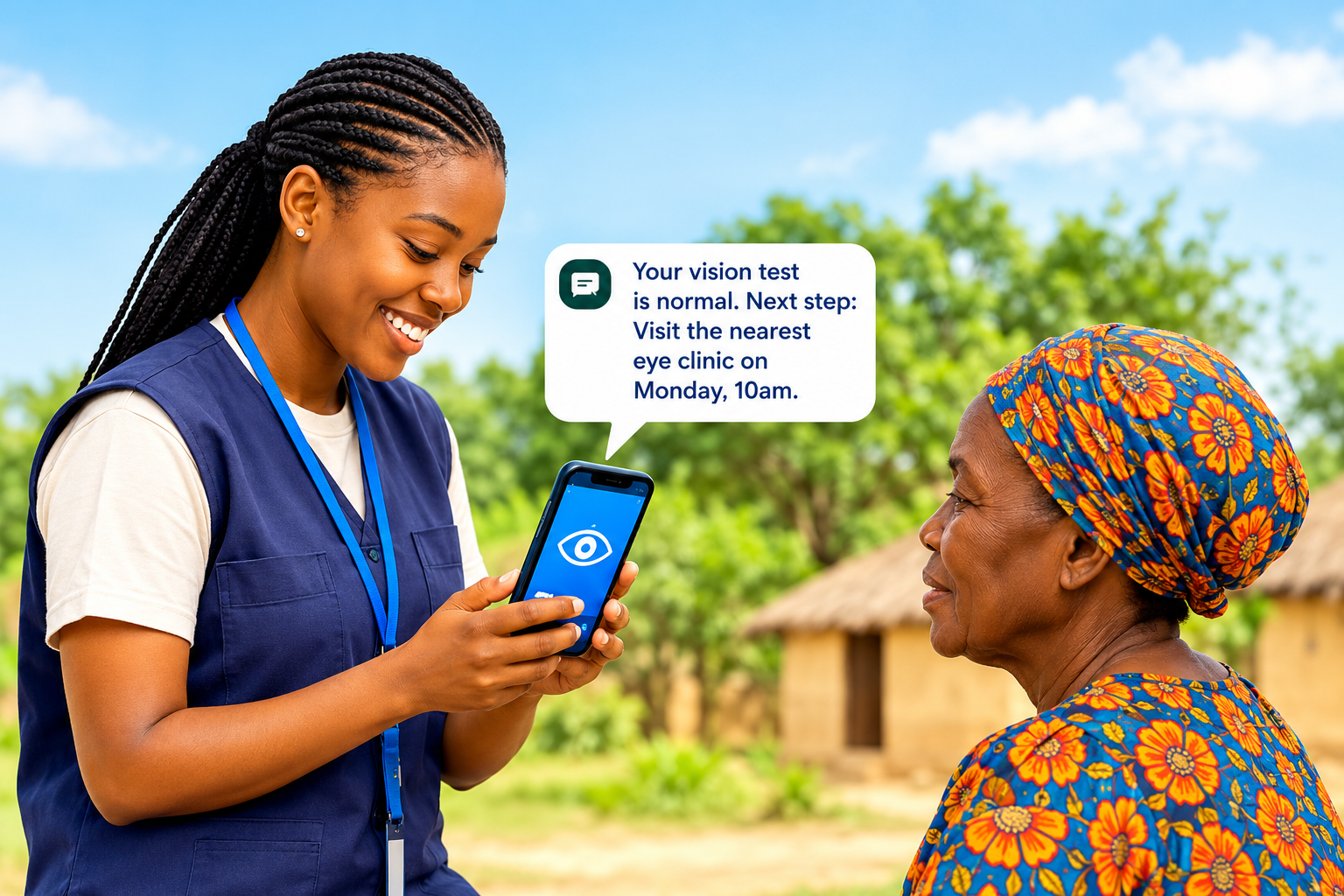

Figure 1: This image shows the simplified illustration of a healthcare worker using a smartphone to demonstrate an eye-care service to an older woman in a rural setting.
Image courtesy: Created by the Author using Generative AI
The Size of the Gap
More than 2.2 billion people suffer from near or distance vision impairment, half of which are preventable or treatable.(1) Eye specialists are both scarce and located in cities, and low- and middle-income countries (LMICs) have the fewest ophthalmologists per capita. (1) Digital health, an umbrella term for the application of information and communication technology in healthcare delivery, has the potential to bring the first step of eye care to the patient.
Screening at the Doorstep
A cluster-randomised controlled trial in Trans Nzoia County, Kenya, reported that lay volunteers using the Peek Community Screening app (Peek Vision, Berkhamsted, UK) to test visual acuity and follow a decision algorithm, with short message service (SMS) reminders to referred individuals, resulted in 1429 per 10,000 residents attending community triage clinics for confirmed eye conditions in the intervention group, compared with 522 in the control group (Figure 1). (2) Minor conditions were managed locally, and 62.9% of those attending the hospital had priority vision-impairing conditions as opposed to 8% in previous regional data. (2)
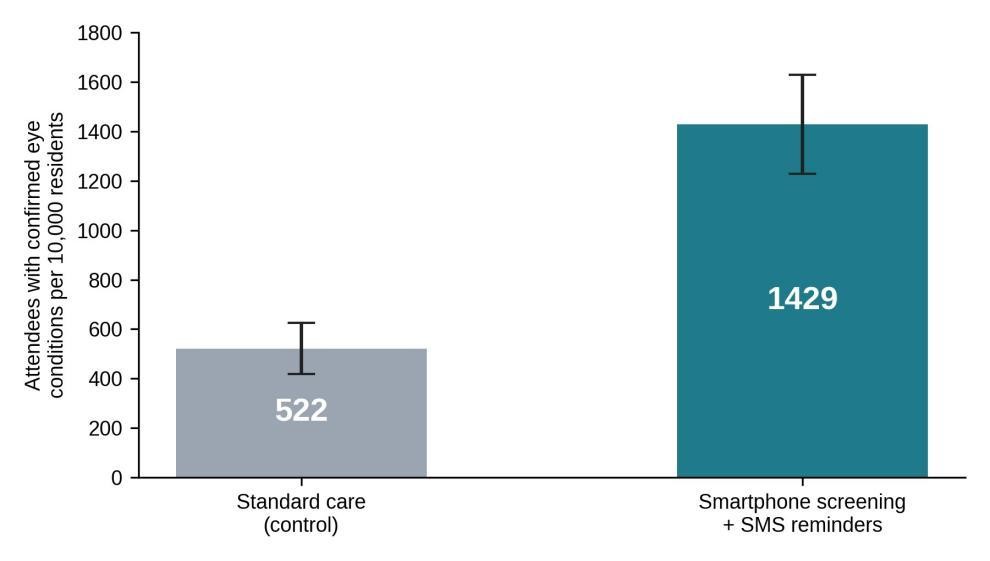

Figure 2: This graph shows the mean attendance at community triage clinics by people with confirmed eye conditions, per 10,000 residents, in the cluster-randomised trial in Trans Nzoia County, Kenya (error bars show 95% confidence intervals). SMS, short message service.
Image Courtesy: Data from reference (2); chart redrawn by the author.
Artificial Intelligence and the Retina
Artificial Intelligence (AI) algorithms can process images in seconds, making image screening a promising modality. In Rwanda, AI-assisted Diabetic Retinopathy screening produced a report in 60 seconds and led to greater referral adherence than manual grading, and smartphone-based fundus photography in India achieved 95.8% sensitivity for identifying Diabetic Retinopathy. (1) Research focus is unbalanced: of 1069 digital health studies in vision science, 68.1% involved the posterior segment, whereas only 153 of 1002 clinical studies focused on primary eye care. (3)
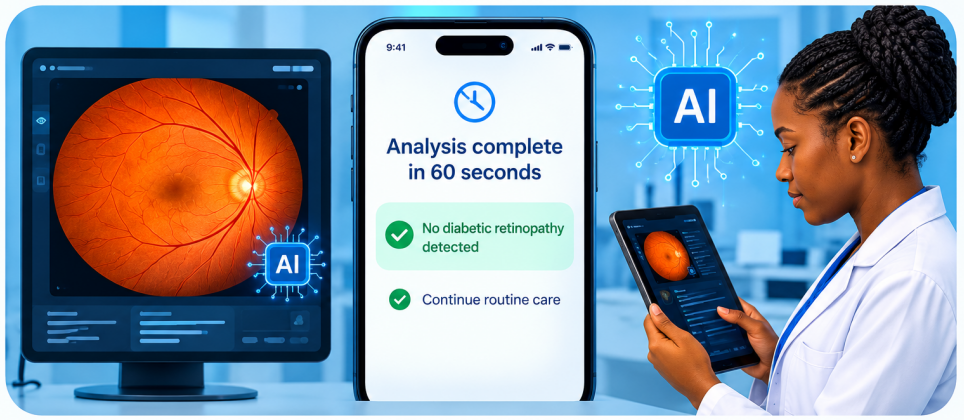

Figure 3: This image shows the simplified illustration of a retinal scan on a computer screen, a smartphone displaying an AI screening result, and a clinician reviewing the findings on a tablet.
Image courtesy: Created by Author using Generative AI
Realism Matters
These tools assist clinicians; they do not replace them. Weak broadband limits live video consultations, so store-and-forward approaches, in which images are captured locally and reviewed later, are a practical alternative. (4) Data availability is also a concern: publicly available Ophthalmological datasets in 2021 excluded patients from 172 countries (42% of the world’s population), risking biased algorithms. (1) In the Kenyan trial, only 40.6% of consenting residents in intervention clusters were screened, and evidence of improved hospital attendance was limited. (2)
The Way Forward
Further progress will require affordable devices, community workers and referral systems, combined with appropriate data management and cost analysis. The clinic in your pocket will not replace the one down the road, but used appropriately, it will identify those in greatest need and help them to access care.
Patient Consent
No identifiable patient information is included; the opening scenario is fictional.
References
- Tan TF, Thirunavukarasu AJ, Jin L, Lim J, Poh S, Teo ZL, et al. Artificial intelligence and digital health in global eye health: opportunities and challenges. Lancet Glob Health. 2023;11(9):e1432–1443. https://doi.org/10.1016/S2214-109X(23)00323-6
- Rono H, Bastawrous A, Macleod D, Mamboleo R, Bunywera C, Wanjala E, et al. Effectiveness of an mHealth system on access to eye health services in Kenya: a cluster-randomised controlled trial. The Lancet Digital Health. 2021;3(7):e414–424. https://doi.org/10.1016/S2589-7500(21)00083-2
- Stuermer L, Martin R. Characterization of technologies in digital health applied in vision care. Journal of Optometry. 2022;15(Suppl 1):S70–81. https://doi.org/10.1016/j.optom.2022.09.005
- Okore NE. Tele-optometry and mobile diagnostic clinics: a model for addressing barriers and expanding access to eye care in rural and underserved population in the United States. Open Access Library Journal. 2025;12:e13572. https://doi.org/10.4236/oalib.1113572
About the Author


Dr. Jubilee Olorunmola
Intern Optometrist,