


Ekta Nebhrajani, B. Optom Student
Bharati Vidyapeeth (Deemed To Be) University, Pune, India
Eyewear has balanced function and fashion, but traditional methods limit customisation and innovation. Recently, additive technology (commonly called 3D Printing) has begun to reshape the eyewear industry. 3D printing now reshapes the industry, enabling tailored frames for individual features and styles, enhancing comfort and fit, rapid prototyping, and sustainability. The World Health Organisation (WHO) estimates that at least 2.2 billion people suffer from blindness or vision impairment, most of which can be treated with well-fitting glasses. (1)
The Process of 3D Printing Glasses
3D printing builds objects layer by layer using digital designs. The process includes: (2)
- Creation of Digital Model: Digital models are developed using Computer-Aided Design (CAD) software or generated from 3D scans, like Computed Tomography (CT) or Magnetic Resonance Imaging (MRI) of existing objects.
- Print File Preparation: The digital model is converted into a Standard Triangle Language (STL) file (or similar format) and processed by slicing software, which divides the design into thin, printable layers.
- 3D Printing: Printer builds the physical object using a specific technology, for example, Fused Deposition Modelling (FDM), Stereolithography (SLA), Selective Laser Sintering (SLS) and material tailored to the chosen fabrication method.
- Object Removal: Afterwards, the object is removed from the printer.
- Post-processing: The printed object may undergo additional processing to enhance durability and aesthetics.
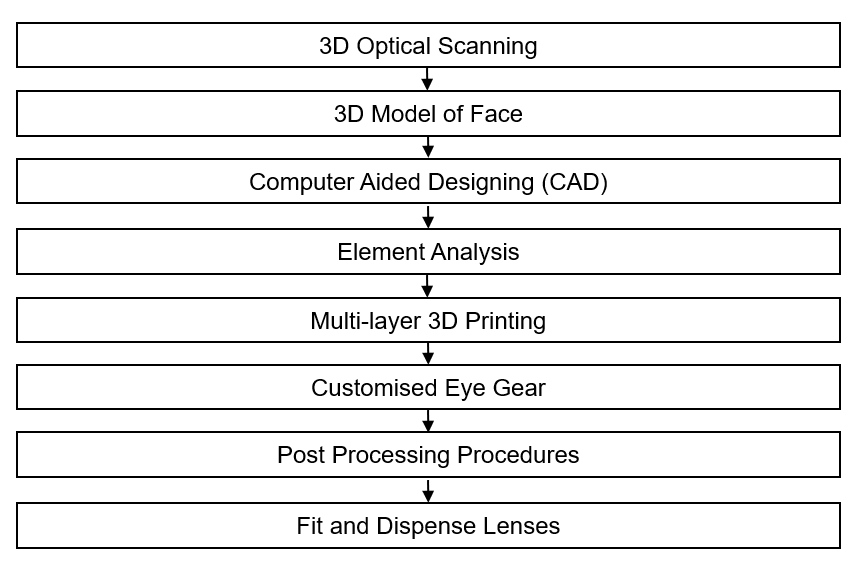

Figure 1: This flowchart describes the process of 3D printing frames.
Image Courtesy: Created by the Author
Clinical Applications in Optometry
3D printing adds value to Optometry by enabling personalised patient solutions and supporting practice development. Here are some specific clinical situations in which additive technologies can be beneficial:
- Standard frames fail complex cases: 3D printing uses scans for custom-fit frames, as in a 2018 Goldenhar Syndrome case, delivering a precise, secure fit for the unique structure of a child. (2-4)
- Custom-made attachments for low vision equipment: 3D printing can create mounts for magnifiers, filters, and smartphones tailored to the needs of the patient. (2,5)
- Therapeutic eyewear: 3D-printed moisture-chamber spectacles have been used for dry eye patients, showing significantly increased periocular humidity compared to standard models. (2)
- Lightweight and adjustable frames: Customised frames for children enhance comfort and compliance. (4)
- Faster and cost-effective production of ocular prostheses: 3D printing provides more efficient production compared to manual methods. (2,6)
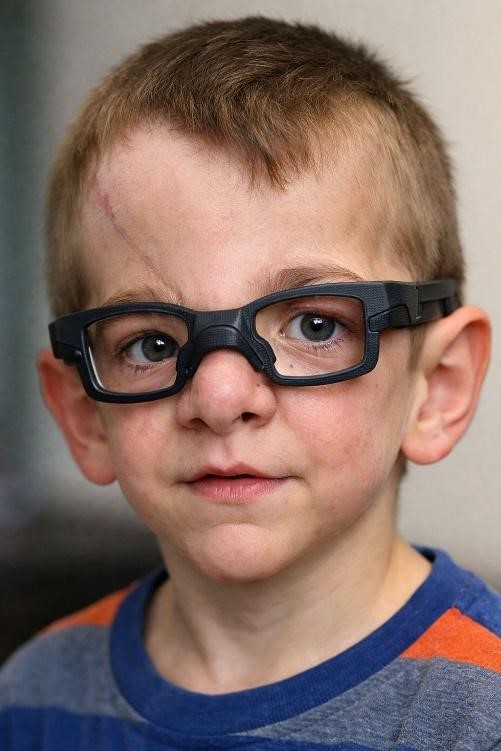

Figure 1: This image shows a customised 3D-printed spectacle frame for a child with craniofacial asymmetry.
Image Courtesy: Created by the Author
Advantages of 3D Printing
- Innovative designs and shapes.
- Customisation for anatomy and prescription resulting in improved comfort and compliance.
- Lower product-development cost.
- Wide material options (polymers, metals, composites).
- Reduced waste. (2,7,8)
Limitations of 3D Printing
- Some materials lack the durability of traditional frame materials, like acetate.
- High initial investment in equipment.
- Limited build size and approved medical materials.
- Need for post-processing and modifications. (2,7,8)
Conclusion
3D printing represents a transformative advancement in Optometry, bridging the gap between technology and personalised patient care. By enabling precise, patient-specific eyewear solutions, it improves both clinical outcomes and patient satisfaction. Although challenges such as cost, material limitations, and regulatory concerns remain, ongoing adoption increases, and 3D printing has the potential to redefine how eyewear is designed, produced, and delivered in modern vision care.
References
- World Health Organization. (2026, February 10). Blindness and vision impairment.
- Fakhoury, Y., Ellabban, A., Attia, U., Sallam, A., & Elsherbiny, S. (2022). Three-dimensional printing in ophthalmology and eye care: current applications and future developments. Therapeutic advances in ophthalmology, 14, 25158414221106682.
- Brodie, F. L., Nattagh, K., Shah, V., Swarnakar, V., Lin, S., Kelil, T., Gillan, D., Romero, D., & de Alba Campomanes, A. G. (2019). Computed tomography-based 3D modeling to provide custom 3D-printed glasses for children with craniofacial abnormalities. Journal of AAPOS : the official publication of the American Association for Pediatric Ophthalmology and Strabismus, 23(3), 165–167.e1.
- Sechrist, S., Meer, E., Brodie, F. L., & de Alba Campomanes, A. G. (2024). Designing custom three-dimensional printed eyeglasses for children with frontonasal abnormalities: addressing challenges in access and fit. Journal of AAPOS : the official publication of the American Association for Pediatric Ophthalmology and Strabismus, 28(2), 103833.
- Hopkins, G. R., & Irvin, B. C. (2019). Optometric Applications for Three-dimensional Printing: A Technical Report from Low Vision Rehabilitation Practice. Optometry and vision science : official publication of the American Academy of Optometry, 96(3), 213–220.
- Reinhard, J., Urban, P., Bell, S., Carpenter, D., & Sagoo, M. S. (2024). Automatic data-driven design and 3D printing of custom ocular prostheses. Nature Communications, 15(1), 1360.
- Damaris Akhigbe, OD (2025). The Future of Frames: How 3D Printing is Transforming Eyewear. Eyes On Eyecare.
- Larochelle, R. D., Mann, S. E., & Ifantides, C. (2021). 3D Printing in Eye Care. Ophthalmology and therapy, 10(4), 733–752.
About the Author


Ekta Nebhrajani
B. Optom Student