


Uma Maheswari M, M. Optom., FBVVT
Assistant Professor, Hindustan Institute of Technology and Science, Chennai, India
Artificial Intelligence (AI) aims to develop systems that mimic human intelligence, changing our understanding of visual perception and cognitive abilities. Incorporating AI into the field of visual neuropsychology helps researchers gain deeper insights into the relationship between vision and cognition.
Visual Neuropsychology
Visual neuropsychology is the field of enquiry devoted to elucidating the links between the anatomy and physiological functioning of visual cerebrocortical structures and the visual perceptions and visually mediated behaviours to which they give rise through experimentation in healthy and brain-damaged humans. (1)
Visual Neuropsychology and Visual Disorders
Visual neuropsychology plays a key role in understanding object recognition, visuo-spatial, visuo-motor integrations, face, body and depth perception. (1)
Impact of brain lesions: Visual neuropsychology also investigates how brain lesions lead to higher and lower level dysfunctions. (1)
Lower-level dysfunctions:
- Strabismus
- Optic Apraxia
- Amblyopia
- Akinetopsia
Higher-level dysfunctions:
- Optic Ataxia
- Cerebral Visual Impairment
- Developmental Coordination Disorders
- Prosopagnosia
- Hemispatial Neglect
- Visual Memory Impairment
The interconnections between the visual regions of the brain can be classified into the ‘what’ ventral and the ‘where’ dorsal streams. (2)
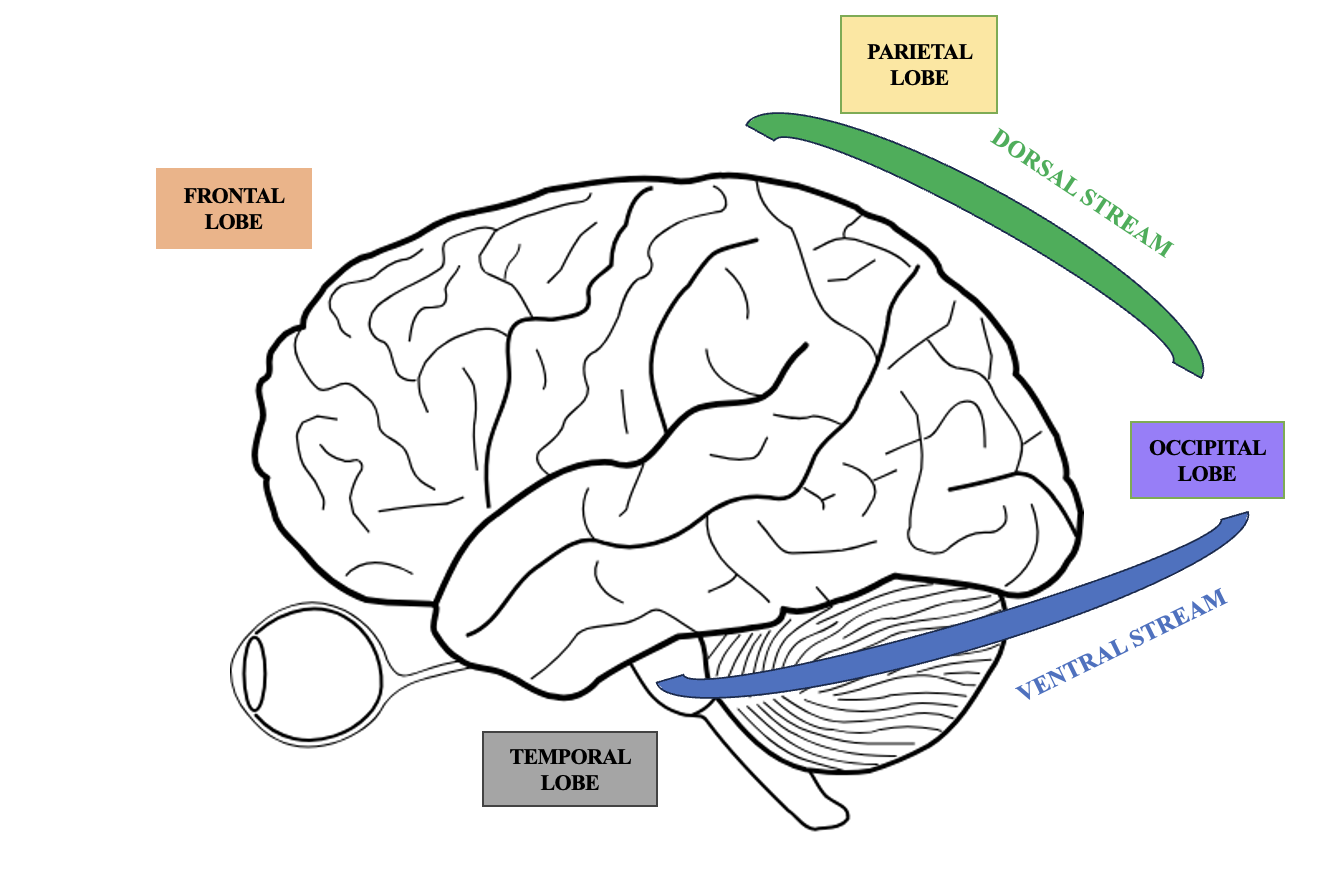

Figure 1: Dorsal and Ventral Stream
Lesions in the ventral stream produce recognition deficits like prosopagnosia. (3) Lesions in the dorsal stream produce visuo-motor deficits like optic ataxia. (4) Neurological conditions within the visual cortex can also lead to changes in visual perception. (5)
AI in Neuroimaging and Diagnosis
Machine Learning and Deep Learning algorithms can detect subtle alterations in cortical and subcortical structures associated with visual processing, enabling earlier diagnosis of disorders. (6–8)
Deep learning algorithms, including convolutional neural networks (CNNs) and transformer-based models, can perform tasks such as brain and optic nerve segmentation, volume measurement, and pathology identification with exceptional accuracy. These models improve diagnostic accuracy by integrating multimodal imaging data and predicting disease progression. (9–11)
Rehabilitation and Assistive Technologies
Through the research of intelligent systems, we can try to understand how the human brain works and model or simulate it on the computer. (12) AI technologies like Brain-Computer Interface (BCI), Visual Language Model (VLM), and Neurofeedback (NFB) decode neural activity, provide assistive solutions, and optimise recovery of visual perceptual skill deficits. (13–16)
Brain-Computer Interface (BCI): BCI uses neurophysiological signals as input commands to control external devices. (13) It can decode brain signals to assist in diagnosis and compensate for damaged functions. (14) By providing visual stimuli, BCI also aids in the assessment and training of eye tracking, visual attention, and pursuits. Auditory and tactile BCIs are designed for individuals with visual impairments.
Neurofeedback (NFB): NFB is effective in improving verbal memory and certain dimensions of visual memory. (15)
Visual Language Model (VLM): VLMs are multimodal AI models capable of processing both text and images, integrating linguistic and visual elements. They assist in face recognition and object identification, helping model cognitive deficits in neurological diseases. (16,17)
AI Technologies in Visual Neuropsychology
| AI Technology | Key Features | Applications |
|---|---|---|
| Brain-Computer Interface (BCI) | Auditory and visual modalities for real-time decoding of brain activity. Direct neural signal acquisition from the brain. Interfaces with external devices. |
Assistive solutions for visually impaired individuals. Training of visuo-motor skills.(18) |
| Neurofeedback (NFB) | Monitors brain activity in real time and provides feedback to regulate neural activity. | Assistive solutions for visual perceptual skills.(15) |
| Visual Language Model (VLM) | Integrates visual inputs with language processing. Capable of interpreting visual scenes and generating descriptive outputs. |
Assists in face recognition and object identification.(17) |
Table 1: AI Technologies in Visual Neuropsychology
Conclusion
AI represents a transformative tool, building an intersection between clinical practice and computation. AI-based technologies deepen our understanding of the visual brain, support early diagnosis, and help in the rehabilitation of visual disorders.
Keywords
Visual neuropsychology, Artificial Intelligence, Visual perception
References
- Brooks A, van der Zwan R, Mercier M, Blanke O. Visual Neuropsychology. InEncyclopedia of Neuroscience 2009 (pp. 4318-4322). Springer, Berlin, Heidelberg.
- Hickok G, Poeppel D. Dorsal and ventral streams: a framework for understanding aspects of the functional anatomy of language. Cognition. 2004 May 1;92(1-2):67-99.
- Mayer E, Rossion B. Prosopagnosia. In: Godefroy O, Bogousslavsky J, editors. The Cognitive Neurology of Stroke. Cambridge: Cambridge University Press; (in press).
- Himmelbach M, Nau M, Zündorf I, Erb M, Perenin MT, Karnath HO. Brain activation during immediate and delayed reaching in optic ataxia. Neuropsychologia. 2009 May 1;47(6):1508-17.
- Ma J, Rui Z, Zou Y, Qin Z, Zhao Z, Zhang Y, Mao Z, Bai H, Zhang J. Neurosurgical and BCI approaches to visual rehabilitation in occipital lobe tumor patients. Heliyon. 2024 Dec 15;10(23).
- Esteva A, Robicquet A, Ramsundar B, Kuleshov V, DePristo M, Chou K, Cui C, Corrado G, Thrun S, Dean J. A guide to deep learning in healthcare. Nat Med. 2019 Jan;25(1):24-29. doi: 10.1038/s41591-018-0316-z. Epub 2019 Jan 7. PMID: 30617335.
- Wu, Y., Besson, P., Azcona, E.A. et al. A multicohort geometric deep learning study of age dependent cortical and subcortical morphologic interactions for fluid intelligence prediction. Sci Rep 12, 17760 (2022). https://doi.org/10.1038/s41598-022-22313-x
- Huaidong Huang, Shiqiang Zheng, Zhongxian Yang, Yi Wu, Yan Li, Jinming Qiu, Yan Cheng, Panpan Lin, Yan Lin, Jitian Guan, David John Mikulis, Teng Zhou, Renhua Wu, Voxel-based morphometry and a deep learning model for the diagnosis of early Alzheimer’s disease based on cerebral gray matter changes, Cerebral Cortex, Volume 33, Issue 3, 1 February 2023, Pages 754–763,
- Lundervold AS, Lundervold A. An overview of deep learning in medical imaging focusing on MRI. Zeitschrift fuer medizinische Physik. 2019 May 1;29(2):102-27.
- 10. Akkus Z, Galimzianova A, Hoogi A, Rubin DL, Erickson BJ. Deep learning for brain MRI segmentation: state of the art and future directions. Journal of digital imaging. 2017 Aug;30(4):449-59.
- Varoquaux G, Schwartz Y, Poldrack RA, Gauthier B, Bzdok D, Poline JB, Thirion B. Atlases of cognition with large-scale human brain mapping. PLoS computational biology. 2018 Nov 29;14(11):e1006565.
- Ertel W. Introduction to artificial intelligence. Springer Nature; 2024 Sep 6.
- Brain Computer Interface and Eye-tracking for Neuropsychological Assessment of Executive Functions: A Pilot Study
- Chai X, Cao T, He Q, Wang N, Zhang X, Shan X, Lv Z, Tu W, Yang Y, Zhao J. Brain-computer interface digital prescription for neurological disorders. CNS Neurosci Ther. 2024 Feb;30(2):e14615. doi: 10.1111/cns.14615. PMID: 38358054; PMCID: PMC10867871.
- Nazer M, Mirzaei H, Mokhtaree M. Effectiveness of neurofeedback training on verbal memory, visual memory and self-efficacy in students. Electron Physician. 2018 Sep 9;10(9):7259-7265. doi: 10.19082/7259. PMID: 30258558; PMCID: PMC6140992.
- Tangtartharakul G, Storrs KR. Visual Language Models show widespread visual deficits on neuropsychological tests. arXiv preprint arXiv:2504.10786. 2025 Apr 15.
- Singh G, Ramanathan M. Repurposing Artificial Intelligence Tools for Disease Modeling: Case Study of Face Recognition Deficits in Neurodegenerative Diseases. Clin Pharmacol Ther. 2023 Oct;114(4):862-873. doi: 10.1002/cpt.2987. Epub 2023 Jul 14. PMID: 37394678.
- Daly JJ, Wolpaw JR. Brain–computer interfaces in neurological rehabilitation. Lancet Neurol. 2008;7(11):1032–1043