


Bhoomi Srivastav(1), B. Optom. Student,
Shubham Bhattacharya(2), Assistant Professor
Sumandeep Vidyapeeth (Deemed to be) University, Vadodara, India
Keywords
spaceflight-associated neuro-ocular syndrome, microgravity, astronaut vision, ocular health.
Declaration of Interest
This article is written for educational purposes and does not have any financial support or conflict of interest.
Spaceflight-Associated Neuro-ocular Syndrome (SANS) and the Challenge for Mars missions
A Disturbance in the Silent Void
Picture yourself in the Cupola window 250 miles above Earth looking at blue Earth. You go to pull out your emergency procedure card and the words are smudged. You push it away. Still blurred. Farther. Finally, focus returns. Your vision has not failed from fatigue. Microgravity itself has reshaped your eyes. (1)
In space, about 2 litres of fluid move from your legs towards your head. (2) Your optic nerve becomes swollen. Your eyeball is flattened as if you pressed your thumb into soft rubber. The result: Spaceflight-Associated Neuro-ocular Syndrome (SANS), a condition that has been reported in up to 69% of long-duration astronauts and results in permanent structural eye damage in some cases. (1) On the International Space Station (ISS), this is manageable. However, on a nine-month Mars transit, blurred vision is mission-critical.
What Is SANS?
SANS is not an infection, radiation, or the natural fatigue of the eye. SANS is a change in the shape and structure of the eye and optic nerve due to fluid redistribution in microgravity. (2,3) On Earth, gravity pulls fluids downwards. In microgravity, that force vanishes. In only a matter of minutes, two litres travel from your lower body to your brain. (2)
The mechanism is brutal: excess fluid pools around the optic nerve, building pressure inside its protective sheath. This pushes against the back of the eyeball, flattening it. The pressure also forces the sensitive tissues to form small folds known as choroidal folds (2).
By the Numbers
| SANS Indicator / Metric | Prevalence in Long-Duration Missions | Clinical Impact on Astronaut Crew |
|---|---|---|
| Anatomical SANS Changes | 60% – 68% of long-duration astronauts | Measurable tissue thickening, nerve sheath widening, or globe flattening. |
| Hyperopic Refractive Shift | ~60% of ISS crew members | Noticeable shift toward farsightedness; difficulty reading fine print or screens. |
| Optic Disc Oedema (Swelling) | 70% – 75% of crew members evaluated | Swelling of the optic nerve head visible on digital fundus photography. |
| Choroidal Folds and Wrinkling | 20% – 30% of affected astronauts | Microscopic structural folds in the vascular retina; potential localised visual distortions. |
| Post-Flight Persistence | Up to 50% of affected crew | Structural changes (flattening/folds) that persist for years after returning to 1g. |
Table 1. This table shows the prevalence and clinical impact of key SANS indicators across long-duration astronaut missions.
The Mars Problem
A Mars mission requires 6-9 months weightless, 1-1.5 years in 0.38 gravity and finally 6-9 months back in zero-g. No human has ever gone through three continuous years of microgravity. Though fluid shifts level out on the ISS, nerve swelling could deteriorate over time resulting in permanent damage. (2)
Consider the landing: after nine months weightless, crews must pilot through a thin atmosphere, land on rugged terrain, don heavy pressure suits and immediately build shelter. They cannot afford blurred vision or compromised depth perception. Figure 1 summarises these mechanisms and the added risks the Mars mission timeline poses for astronaut vision.
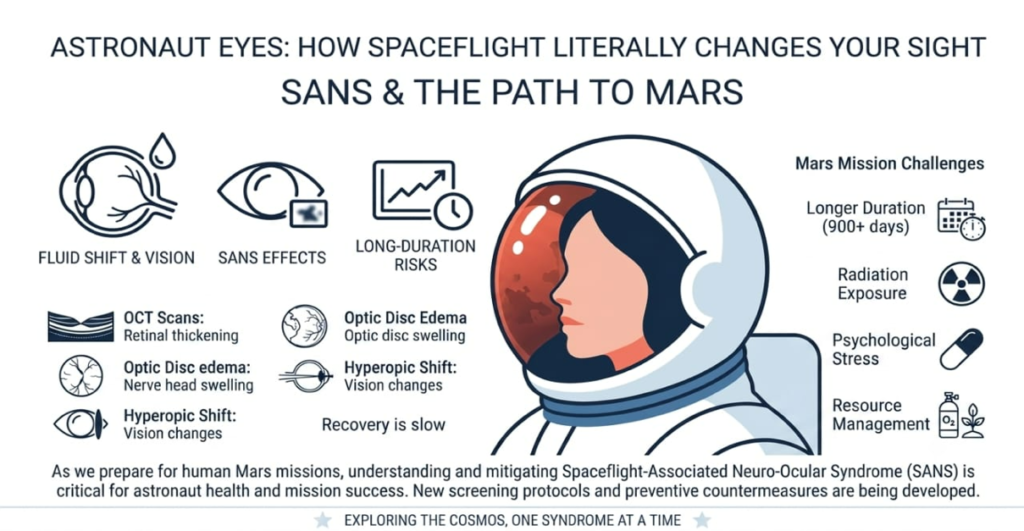

Figure 1. Summary of SANS mechanisms, clinical effects, and the added risks a Mars mission timeline poses for astronaut vision.
Image Courtesy: Created by Author
The Competing Theories
Scientists believe SANS stems from multiple mechanisms: (1,2,5)
- Intracranial Pressure: Fluid prevents cerebrospinal fluid from draining normally, increasing skull pressure transmitted along the optic nerve sheath. (2)
- Glymphatic Stagnation: Without gravity, the brain’s waste-clearance system may stagnate, creating localised pressure around the optic nerve. (5)
- Genetic Susceptibility: Severe SANS correlates with genetic variations in the one-carbon metabolic pathway exhibiting higher homocysteine levels which make blood vessels more prone to fluid accumulation. (1)
Engineers and surgeons are fighting back. ISS crews use adjustable-focus reading glasses with small dials on each lens which let astronauts manually correct shifting vision. (2)
Conclusion
When we dream of the cosmos, we imagine rockets and rovers. However, SANS reminds us: the most complex, fragile component of any mission is the human body. The fact that weightlessness literally squashes our eyes is a reminder of how deeply tied we are to this planet. Yet, SANS is not a barrier that will keep humanity grounded. It is simply a puzzle waiting to be solved.
References
- National Aeronautics and Space Administration. Risk of spaceflight-associated neuro-ocular syndrome (SANS) [Internet]. Washington (DC): NASA; 2024 Oct 23 [updated 2025 May 16; cited 2026 Jul 25]. Available from: https://www.nasa.gov/reference/risk-of-spaceflight-associated-neuro-ocular-syndrome-sans/
- Mader TH, Gibson CR, Pass AF, Kramer LA, Lee AG, Fogarty J, et al. Optic disc edema, globe flattening, choroidal folds, and hyperopic shifts observed in astronauts after long-duration space flight. Ophthalmology. 2011;118(10):2058-69. Available from: https://doi.org/10.1016/j.ophtha.2011.06.021
- Joe B. Spaceflight associated neuro-ocular syndrome: connections with terrestrial eye and brain disorders. Front Ophthalmol (Lausanne). 2024;4:1487992.
- Yang JW, Song QY, Zhang MX, et al. Spaceflight-associated neuro-ocular syndrome: a review of potential pathogenesis and intervention. Int J Ophthalmol. 2022;15(2):336-341.
- Kalberer D. Gauging the impact of spaceflight-associated neuro-ocular syndrome [Internet]. San Diego (CA): Eyes On Eyecare; 2024 Feb 6 [cited 2026 Jul 25]. Available from: https://eyesoneyecare.com/resources/gauging-impact-of-spaceflight-associated-neuro-ocular-syndrome/
About the Authors

Bhoomi Srivastav
B. Optom Student,
Sumandeep Vidyapeeth (Deemed to be) University, Vadodara, India

Shubham Bhattacharya
Assistant Professor,