


Ishwarya A, B. Optom
M. Optom Student, Dr. Agarwal’s Institute of Optometry, Chennai, India
Vision acuity is just one part of the picture. Two people can have 20/20 vision, but they can show big differences in how their retinas respond to glare, blue light, or metabolic stress. The ABCD framework: Assessment, Biomarkers, Counselling, and Documentation gives clinicians a practical, evidence-based way to change dietary habits into measurable eye protection and improved function.


Figure 1: This image depicts the ABCD approach for integrating nutrition into clinical eye care.
Image Courtesy: Created by the Author
A: Assessment: Quantifying Diet with MEDAS
Clinical integration begins with dietary quantification using validated tools. The 14-point Mediterranean Diet Adherence Screener (MEDAS) reliably converts dietary habits into a standardised score reflecting cardiometabolic and inflammatory risk. (1) Higher adherence to a Mediterranean dietary pattern has been associated with reduced incidence and progression of age-related eye diseases, particularly Age-related Macular Degeneration (AMD). (2)
A low MEDAS score (0–5) means that the diet is pro-inflammatory, which may mean that early nutritional intervention is needed. Moderate scores (6–8) show gaps that can be fixed, while high scores (≥9) are close to the protective dietary pattern that is linked to a lower risk of AMD. (2) The Mediterranean diet’s main parts: daily olive oil, a lot of fruits and vegetables, and regular oily fish give the body carotenoids and omega-3 fatty acids that are important for protecting the body from free radicals and keeping the retina’s structure intact. (2,3)
B: Biomarkers: Measuring Functional Change
Objective testing validates nutritional intervention, Macular Pigment Optical Density (MPOD) quantifies retinal lutein and zeaxanthin concentration and is associated with improved visual performance and blue-light filtration. (4) Protective MPOD values are generally ≥0.4, whereas values below 0.25 indicate increased vulnerability to oxidative damage. (4) Randomised supplementation trials demonstrate that increasing macular pigment significantly improves contrast sensitivity, with clinically meaningful gains of approximately 0.15–0.3 log units. (4) These improvements correlate directly with enhanced retinal carotenoid levels. (4)
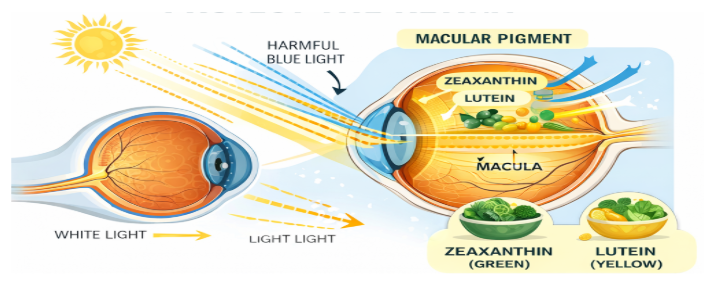

Figure 2: This image illustrates the role of Lutein and Zeaxanthin in filtering blue light and reducing oxidative stress.
Image Courtesy: Created by the Author
Dark adaptation testing further evaluates retinal pigment epithelium function and may detect early dysfunction before structural retinal changes appear.
Systemic biomarkers complement ocular measures. The Omega-3 Index (RBC EPA+DHA%) is considered optimal at ≥8%, whereas ≤4% reflects increased inflammatory and cardiovascular risk. (5) Randomised controlled trials show that omega-3 supplementation improves dry eye symptoms and tear film parameters, particularly in individuals with low baseline omega-3 status. (6)
| Biomarker | Reference Range | Significance |
|---|---|---|
| MPOD | ≥0.4 | Macular protection |
| Contrast Sensitivity | 0.15–0.3 log units | Functional vision improvement |
| Dark Adaptation | Normal recovery | Early retinal function marker |
| Omega-3 Index | ≥8% | Anti-inflammatory, supports tear film |
Table 1: This table shows the key biomarkers and their clinical significance in nutritional eye care.
C: Counselling: Optimising Bioavailability
Nutrient absorption determines therapeutic success. Lutein, zeaxanthin, and DHA are lipophilic molecules whose intestinal uptake depends on micelle formation stimulated by dietary fat. Research confirms that unsaturated fats significantly enhance carotenoid micellarisation and absorption. (3) Therefore, supplements should be consumed with meals containing olive oil, nuts, avocado, eggs, or other healthy fats to maximise bioavailability. (3) Clear, documented counseling ensures adherence and supports follow-up evaluation.
D: Documentation: Proving Clinical Impact
Baseline and follow-up documentation transform nutrition into accountable medical care. Recording MPOD, contrast sensitivity, dark adaptation, and relevant laboratory indices before intervention and reassessing after 3-6 months provides objective evidence of change. Clinical trials demonstrate that improvements in MPOD correspond with measurable functional contrast gains. (4) Structured documentation strengthens medical justification and reinforces patient compliance.
Conclusion
Moving beyond the Snellen chart requires measuring functional retinal physiology influenced by nutrition. The ABCD framework integrates validated dietary assessment, objective biomarker tracking, targeted bioavailability counseling, and structured documentation into a cohesive preventive model. Thus, incorporating these steps into routine practice shifts eye care from reactive disease management to proactive metabolic protection.
References
- Schröder H, Fitó M, Estruch R, Martínez-González MA, Corella D, Salas-Salvadó J, et al. A short screener is valid for assessing Mediterranean diet adherence among older Spanish men and women. The Journal of Nutrition. 2011;141(6):1140–1145.
- Wu Y, Xie Y, Yuan Y, Xiong R, Hu Y, Ning K, et al. The Mediterranean diet and age-related eye diseases: a systematic review. Nutrients. 2023;15(9):2043.
- Mashurabad PC, Palika R, Jyrwa YW, Bhaskarachary K, Pullakhandam R. Dietary fat composition, food matrix and relative polarity modulate the micellarization and intestinal uptake of carotenoids from vegetables and fruits. Journal of Food Science and Technology. 2017;54(2):333–341.
- Nolan JM, Power R, Stringham J, Dennison J, Stack J, Kelly D, et al. Enrichment of macular pigment enhances contrast sensitivity in subjects free of retinal disease: Central Retinal Enrichment Supplementation Trials–Report 1. Investigative Ophthalmology & Visual Science. 2016;57(7):3429–3439.
- Harris WS, Von Schacky C. The Omega-3 Index: a new risk factor for death from coronary heart disease? Preventive Medicine. 2004;39(1):212–220.
- Bhargava R, Pandey K, Ranjan S, Mehta B, Malik A. Omega-3 fatty acids supplements for dry eye—Are they effective or ineffective? Indian Journal of Ophthalmology. 2023;71(4):1619–1625.
About the Author


Ishwarya A
M. Optom Student,