


Swarnalakshmi. M.R, Assistant Professor
Avinashilingam University, Coimbatore, India
In the rapidly evolving healthcare landscape, technology is no longer just a support tool—it is becoming an integral part of patient care. From electronic medical records and teleconsultations to artificial intelligence and wearable devices, digital innovation is reshaping the way eye care is delivered. Yet, many optometrists still view software development as something reserved exclusively for programmers and IT professionals.
But What If Optometrists Could Build the Solutions They Need Themselves?
The answer is yes. With modern low-code frameworks like Frappeas Enterprise Resource Planning(ERP)Next, clinicians can transform their ideas into functional applications without being expert software engineers. (1) By learning basic coding concepts and understanding digital workflows, optometrists can become innovators who improve efficiency, enhance patient care, and solve real-world clinical problems.
Why Should Optometrists Learn Basic Coding?
Learning basic coding does not mean abandoning clinical practice to become a software developer. Instead, it provides a valuable skill set that empowers clinicians to actively participate in healthcare innovation and digital transformation.
What Can Optometrists Build Using Frappe ERPNext?
The possibilities extend far beyond appointment scheduling. (1) Frappe ERPNext enables clinicians to build customized electronic medical records, manage low vision rehabilitation programs, streamline optical store management, coordinate community vision screening initiatives, automate patient follow-ups, and generate comprehensive clinical reports.
1. Electronic Medical Records
Develop customized optometry records that include:
- Visual acuity testing.
- Objective and subjective refraction findings.
- Orthoptic evaluation.
- Documentation of contact lens fittings.
- Records of ocular health examinations.
- Low vision assessment details. (2)
2. Low Vision Rehabilitation Platforms
A dedicated rehabilitation platform can help clinicians by providing:
- Monitoring rehabilitation goals.
- Tracking patient progress.
- Documenting functional outcomes.
- Automated follow-up reminders and intervention scheduling.
- Generating clinical reports. (3)
3. Community Vision Screening Systems
Digital outreach programs can simplify community eye care through:
- Mobile vision screening forms.
- Referral management.
- Automated report generation. (4)
4. Optical Store Management
Daily optical practice operations can be streamlined by managing:
- Frame inventory.
- Lens orders.
- Supplier information.
- Billing records.
- Delivery tracking.
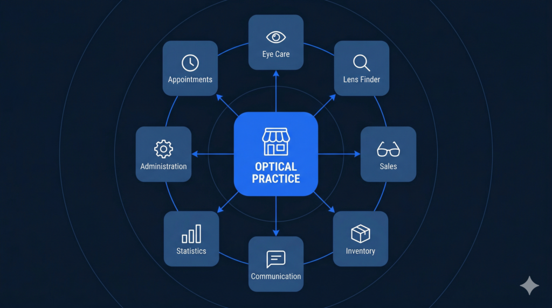

Figure 1: This illustration demonstrates an integrated workflow for modern optical practice management using digital technologies.
Image Courtesy: https://www.glasson.app/blog/optical-store-management-system-what-you-actually-need-and-how-glasson-covers-it/
5. Student Clinic Management
Academic institutions can benefit from digital platforms that help monitor:
- Clinical logbooks.
- Competency achievements.
- Faculty assessments.
- Case discussions.
- Student progress and performance.
From Clinician to Innovator
Optometrists are uniquely positioned to innovate because they understand both the science of vision and the realities of patient care. By combining clinical expertise with digital literacy, they can create practical, efficient, and patient-centered solutions that improve healthcare delivery.
Importantly, learning coding is not about replacing software developers. Instead, it promotes meaningful collaboration between clinicians and technology professionals. Optometrists who understand digital systems can contribute more effectively to the design, development, and implementation of healthcare applications.
Conclusion
Innovation does not always begin in research laboratories or technology companies. Often, it starts in the examination room, where clinicians identify everyday challenges and transform them into opportunities for better patient care. By embracing basic coding skills and platforms like Frappe ERPNext, optometrists can become active contributors to the future of digital eye care.
Declaration of Interest
This article is written solely for educational purposes and has no financial support or conflicts of interest to declare.
References
- Courtney, A. (2001). Frappé: Functional reactive programming in Java. In International Symposium on Practical Aspects of Declarative Languages (pp. 29–44). Springer.
- McVeigh, F. L., Tarbett, A. K., Betts, A. M., & Boal, T. R. (2008). Efficiency of automation and electronic health records in optometric practice. Optometry – Journal of the American Optometric Association, 79(1), 43–49.
- Macnaughton, J. (2005). Low Vision Assessment. Elsevier Health Sciences.
- Rono, H., Bastawrous, A., Macleod, D., Wanjala, E., Gichuhi, S., & Burton, M. (2019). Peek Community Eye Health—mHealth system to increase access and efficiency of eye health services in Kenya. Trials, 20(1), 502.
About the Author


Swarnalakshmi. M.R
Assistant Professor