


Ranjitha Kabbinale, M. Optom
Optometrist, Sri Durga Opticals, Manipal, India
Keywords
rapid eye movements (REM) sleep, eye movements, working memory, PTSD, smooth pursuit, trauma therapy, neurobiology of sleep
Declaration of Interest
The blog is written solely for education purposes, and it does not have any financial support and conflict of interest.
Imagine a patient who wakes night after night, heart pounding, reliving an event that ended years ago. Post-Traumatic Stress Disorder (PTSD) leaves a profound physical footprint on the brain and nervous system, and clinicians have long noted a strong link between PTSD and disrupted Rapid Eye Movement (REM) sleep. (1) Paradoxically, while broken REM sleep fuels recurring nightmares, harnessed rapid eye movements sit at the core of one of modern psychology’s most powerful treatments: Eye Movement Desensitisation and Reprocessing (EMDR). Understanding ‘why’ begins with what the eyes do during sleep.
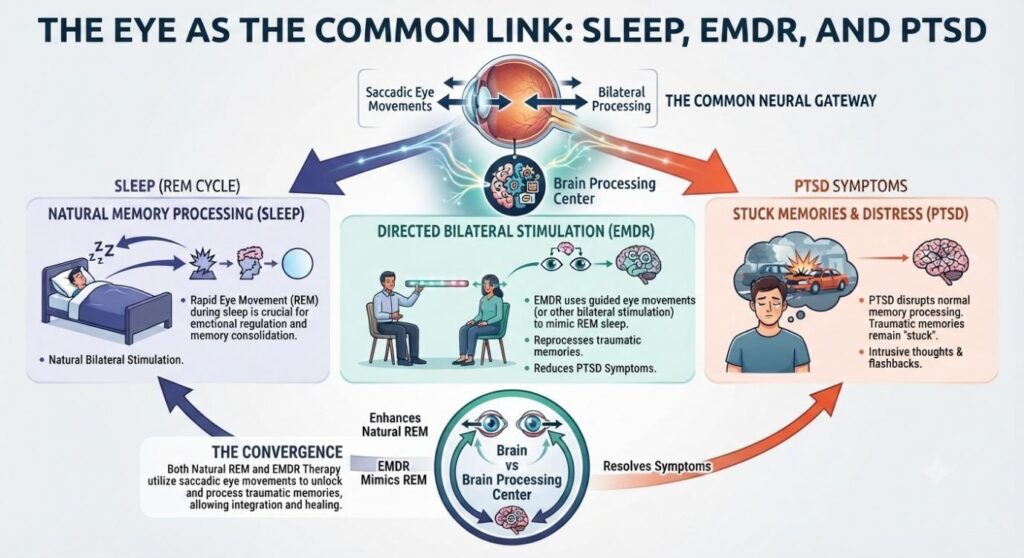

Figure 1: This image shows an overview illustrating how saccadic eye movements and bilateral processing serve as the common neural gateway connecting natural REM sleep, EMDR therapy and PTSD symptom processing.
Image Courtesy: Created by Author
The transition to REM sleep shifts the visual apparatus from external observation to internal cognitive processing. While skeletal muscles remain paralysed, the extra-ocular muscles are spared, and brief bursts of rapid conjugate eye movements break the stillness. The scanning hypothesis proposes that these saccades track spatial events unfolding within dream environments, correlating with subsequent dream reports. (2) Pontine-geniculate-occipital waves originate in the brainstem, trigger REM saccades and broadcast activation across visual networks, supporting synaptic plasticity without any retinal input. (3)
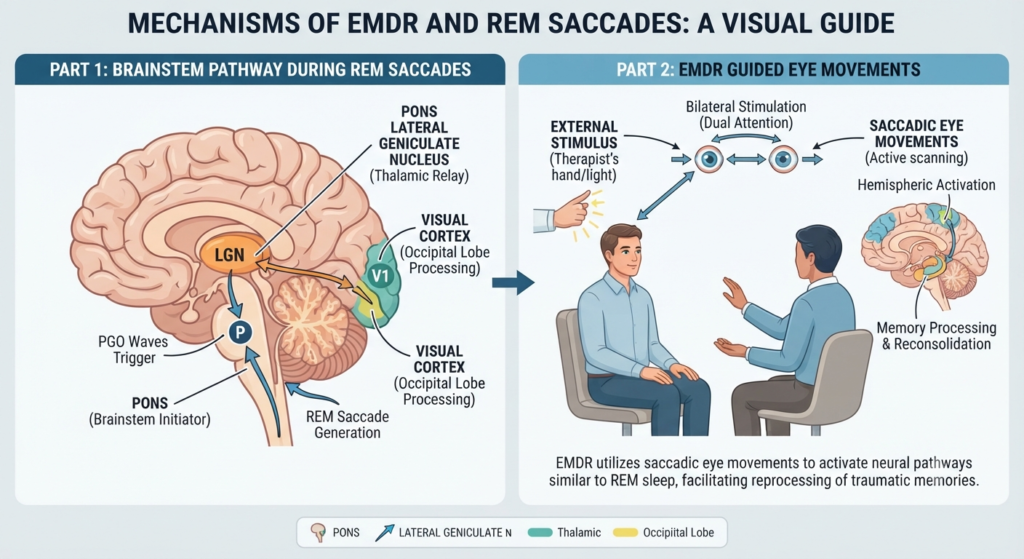

Figure 2: Biological comparison showing pontine-geniculate-occipital (PGO) wave generation in the brainstem during REM sleep (Part 1) and parallel activation via external bilateral stimulation during EMDR (Part 2)
Crucially, this nocturnal state supports emotional healing. During REM sleep, rapid eye movements helping to uncouple emotional intensity from distressing memories. By reactivating affective networks in a safe neurochemical environment, these saccades aid fear extinction and adaptation. (4) When this nocturnal processing falters, individuals frequently experience the emotional hyperarousal characteristic of PTSD.
EMDR puts the same oculomotor system to therapeutic use while the patient is awake. Developed by Francine Shapiro, the therapy asks patients to recall a distressing memory while following a therapist’s guided horizontal eye movements. (5) Sessions typically alternate short sets of eye movements with brief pauses, during which the patient notes whatever thoughts or sensations arise. One explanation is the working memory account: holding a painful memory in mind while tracking a moving target competes for limited cognitive resources, so the memory becomes less vivid and less emotionally charged. (6) Another suggests that the eye movements recreate aspects of REM-like processing while the patient is awake, helping traumatic memories to be integrated. (7) Which mechanism matters most remains debated, yet both place the oculomotor system at the centre of recovery.
This matters for eye-care practitioners. Optometrists are often a patient’s first point of contact, and trauma survivors may report poor sleep, heightened startle or discomfort with close-contact tests. A trauma informed approach, such as explaining each step beforehand, allowing pauses and giving the patient control, can make an examination safer and more comfortable. Tests needing close positioning and illuminated targets such as corneal topography are the practical examples where a calm explanation helps. Recognising that persistent sleep complaints and hypervigilance may point to unresolved trauma also helps practitioner to respond with sensitivity. Where trauma is disclosed or suspected, practitioners should refer for assessment rather than attempt treatment, as EMDR should be delivered by trained mental health professionals.
REM sleep proves the visual system is deeply woven into core brain architecture and emotional recovery. Ocular mechanics extend far beyond waking sight to shape psychological healing.
References
- Roffwarg HP, Dement WC, Muzio JN, Fisher C. Dream imagery: relationship to rapid eye movements of sleep. Arch Gen Psychiatry. 1962;7(4):235-258.
- Hobson JA, Pace-Schott EF, Stickgold R. Dreaming and the brain: toward a cognitive neuroscience of conscious states. Behav Brain Sci. 2000;23(6):793-842.
- ROFFWARG, H. P., DEMENT, W. C., MUZIO, J. N., & FISHER, C. (1962). Dream imagery: relationship to rapid eye movements of sleep. Archives of general psychiatry, 7, 235–258.
- Walker, M. P., & van der Helm, E. (2009). Overnight therapy? The role of sleep in emotional brain processing. Psychological bulletin, 135(5), 731–748.
- Shapiro F. (1989). Eye movement desensitization: a new treatment for post-traumatic stress disorder. Journal of behavior therapy and experimental psychiatry, 20(3), 211–217.
- van den Hout MA, Engelhard IM. How does EMDR work? J Exp Psychopathol. 2012;3(5):724-738.
- Stickgold R. (2002). EMDR: a putative neurobiological mechanism of action. Journal of clinical psychology, 58(1), 61–75.
About the Author


Ranjitha Kabbinale
Optometrist ,