


Mankala Srinath, B. Optom Student
Bharati Vidyapeeth Deemed University, Pune, India
Diabetic Retinopathy (DR) is reported as one of the major causes of preventable blindness across the world, among working-age individuals. Due to rising Diabetes mellitus prevalence, healthcare services are challenged with effectively screening large populations in terms of early detection. Artificial Intelligence (AI), especially deep learning image analysis, has emerged as a rejuvenating tool for early detection and vast-scale screening of DR. (1)
Diabetic Retinopathy
DR is a complication of Diabetes mellitus that arises from the microvascular damage caused by hyperglycaemia to the blood vessels of the retina, resulting in microaneurysms, haemorrhages, and exudates, as well as retinal detachment in the advanced stages. The early stages of the disease are usually painless and asymptomatic. (2)
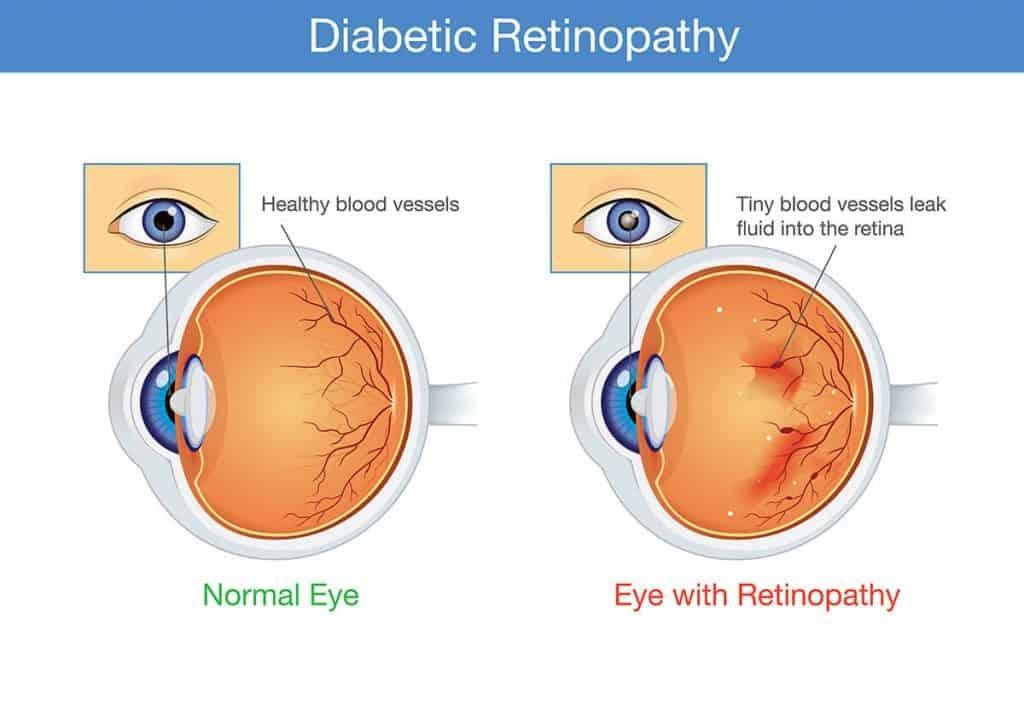

Figure 1: This image shows the difference between a normal eye vs eye with retinopathy.
Image Courtesy: Created by the Author
How AI Detects Diabetic Retinopathy
The AI models are basically Convolutional Neural Networks (CNN) that are trained on thousands of labelled retinal fundus images. The models are capable of learning the patterns of diseases, such as:
- Microaneurysms
- Haemorrhages
- Hard Exudates
- Neovascularisation (1)
Deep Learning Models for DR detection
A seminal study in deep learning proved that AI was able to identify DR with sensitivity and specificity like that of ophthalmologists from retinal fundus photographs. The AI system was trained on many annotated images from datasets and performed well in detecting referable DR. (1)
However, recent studies have found that AI is not only capable of detecting DR but also of predicting disease progression and the risk of vision loss. By analysing minimal retinal features, AI models assist in distinguishing patients based on severity and risk of progression. (4)
Advantages of AI in DR Screening
- Early Detection: Detects minute changes in the retina even before the onset of symptoms
- Scalability: Allows for the screening of many people, especially in rural settings
- Consistency: Minimises variations in observations
- Cost Effectiveness: Makes the diagnosis less dependent on specialists
- Rapid Results: Delivers instant diagnostic results. (3)
Challenges and Limitations
Although showing promising results, the following are some of the challenges encountered during the implementation of AI:
- The need for high-quality training datasets
- Ethical issues and data privacy
- Implementation and clinical workflows
- Regulatory approval and validation
AI should support, not replace, Ophthalmologists. Clinical judgment is still important in management. (3)
Prospective Directions
The prospective directions for the use of AI in Diabetic screening are as follows:
- Implementation of AI in Teleophthalmology systems
- Smartphone-based fundus imaging with AI analysis
- Predictive analytics for personalised patient care
- Using combined AI systems to screen for various retinal diseases. (5)
Conclusion
By facilitating precise, scalable, and effective analysis of retinal images, AI is transforming the early diagnosis and screening of DR. Research has been published that proves the ability of these systems to work at the same level as experts and to increase accessibility, even in resource-scarce settings. The importance of AI in the prevention of vision loss in Diabetes will continue to increase, particularly as integration improves. (1-5)
References
- Gulshan, V., Peng, L., Coram, M., Stumpe, M. C., Wu, D., Narayanaswamy, A., … & Webster, D. R. (2016). Development and validation of a deep learning algorithm for detection of diabetic retinopathy in retinal fundus photographs. jama, 316(22), 2402-2410.
- Abràmoff, M. D., Lavin, P. T., Birch, M., Shah, N., & Folk, J. C. (2018). Pivotal trial of an autonomous AI-based diagnostic system for detection of diabetic retinopathy in primary care offices. NPJ digital medicine, 1(1), 39.
- Ting, D. S. W., Pasquale, L. R., Peng, L., Campbell, J. P., Lee, A. Y., Raman, R., Tan, G. S. W., Schmetterer, L., Keane, P. A., & Wong, T. Y. (2019). Artificial intelligence and deep learning in ophthalmology. The British journal of ophthalmology, 103(2), 167–175. https://doi.org/10.1136/bjophthalmol-2018-313173
- Li, Z., Keel, S., Liu, C., He, Y., Meng, W., Scheetz, J., … & He, M. (2018). An automated grading system for detection of vision-threatening referable diabetic retinopathy on the basis of color fundus photographs. Diabetes care, 41(12), 2509-2516.
- De Fauw, J., Ledsam, J. R., Romera-Paredes, B., Nikolov, S., Tomasev, N., Blackwell, S., … & Ronneberger, O. (2018). Clinically applicable deep learning for diagnosis and referral in retinal disease. Nature medicine, 24(9), 1342-1350.
About the Author


Mankala Srinath
B. Optom Student