
Jeba Ahmed1, M. Optom Student
Haziel Rynjah2, Assistant Professor
Royal Global University, Guwahati, India
When Machines Help Us See Better
Artificial Intelligence (AI) is a smart system that is changing how eye health is assessed, making results more error free. Instead of delaying, tools powered by AI now help doctors examine images, detecting eye issues earlier than before. (1) Methods like Machine Learning (ML) algorithms prove useful when sorting symptoms or predicting how a condition might progress.
Furthermore, Deep Learning (DL) approaches are broadening the scope of study and enhancing treatment planning choices. (2) Scientists are focusing more on AI in eye care due to encouraging results in both research and routine clinical practice. (3)
These learning devices might eventually be used in eye exams as frequently as vision charts and examination lights. (3,4)
Spotting Eye Problems Earlier Than Ever
Today, machines are entering the field of eye health, helping identify issues more quickly. By initiating careful review of eye images, such tools detect small alterations that people may overlook. As a result, medical professionals respond earlier once signs appear. Such timely responses frequently preserve vision prior to worsening harm. Evidence from one analysis confirmed their clinical benefit. (1)
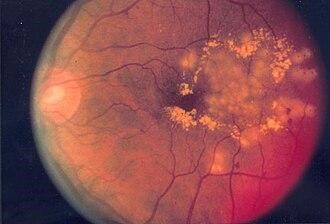
Figure 1: Image showing fundus image of an abnormal retina
Image Courtesy:
https://commons.wikimedia.org/wiki/File:Fundus_photo_showing_focal_laser_surgery_for_diabetic_retinopathy_EDA10.JPG
Smart Scans: How AI Reads Eye Images
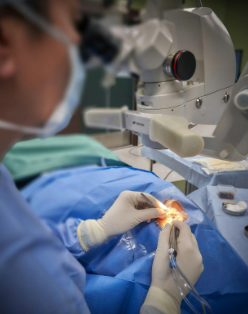
Eye scans become remarkable when examining machine support in medicine. Rather than relying entirely on human observation, systems analyse outputs from devices such as Optical Coherence Tomography (OCT) along with standard retinal images. Such visuals reveal microscopic structures which were previously difficult to detect. (4) AI can rapidly detect damage indicators like lesions, tissue weakening, or fluid accumulation using sophisticated algorithms. Early detection of subtle changes that may indicate disease enables prompt and accurate diagnosis. (3,4) In this sense, AI saves important clinical time while also increasing accuracy.
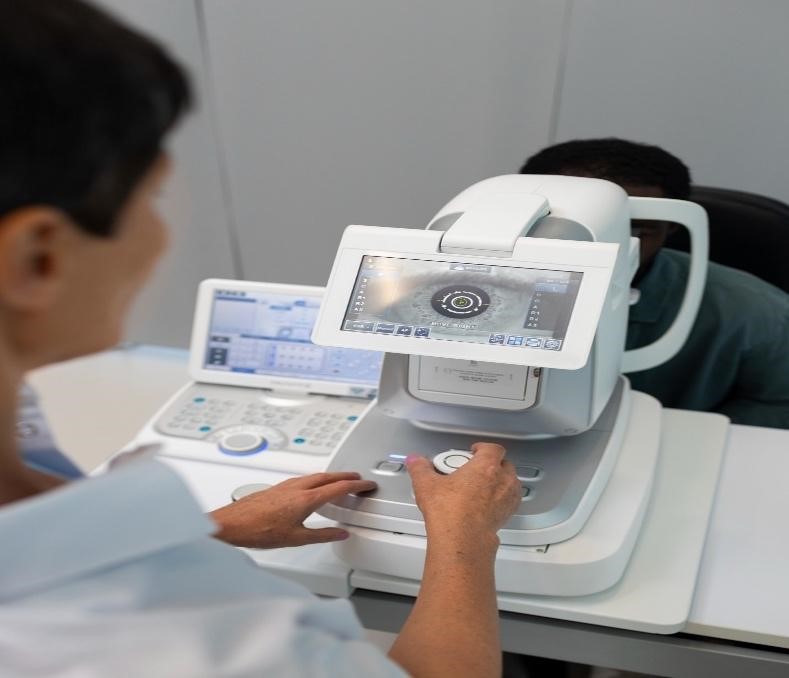
Figure 2: Image showing a modern computerised eye examination device used for automated vision assessment and image-based analysis in clinical practice.
Predicting the Future of Eye Health
Should eye conditions be anticipated, ML images predict swiftly. Without reliance on assumptions, models such as Random Forest identify trends in ocular history with dependable precision. (5) A research effort demonstrated capability across issue recognition alongside progression monitoring through time. Care pathways evolve because data flows continuously instead of arriving in fragments. (1)
Brain Behind Deep Learning: The Smart Eye Care
A step beyond, DL drives progress within vision research and more precise diagnostic methods. Despite benefits noted by physicians, concerns arise about ethical standards, together with sufficient training demands. (4) In the background, documentation traces rapid advancements through ophthalmic studies, suggesting long-term changes in patient assessment approaches. (5,6) Beginning unclear, technology supports vision health by reducing errors while expediting exams. (1,6)
Conclusion: A Smarter Way to Save Sight
AI is progressively becoming basic to modern Optometry. It is transforming eye health care by promoting diagnostic precision and accuracy, assisting in the early spotting of diseases, and upgrading clinical assessment. With ongoing progress in research and technology, AI is assured to become a central component in providing more effective and patient-focused Optometric services in the years ahead.
References
- Munsamy AJ, Oderinlo O. Artificial intelligence: An innovation shaping modern eye care. African Vision and Eye Health.2024;83(1):1-2.
- Santos LF, Sánchez-Tena MÁ, Alvarez-Peregrina C, Martinez-Perez C. Artificial Intelligence-Driven Diagnostics in Eye Care: A Random Forest Approach for Data Classification and Predictive Modeling. Algorithms. 2025 Oct 15;18(10):647.
- Santos LF, Sánchez-Tena MÁ, Alvarez-Peregrina C, Sánchez-González JM, Martinez-Perez C. The Role of Artificial Intelligence in Optometric Diagnostics and Research: Deep Learning and Time-Series Forecasting Applications. Technologies. 2025 Feb 12;13(2):77.
- Scanzera AC, Shorter E, Kinnaird C, Valikodath N, Al-Khaled T, Cole E, Kravets S, Hallak JA, McMahon T, Chan RP. Optometrist’s perspectives of Artificial Intelligence in eye care. Journal of Optometry. 2022 Jan 1;15:S91-7.
- Martinez-Perez C, Alvarez-Peregrina C, Villa-Collar C, Sanchez-Tena MA. Artificial intelligence applied to ophthalmology and optometry: A citation network analysis. Journal of optometry. 2022 Jan 1;15:S82-90.
- Anton N, Doroftei B, Curteanu S, Catalin L, Ilie OD, Târcoveanu F, Bogdănici CM. Comprehensive review on the use of artificial intelligence in ophthalmology and future research directions. Diagnostics. 2022 Dec 29;13(1):100.
About the Author

Jeba Ahmed
M. Optom Student
Royal Global University, Guwahati, India

Haziel Rynjah
Assistant Professor
Recent Comments