


Kristi Sharma, M. Optom
Senior Manager – Advanced Education and Partnerships, Vision Science Academy
Human spaceflight has transformed our understanding of science, medicine, and human adaptability. Yet, as astronauts spend longer durations in space, researchers have identified a significant health concern that continues to challenge long-term missions; changes in vision and ocular structure during spaceflight. Many astronauts returning from missions report blurred vision, difficulty focusing, altered visual acuity, and structural changes within the eye. These findings have led to the emergence of a specialised field called Space Ophthalmology.
The Human Body in Microgravity
On Earth, gravity constantly influences how fluids move throughout the body. Blood and other fluids are naturally pulled downward, creating a balance in circulation and pressure. However, in space, astronauts experience microgravity, a condition in which the effects of gravity are greatly reduced. Without gravity pulling fluids toward the lower body, fluids shift upward toward the head.
This phenomenon is referred to as “cephalad fluid shift”, and it causes astronauts to develop puffy faces, nasal congestion, and increased pressure within the upper body. Although these effects may initially seem harmless, the redistribution of fluid can significantly influence the eyes, brain, and the optic nerve.
The human eye is an extremely delicate organ that depends on stable pressure relationships between the eye, the orbit, blood vessels, and the brain. Even subtle changes in fluid dynamics can alter ocular anatomy and visual performance.
Changes in Ocular Anatomy During Spaceflight
Advanced ocular imaging technologies have allowed researchers to closely examine the structural changes occurring in astronauts’ eyes during missions. Portable Optical Coherence Tomography (OCT) devices aboard the space station have been particularly valuable in studying retinal and optic nerve changes in real time.
Some important anatomical changes include:
- Optic Disc Oedema
The optic disc is the point where the optic nerve enters the retina. Swelling of the region may interfere with visual signal transmission.
- Globe Flattening
In some astronauts, the posterior portion of the eyeball becomes slightly flattened. Since the eye functions like a precisely shaped optical system, even minor alterations in shape can affect refractive status of the eye.
- Choroidal Folds
Choroid is the vascular layer supplying blood to the retina. Compression or mechanical stress may produce folds within this layer, potentially affecting retinal alignment and vision.
- Refractive Changes
Hyperopic shifts are common in astronauts, due to the posterior flattening of the eyeball.
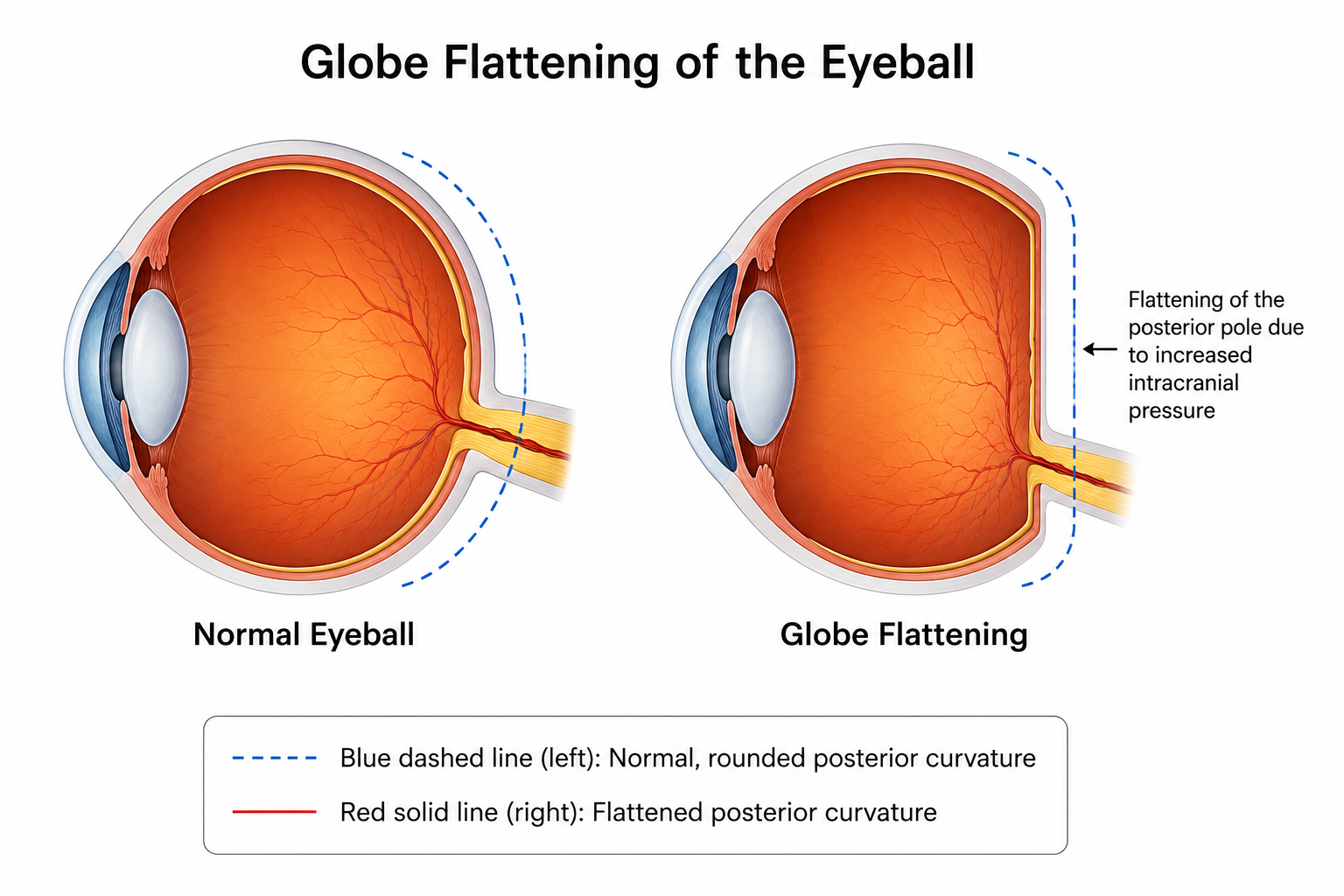

Figure 1: This image demonstrates globe flattening due to increased intracranial pressure.
Image Courtesy: Created by the Author
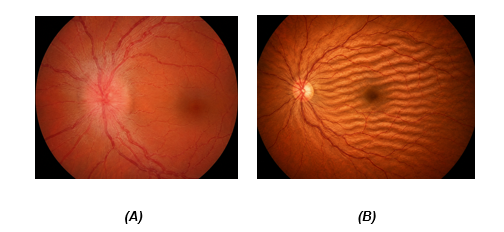

Figure 2: These images represent (A) Optic disc oedema and (B) Choroidal folds.
Image Courtesy: Created by the Author
Spaceflight-Associated Neuro-ocular Syndrome (SANS)
Researchers first began noticing unusual visual changes in astronauts involved in long-duration missions. Over time, imaging studies revealed structural abnormalities than could persist even after astronauts returned to Earth. These findings eventually led to the identification of Spaceflight-Associated Neuro-ocular Syndrome, or SANS.
Role of Intracranial Pressure
One of the leading theories behind SANS involves increased intracranial pressure (ICP). ICP refers to the pressure exerted by fluids surrounding the brain and spinal cord. Under normal Earth conditions, gravity helps regulate cerebrospinal fluid distribution. However, in microgravity, the upward fluid shift may increase pressure around the brain and optic nerve.
The optic nerve connects the eye directly to the brain and is surrounded by cerebrospinal fluid. If pressure within the surrounding space increases, it can compress the back of the eye and lead to optic disc swelling. This may explain why astronauts develop globe flattening and visual disturbances during prolonged missions.
However, the theory is not entirely straight-forward. Unlike patients on Earth with elevated intracranial pressure disorders such as idiopathic intracranial hypertension, astronauts with SANS do not always exhibit severe neurological symptoms like headaches or nausea. This suggests that SANS may involve a unique mechanism distinct from traditional intracranial hypertension.
The Impact on Future Space Exploration
Understanding visual problems in astronauts is critical because vision plays an essential role in navigation, equipment handling, docking procedures, robotic operations, and emergency responses. Even small reductions in visual performance could compromise mission safety.
As space agencies plan for extended lunar missions and eventual human exploration of Mars, protecting astronaut vision has become a major priority. Long duration missions involve prolonged exposure to microgravity, isolation, radiation, and altered circadian rhythms, all of which may influence ocular health.
A mission to Mars could expose astronauts to these conditions for more than two years. If SANS worsens over time or causes irreversible visual impairment, it may become a limiting factor for deep-space exploration.
Current Research and Countermeasures
Scientists are actively developing strategies to reduce or prevent vision-related complications in astronauts. Several approaches are currently being investigated.
-
Lower Body Negative Pressure Devices
These devices create suction around the lower body to pull fluids away from the head, mimicking some effects of gravity. Researchers hope this may reduce intracranial and ocular pressure.
-
Artificial Gravity
Rotating spacecraft or centrifuge systems could potentially create gravitational forces and normalise fluid distribution. Although technically challenging, artificial gravity remains a promising area of research.
-
Exercise Protocols
Astronauts already follow strict exercise regimens to minimize muscle and bone loss. Researchers are now examining whether specific exercises may also help regulate fluid dynamics and reduce ocular changes.
-
Advanced Monitoring Technologies
Portable OCT systems, ultrasound devices, and telemedicine tools allow continuous monitoring of astronaut eye health during missions. Artificial Intelligence may eventually assist with autonomous ocular screening in deep-space environments.
-
Pharmacological Approaches
Scientists are also exploring medications that could regulate intracranial pressure or vascular changes during spaceflight.
The Future of Space Ophthalmology
As commercial spaceflight expands, the importance of space medicine will continue to grow. This evolution creates new challenges for eye care professionals and vision scientists. Pre-flight screening, in-flight monitoring, and post-flight rehabilitation may become increasingly important components of space healthcare.
Space Ophthalmology is rapidly evolving into a multidisciplinary field that combines Ophthalmology, Neurology, Aerospace Medicine, Imaging Science, Physiology, and Artificial Intelligence. Researchers around the world are working collaboratively to ensure than humans can safely explore deep space without compromising visual function.
Conclusion
Vision problems in astronauts represent one of the most fascinating and complex medical challenges of modern space exploration. In microgravity, the normal balance of fluid distribution within the body is disrupted, leading to changes in ocular anatomy, optic nerve structure, and visual performance.
Although many questions are unanswered, ongoing research is helping scientists better understand the mechanisms behind these visual alternations. Technologies such as OCT imaging, AI, and advanced monitoring systems are playing a crucial role in protecting astronaut eye health.
As humanity prepares for longer missions, solving the problem of space-related vision changes will be essential. The discoveries emerging from Space Ophthalmology not only support the future of interplanetary travel but also deepen our understanding of the human eye here on Earth.
References
- Grigoryan, E. N. (2023). Impact of microgravity and other spaceflight factors on retina of vertebrates and humans in vivo and in vitro. Life, 13(6), 1263.
- Nelson, E. S., Mulugeta, L., & Myers, J. G. (2014). Microgravity-induced fluid shift and ophthalmic changes. Life, 4(4), 621-665.
- Meer, E., Grob, S., Antonsen, E. L., & Sawyer, A. (2023). Ocular conditions and injuries, detection and management in spaceflight. npj Microgravity, 9(1), 37.
- Taibbi, G., Cromwell, R. L., Kapoor, K. G., Godley, B. F., & Vizzeri, G. (2013). The effect of microgravity on ocular structures and visual function: a review. Survey of ophthalmology, 58(2), 155-163.
- Mader, T. H., Gibson, C. R., Pass, A. F., Lee, A. G., Killer, H. E., Hansen, H. C., … & Pettit, D. R. (2013). Optic disc edema in an astronaut after repeat long-duration space flight. Journal of Neuro-Ophthalmology, 33(3), 249-255.
- Mader, T. H., Gibson, C. R., Barratt, M. R., Miller, N. R., Subramanian, P. S., Killer, H. E., … & Lee, A. G. (2021). Persistent globe flattening in astronauts following long-duration spaceflight. Neuro-Ophthalmology, 45(1), 29-35.
- Mader, T. H., Gibson, C. R., Pass, A. F., Kramer, L. A., Lee, A. G., Fogarty, J., … & Polk, J. D. (2011). Optic disc edema, globe flattening, choroidal folds, and hyperopic shifts observed in astronauts after long-duration space flight. Ophthalmology, 118(10), 2058-2069.
- Lee, A. G., Mader, T. H., Gibson, C. R., Tarver, W., Rabiei, P., Riascos, R. F., … & Brunstetter, T. (2020). Spaceflight associated neuro-ocular syndrome (SANS) and the neuro-ophthalmologic effects of microgravity: a review and an update. npj Microgravity, 6(1), 7.
- Rodrigues, G. A., Russomano, T., & Santos Oliveira, E. (2025). Understanding the relationship between intracranial pressure and spaceflight associated neuro-ocular syndrome (SANS): a systematic review. npj Microgravity, 11(1), 22.
- Paladugu, P., Ong, J., Kumar, R., Waisberg, E., Zaman, N., Kamran, S. A., … & Lee, A. G. (2024). Lower body negative pressure as a research tool and countermeasure for the physiological effects of spaceflight: a comprehensive review. Life Sciences in Space Research, 42, 8-16.
- Clément, G. R., Bukley, A. P., & Paloski, W. H. (2015). Artificial gravity as a countermeasure for mitigating physiological deconditioning during long-duration space missions. Frontiers in systems neuroscience, 9, 92.
- Suh, A., Ditelberg, S., Szeto, J. J., Kumar, D., Ong, J., Gibson, C. R., … & Lee, A. G. (2025). Safety protocols, precautions, and countermeasures aboard the International Space Station to prevent ocular injury. Survey of Ophthalmology, 70(5), 1003-1012.
- Gupta, R., & Ghosh, P. S. (2025). Advancements in health monitoring technologies for astronauts in deep space missions: A Review. Life Sciences in Space Research, 47, 190-196.
About the Author


Kristi Sharma is a Master of Optometry with a clinical research expertise in Teleophthalmology and Retina. She serves as the Senior Manager for Advanced Education and Partnerships at Vision Science Academy and has curated and tutored extensive courses at the Vision Science Academy Learning Centre. She is actively engaged in developing the research forum of Vision Science Academy, in addition to all the ongoing and upcoming initiatives in the Academy. She has published a number of scientific blog articles in the past 5 years and aspires to continue contributing significantly in the domain of vision research and writing.