


Anila Farid (1), Lecturer ,
Hadia Asif (2), Optometrist
The University of Lahore, Lahore, Pakistan
Keywords
cerebrospinal fluid, glaucoma, glymphatic system, optic nerve
Declaration of Interest
The blog is written solely for education purpose and it does not have any financial support and conflict of interest.
Glaucoma is often described as a disease of raised intraocular pressure. However, some people develop optic nerve damage even when their pressure readings remain within the normal range, while others continue to worsen despite treatment. This suggests that pressure is important but it may not be the complete explanation. An emerging area of research, the ocular glymphatic pathway, may offer another piece of the puzzle.
What is the Ocular Glymphatic Pathway?
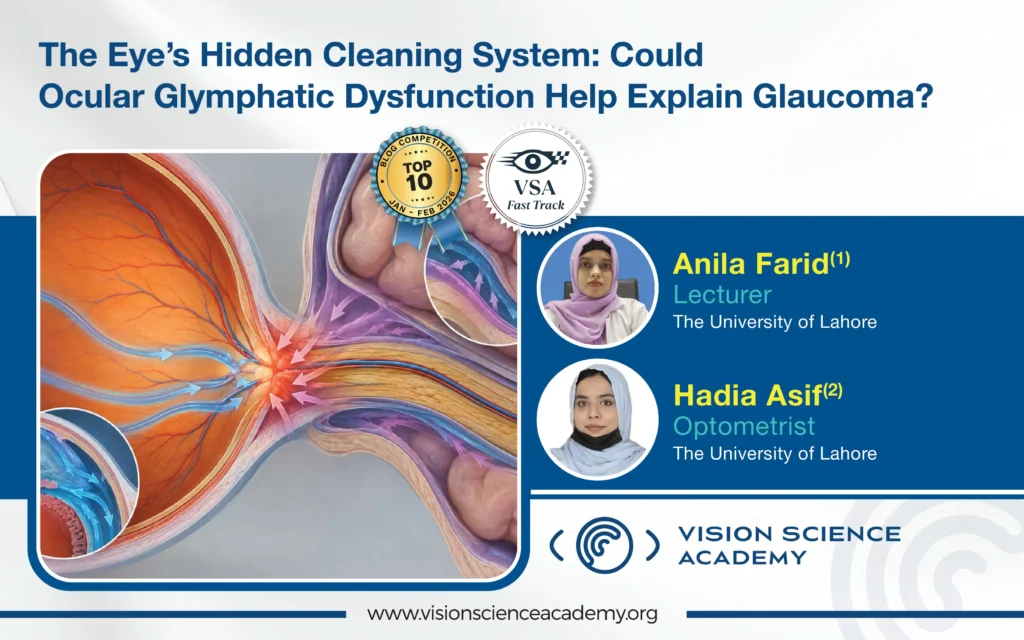
The retina is highly active tissue. Every second, it converts light into signals for the brain and produces metabolic waste in the process. Unlike many body tissues, the retina and optic nerve do not contain a conventional lymphatic drainage network. Scientists therefore propose that fluid moves through microscopic spaces around blood vessels and nerve fibres to help remove waste. This process resembles the brain’s glymphatic system which uses cerebrospinal fluid and supporting glial cells to maintain the environment around neurons. (1)
Experimental studies show that cerebrospinal fluid can enter the optic nerve along perivascular spaces. (2) In rodents, amyloid-beta and fluid from inside the eye were transported through the optic nerve by a pathway influenced by aquaporin-4 water channels and the pressure difference between the eye and skull. (3) Human imaging has also shown communication between the visual pathway and the subarachnoid space, although the exact route and direction of the flow in people are still being investigated. (4,5)
Where might Glaucoma Fit?
The optic nerve head sits between two pressure environments: Intraocular pressure from the eye and Cerebrospinal fluid pressure behind it. An abnormal difference between these pressures may place stress across lamina cribrosa, the delicate tissue through which retinal ganglion cell axons leave the eye. (6) Studies of normal tension Glaucoma have reported disturbed cerebrospinal fluid movement along the optic nerve. (7)
Animal models provide more direct evidence. Cerebrospinal fluid entry into the optic nerve was reduced in experimental Glaucoma. (8) Another study found that ageing generally slowed ocular glymphatic transport, whereas Glaucoma caused disorganised flow and abnormal leakage rather than a simple reduction. (9) Recent magnetic resonance imaging studies have also reported markers of impaired glymphatic function in people with normal tension and Primary Open Angle Glaucoma. (10,11)
Why does this Matter?
If fluid transport is disturbed, waste products may remain around retinal ganglion cell axons and supporting glial cells for longer. This could add metabolic stress to tissue already affected by pressure, blood flow changes or ageing. Larger molecules may enter the optic nerve without reaching the retina, suggesting that biological barriers control their movements. (12) Lymphatic vessels around the optic nerve provide a later drainage route towards cervical lymph nodes. (13)
The ocular glymphatic pathway is therefore a promising hypothesis, not an established clinical target. (14) Most direct evidence still comes from animals and even recent optic nerve studies require further human confirmation. (15) Future non-invasive imaging may reveal whether glymphatic dysfunction can improve Glaucoma risk assessment or inspire treatments that complement, not replace, intraocular pressure control.
References
- Iliff JJ, Wang M, Liao Y, Plogg BA, Peng W, Gundersen GA, et al. A Paravascular Pathway Facilitates CSF Flow Through the Brain Parenchyma and the Clearance of Interstitial Solutes, Including Amyloid β. Sci Transl Med. 2012 Aug 15;4(147). doi:10.1126/scitranslmed.3003748
- Mathieu E, Gupta N, Ahari A, Zhou X, Hanna J, Yücel YH. Evidence for Cerebrospinal Fluid Entry Into the Optic Nerve via a Glymphatic Pathway. Investig Opthalmology Vis Sci. 2017 Sep 21;58(11):4784. doi:10.1167/iovs.17-22290
- Wang X, Lou N, Eberhardt A, Yang Y, Kusk P, Xu Q, et al. An ocular glymphatic clearance system removes β-amyloid from the rodent eye. Sci Transl Med. 2020 Mar 25;12(536):eaaw3210. doi:10.1126/scitranslmed.aaw3210
- Jacobsen HH, Ringstad G, Jørstad ØK, Moe MC, Sandell T, Eide PK. The Human Visual Pathway Communicates Directly With the Subarachnoid Space. Investig Opthalmology Vis Sci. 2019 Jun 27;60(7):2773. doi:10.1167/iovs.19-26997
- Jacobsen HH, Sandell T, Jørstad ØK, Moe MC, Ringstad G, Eide PK. In Vivo Evidence for Impaired Glymphatic Function in the Visual Pathway of Patients With Normal Pressure Hydrocephalus. Investig Opthalmology Vis Sci. 2020 Nov 17;61(13):24. doi:10.1167/iovs.61.13.24
- Hoang TT, Anh BV, Subramanian P. Is Glaucoma a Two-Pressure-Related Optic Neuropathy? A Systematic Review and Meta-Analysis. Turk J Ophthalmol. 2024 Apr 1;54(2):83–9. doi:10.4274/tjo.galenos.2024.66267
- Pircher A, Montali M, Wostyn P, Pircher J, Berberat J, Remonda L, et al. Impaired cerebrospinal fluid dynamics along the entire optic nerve in normal‐tension glaucoma. Acta Ophthalmol (Copenh). 2018 Aug;96(5). doi:10.1111/aos.13647
- Mathieu E, Gupta N, Paczka-Giorgi LA, Zhou X, Ahari A, Lani R, et al. Reduced Cerebrospinal Fluid Inflow to the Optic Nerve in Glaucoma. Investig Opthalmology Vis Sci. 2018 Dec 13;59(15):5876. doi:10.1167/iovs.18-24521
- Wang X, Delle C, Peng W, Plá V, Giannetto M, Kusk P, et al. Age- and glaucoma-induced changes to the ocular glymphatic system. Neurobiol Dis. 2023 Nov;188:106322. doi:10.1016/j.nbd.2023.106322
- Li T, Wang Q, Yang B, Qu X, Chen W, Wang H, et al. Glymphatic system impairment in normal tension glaucoma evaluated by diffusion tensor image analysis along the perivascular space. Brain Res. 2025 Mar;1850:149450. doi:10.1016/j.brainres.2025.149450
- Sheng Y, Yang X, Qiu J, Lu W. Glymphatic Function Abnormality and Its Association With Pathophysiology in Primary Open‐Angle Glaucoma. Clin Experiment Ophthalmol. 2025 Nov;53(8):900–7. doi:10.1111/ceo.14574
- Tong XJ, Akdemir G, Wadhwa M, Verkman AS, Smith AJ. Large molecules from the cerebrospinal fluid enter the optic nerve but not the retina of mice. Fluids Barriers CNS. 2024 Jan 4;21(1):1. doi:10.1186/s12987-023-00506-4
- Yin X, Zhang S, Lee JH, Dong H, Mourgkos G, Terwilliger G, et al. Compartmentalized ocular lymphatic system mediates eye–brain immunity. Nature. 2024 Apr 4;628(8006):204–11. doi:10.1038/s41586-024-07130-8
- Delle C, Wang X, Nedergaard M. The Ocular Glymphatic System—Current Understanding and Future Perspectives. Int J Mol Sci. 2024 May 24;25(11):5734. doi:10.3390/ijms25115734
- Zhang Y, Chen Z, Jiang Y, Ye Q, Lin J, Zhang X, et al. Optic nerve glymphatic system: Physiological characterization, ischemia-induced changes, and neuroprotection in ischemic optic neuropathy. Neurobiol Dis. 2026 Jan;218:107214. doi:10.1016/j.nbd.2025.107214
About the Authors


Anila Farid
Lecturer ,
The University of Lahore, Lahore, Pakistan

Hadia Asif
Optometrist ,