


Kristi Sharma, B. Optom Student
Education Engagement Manager, Vision Science Academy
Abstract
Motion sickness is a multisensory disorder arising from a mismatch between visual, vestibular, and proprioceptive inputs. (1) Despite being common in sea travel, aviation, virtual reality exposure, and spaceflight, its neural mechanism remains an area of active investigation. This article reviews the neurobiological basis of motion sickness, focusing on sensory conflict theory, central vestibular pathways, cortical integration networks, autonomic responses, and implications for modern digital environments. Understanding the neural circuitry underlying motion sickness not only informs clinical management but also provides insights into multisensory integration in the human brain.
Introduction
Motion sickness is characterised by nausea, vomiting, dizziness, pallor, sweating, and malaise triggered by real or perceived motion. (2) It occurs in environments such as cars, ships, aircraft, amusement rides, and increasingly in immersive digital settings. (1) While historically viewed as a peripheral vestibular disorder, current neuroscience frames motion sickness as a disorder of sensory integration, involving complex interactions between visual, vestibular, and autonomic systems.
The fundamental question is: Why does the brain interpret sensory mismatch as nausea? To answer this, we must examine how the nervous system integrates motion sickness.
To answer this, we must examine how the nervous system integrates motion sickness.
The Vestibular System: The Brain’s Motion Detector
The vestibular apparatus, located in the inner ear, consists of: (3)
- Semicircular canals: Detects angular acceleration
- Otolith organs (utricle and saccule): Detects linear acceleration and gravity
- Vestibular nerve: Transmits signals to the brainstem
Vestibular afferents project to the vestibular nuclei in the brainstem, which integrate inputs with cerebellar and visual signals. These nuclei connect to:
- Oculomotor nuclei (via the vestibulo-ocular reflex)
- Spinal cord (via vestibulospinal tracts)
- Thalamus to cortex
- Autonomic centres (nucleus tractus solitarius and dorsal motor nucleus of the vagus)
Importantly, the vestibular system rarely acts alone. Motion perception is constructed through integration with vision and proprioception.
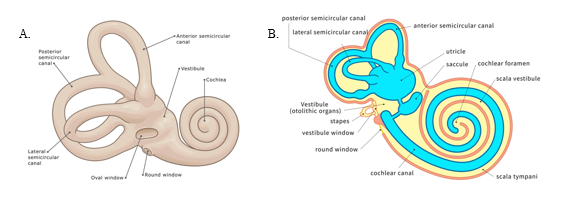

Figure 1: This image shows the anatomy of the human ear with image (A) depicting the inner ear structures and image (B) showing internal structures of the cochlea.
Image Courtesy: Created by the Author
The Visual System’s Contribution to Motion Perception
Visual motion perception relies on optic flow, the pattern of apparent motion of objects as an observer moves. Cortical regions involved include:
- Primary visual cortex (V1)
- Middle temporal area (MT/V5)
- Medial superior temporal area (MST)
These areas interpret direction and speed of motion. When visual motion signals indicate movement but vestibular organs signal stability, such as reading in a moving car, conflict emerges. (4)
Similarly, in virtual reality environments, strong visual motion cues are presented while the vestibular system detects no corresponding physical movement. This mismatch is a primary trigger for cybersickness. (1,5)
Sensory Conflict Theory
The most widely accepted explanation for motion sickness is the Sensory Conflict Theory. (6) It proposes that motion sickness arises when there is a discrepancy between:
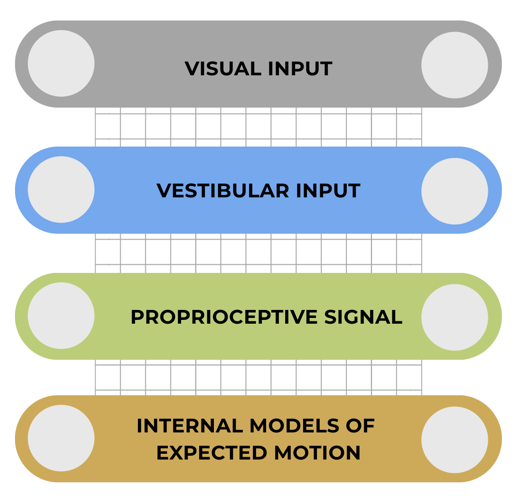

Figure 2: This image shows the components discussed within Sensory Conflict Theory
Image Courtesy: Created by the Author
For example, while reading in a car, the vestibular system detects movement while the visual system signals stillness.
The brain constantly compares incoming sensory data with prior expectations stored in neural networks. When the mismatch exceeds a threshold, motion sickness symptoms are triggered.
Brainstem Integration and the Vomiting Centre
The medulla houses critical nuclei involved in nausea and vomiting: (7)
- Area postrema: Chemoreceptor trigger zone
- Nucleus tractus solitarius (NTS)
- Dorsal motor nucleus of the vagus
Vestibular nuclei project to these autonomic centres. When sensory mismatch is detected, signals propagate to these nuclei, activating parasympathetic response:
- Increased salivation
- Sweating
- Gastric dysrhythmia
- Nausea and vomiting
Interestingly, the area postrema lacks a typical blood-brain barrier, making it sensitive to toxins. Some evolutionary theories suggest motion sickness may have evolved as a protective response against neurotoxins, interpreting sensory mismatch.
Role of the Cerebellum
The cerebellum plays a crucial role in predictive modelling of movement. It compares expected sensory outcomes of motion with actual input. When predictions fail, the cerebellum contributes to error signaling. (7)
Repeated exposure reduces symptoms through habituation, reflecting neural plasticity within cerebellar and vestibular circuits.


Figure 3: This image shows the anatomy of human cerebellum.
Image Courtesy: Created by the Author
Cortical and Multisensory Networks
Motion perception is not confined to brainstem pathways. Functional neuroimaging studies show involvement of:
- Insular cortex
- Parietal cortex
- Anterior cingulate cortex
- Temporo-parietal junction
The insula is particularly significant in interoceptive awareness, the perception of internal bodily states. Increased insular activation correlates with nausea intensity, linking sensory conflict to conscious discomfort. (8,9)
Cybersickness and Modern Environments
The rise of immersive Virtual Reality (VR) has amplified interest in motion sickness mechanisms. Cybersickness mirrors classical motion sickness but may also involve latency between head movement and visual update, inconsistent frame rates, and visual-vestibular gain mismatch. Understanding neural conflict mechanisms informs engineering solutions in digital technologies. (1,5)
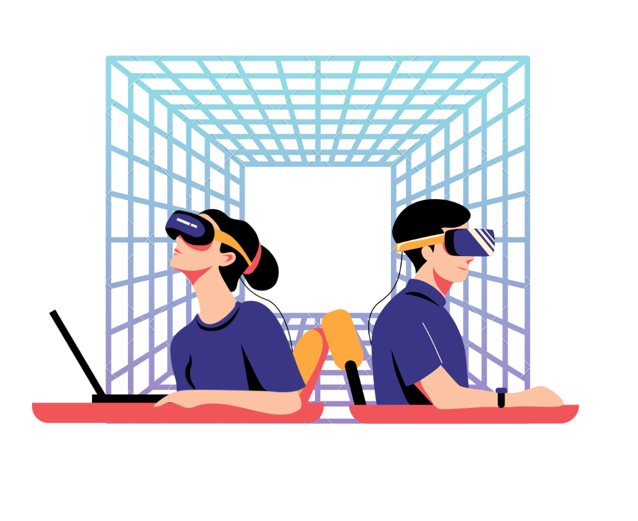

Figure 4: This image shows modern environments that can advertently lead to cybersickness.
Image Courtesy: Created by the Author
Adaptation and Neural Plasticity
Habituation demonstrates the brain’s remarkable adaptability. Sailors often experience severe seasickness initially but adapt over time. This suggests recalibration of internal models within vestibular and cerebellar circuits. Neural plasticity allows the brain to reduce prediction error signals after repeated exposure. However, maladaptation can occur in certain conditions, leading to persistent motion sensitivity. (10,11)
Evolutionary Perspective
One prominent evolutionary hypothesis proposes that sensory mismatch resembles neurotoxic states. If ingested toxins disrupt neural integration, conflicting sensory signals may arise. Vomiting would then function as a defensive mechanism. (12)
Conclusion
Motion sickness is not merely a peripheral vestibular disturbance but a complex disorder of multisensory integration and neural prediction. At its core lies a conflict between visual and vestibular signals, processed through brainstem nuclei, cerebellar circuits, cortical networks, and autonomic centres.
By studying motion sickness, neuroscientists gain broader insights into how the brain constructs coherent perception from multiple sensory streams, and what happens when that coherence breaks down. In an era of expanding virtual environments and autonomous mobility, understanding these neural dynamics is more relevant than ever.
References
- Laessoe, U., Abrahamsen, S., Zepernick, S., Raunsbaek, A., & Stensen, C. (2023). Motion sickness and cybersickness–Sensory mismatch. Physiology & Behavior, 258, 114015.
- Keshavarz, B., & Golding, J. F. (2022). Motion sickness: current concepts and management. Current opinion in neurology, 35(1), 107-112.
- Yoo, H., & Mihaila, D. M. (2022). Neuroanatomy, vestibular pathways. In StatPearls [Internet]. StatPearls Publishing.
- Kandel, E. R., Schwartz, J. H., Jessell, T. M., Siegelbaum, S., Hudspeth, A. J., & Mack, S. (Eds.). (2000). Principles of neural science (Vol. 4, pp. 1227-1246). New York: McGraw-hill.
- LaViola Jr, J. J. (2000). A discussion of cybersickness in virtual environments. ACM Sigchi Bulletin, 32(1), 47-56.
- Oman, C. M. (1990). Motion sickness: a synthesis and evaluation of the sensory conflict theory. Canadian journal of physiology and pharmacology, 68(2), 294-303.
- Hall, J. E., & Hall, M. E. (2020). Guyton and Hall Textbook of Medical Physiology (14th ed.). Elsevier.
- Toschi, N., Kim, J., Sclocco, R., Duggento, A., Barbieri, R., Kuo, B., & Napadow, V. (2017). Motion sickness increases functional connectivity between visual motion and nausea-associated brain regions. Autonomic neuroscience : basic & clinical, 202, 108–113.
- Craig, A. D. (2009). How do you feel — now? The anterior insula and human awareness. Nature Reviews Neuroscience, 10(1), 59-70.
- Schmäl, F. (2013). Neuronal mechanisms and the treatment of motion sickness. Pharmacology, 91(3-4), 229-241.
- Mouloua, M., French, J., Smither, J. A., & Kennedy, R. S. (2023). Mitigation of Motion Sickness Symptoms by Adaptive Perceptual Learning: Implications for Space and Cyber Environments. In Human Factors in Simulation and Training (pp. 179-208). CRC Press.
- Treisman, M. (1977). Motion sickness: an evolutionary hypothesis. Science, 197(4302), 493-495.
About the Author


Kristi Sharma
Kristi Sharma is a Master of Optometry with a clinical research expertise in Teleophthalmology and Retina. She serves as the Education Engagement Manager at Vision Science Academy and has curated and tutored extensive courses at the Vision Science Academy Learning Centre. She is actively engaged in developing the research forum of Vision Science Academy, in addition to the ongoing and upcoming educational initiatives in the Academy. She has published a number of scientific blog articles in the past 5 years and aspires to continue contributing significantly in the domain of vision research and writing.