


Aakanksha Pathania, B. Optom
Editorial Assistant and Tutor, Vision Science Academy, Delhi, India
Cold application has long been recognised as an effective therapeutic method across various medical fields. Traditionally used to treat soft-tissue injuries, inflammation, and nerve trauma, cryotherapy helps reduce swelling, improve comfort, and slow down metabolic damage. Although widely practiced in sports medicine and physical rehabilitation, the role of cold therapy in eye care, also known as Cryo-Optometry, is still emerging.
Cold Therapy: Physiological Basis and Mechanisms
Cold application works by inducing vasoconstriction, which reduces blood flow and subsequently decreases the leakage of inflammatory mediators into surrounding tissues. When applied to inflamed tissues, cold helps control the spread of edema by narrowing blood vessels and stabilising cellular metabolism.
Inflammatory responses normally cause blood vessels to dilate, increasing interstitial fluid leakage. Cold reverses this response. Additionally, cryotherapy helps slow cellular metabolism, stabilising neuron membrane potentials and reducing the risk of secondary tissue damage during inflammation or injury.
Cold application has been well documented as effective in:
- Soft tissue trauma management
- Post-nerve injury recovery
- Edema reduction and inflammation control
- Neuronal protection via metabolic slowing
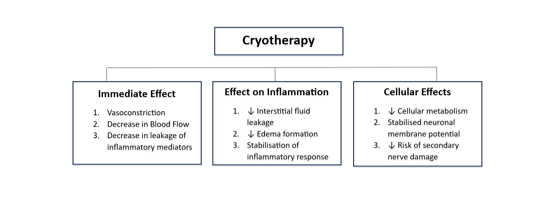

Figure 1: The Flowchart Indicating the Physiological Basis and Mechanisms
Cold Compresses in Eye Care: Current Use and Emerging Potential
In ophthalmology, cold therapy is not typically used as a primary treatment, yet it holds promising supportive benefits. Patients commonly use cold compresses for temporary relief from conditions such as ocular allergies, adenoviral conjunctivitis, and eyelid inflammation. With increasing patient demand, specialised cold compress packs are now readily available.
Recent studies show that cold therapy may extend beyond symptom relief. It has been investigated for its role in:
- Reducing neural damage in optic neuropathy
- Minimising complications after iridoplasty procedures
- Providing analgesia prior to intravitreal injections
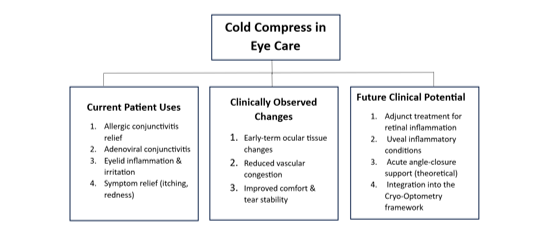

Figure 2: Cold Compress in Eye Care
In a study, researchers examined the early-term effects of cold compress application on ocular tissues. Because the eye contains a rich choroidal vascular network, understanding its response to cold could open new avenues for managing inflammatory retinal and uveal conditions. Their findings suggest a possible role for cold compresses in acute conditions like acute angle-closure, where controlling inflammation and vascular congestion is critical. (1)
Cryotherapy in Ophthalmology: A Historical and Clinical Perspective
Cryotherapy has been used in ophthalmology for over a century, primarily to treat benign and malignant ocular lesions. It works by rapidly freezing targeted tissue, leading to cellular destruction, vascular shutdown, and eventual lesion regression.
Historically, cryotherapy has played a significant role in:
- Treating conjunctival and ocular surface tumors
- Managing retinal tears, retinoblastoma, and vascular lesions
- Serving as adjunct therapy in intraocular surgery
The literature highlights the evolution of cryotherapy and its mechanisms, including freezing-induced damage to melanin-containing cells and disruption of tumor blood supply. (2)
Cryotherapy for Choroidal Melanoma: A Novel Approach
Small, growing choroidal melanomas remain challenging to manage. While radiation therapy and Transpupillary Thermotherapy (TTT) are commonly used, cryotherapy presents a unique alternative in selective cases.
Advantages include:
- Sensitivity of melanin to freezing
- Proven use in other ocular tumors
- Ability to approach tumors transsclerally
- Potential to destroy both tumor tissue and its blood supply
One study reported successful outcomes using cryotherapy for five patients with small melanocytic tumors. Although complications such as retinal detachment or vein occlusion may occur, most patients maintained good vision post-treatment. (3)
Cryotherapy for ROP: Long-Term Outcomes
The landmark CRYO-ROP trial evaluated cryotherapy for treating severe Retinopathy of Prematurity (ROP). After 10 years of follow-up, results demonstrated significant benefits in structural and functional outcomes for infants receiving cryotherapy.
The study concluded that cryotherapy:
- Improved visual acuity outcomes
- Enhanced retinal structural integrity
- Remained valuable despite the rise of laser therapy
Although laser is now preferred, the data continue to validate cryotherapy’s efficacy in severe ROP cases. (4)
Evidence-Based Cold Therapy in Clinical Care
Ice, compression, and elevation form the foundation of acute soft-tissue injury management, yet many clinicians lack clear evidence-based guidelines regarding optimal application. Research shows that the effectiveness of cryotherapy depends on method, duration, tissue depth, and application cycle.
A study demonstrated that melting iced water applied through a wet towel in repeated 10-minute intervals achieves a therapeutic temperature reduction of 10–15°C while avoiding skin compromise. Repeated cycles cool deeper tissues more effectively than continuous icing and allow superficial tissue to recover. Because reflex activity and motor function may be temporarily impaired after application, caution is required for at least 30 minutes post-treatment. (5)
Conclusion
Growing evidence shows that cold-based interventions hold meaningful potential across ocular and general clinical care. The proven effectiveness of repeated 10-minute ice applications reinforces the physiological relevance of controlled cooling in reducing inflammation and protecting tissue. (5) In ophthalmology, cold compresses have demonstrated early-term ocular changes, while cryotherapy continues to play a key role in treating small choroidal melanomas and severe retinopathy of prematurity.
Together, these findings strengthen the emerging field of Cryo-Optometry, suggesting that temperature-guided therapies may become increasingly valuable in managing inflammatory, vascular, and retinal conditions in the years ahead. (1–4)
References
- Bahar, A., & Pekel, G. (2021). Early term ocular changes after cold compress application. Arquivos Brasileiros de Oftalmologia, 85, 229–234.
- Tehrani, S., & Fraunfelder, F. W. (2013). Cryotherapy in ophthalmology. Open Journal of Ophthalmology, 3(4), 103–117.
- Wilson, D. J., & Klein, M. L. (2002). Cryotherapy as a primary treatment for choroidal melanoma. Archives of Ophthalmology, 120(3), 400–403.
- Cryotherapy for Retinopathy of Prematurity Cooperative Group. (2001). Multicenter trial of cryotherapy for retinopathy of prematurity: ophthalmological outcomes at 10 years. Archives of Ophthalmology, 119(8), 1110–1118.
- Mac Auley, D. C. (2001). Ice therapy: how good is the evidence?. International Journal of Sports Medicine, 22(05), 379–384.
About the Author


Aakanksha Pathania is an optometrist and healthcare professional. She completed her Bachelor’s in Optometry and is currently pursuing an MBA in Hospital and Health Management at IIHMR University.
Alongside her clinical experience Aakanksha is an active contributor at the Vision Science Academy (VSA). She serves as a tutor and editorial assistant and is the author of the course “Forensic Optometry.” She has earned top positions in VSA competitions, and several of her blogs have been published in the Academy’s exclusive section.
With a growing presence in clinical practice, research writing, and healthcare management, Aakanksha is committed to advancing evidence-based eye care and contributing meaningfully to the future of vision health.