


Shruti Sawant, M. Optom
PhD Scholar, Chandigarh University, Mohali, Punjab, India
Dyslexia is widely recognised as a neurodevelopmental disorder characterised by persistent difficulties in accurate and fluent word recognition, decoding, and spelling. Contemporary classifications, including Diagnostic and Statistical Manual of Mental Disorders, Fifth Edition (DSM-5) and the International Classification of Diseases, Eleventh Revision (ICD-11), emphasise that Dyslexia exists along a spectrum and frequently co-occurs with other developmental conditions such as Attention-Deficit Hyperactivity Disorder (ADHD) and developmental language disorder. (1) A study aimed to achieve expert consensus on how Dyslexia should be defined; The major agreed points from the study are depicted in Table 1. (2)
| Category | Key Points |
|---|---|
| Definition of Dyslexia | Dyslexia is a neurodevelopmental processing disorder that affects reading and spelling abilities. |
| Core Characteristics | Processing-based difficulty; affects reading and spelling; present across languages and age groups; exists on a severity continuum from mild to severe. |
| Cognitive Profile | Difficulties may involve phonological processing, working memory, processing speed, and orthographic skills. |
| Understanding Variability | Phonological deficits alone do not fully explain the variability observed among individuals with Dyslexia. |
| Developmental Factors | Dyslexia development may be influenced by genetic factors and environmental factors. |
| Common Comorbidities | Frequently co-occurs with ADHD, developmental language disorder, dyscalculia, and developmental coordination disorder. |
Table 1: The table shows the categories and key points of Dyslexia
While phonological deficits remain central to Dyslexia, research increasingly acknowledges that other systems also play a role in shaping learning outcomes. Among these, magnocellular system dysfunction, visual–perceptual and oculomotor functions have received growing attention. (3)
Visual and Oculomotor Inefficiencies in Dyslexia
Reading is a visually intensive task that depends on stable binocular vision, accurate saccades, smooth pursuits, visual attention, and visuomotor integration. Findings include the impaired voluntary and predictive saccades, increased prevalence of binocular vision anomalies, and reduced visual comfort during sustained near work. (4,5) Figure 1 is a Schematic Representation of ocular movement deficits in dyslexic children.
Such visual inefficiencies cause functional difficulties such as slow reading speed, frequent loss of place, visual fatigue, and reduced task endurance. Over time, these challenges can contribute to academic frustration and disengagement.
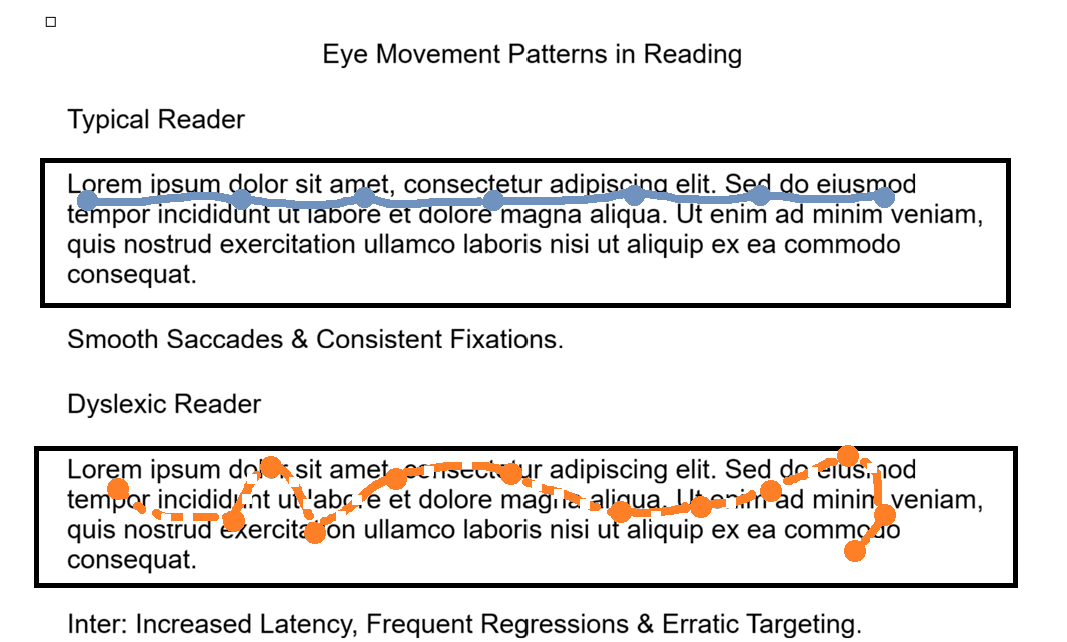

Figure 1: This Image shows the schematic representation of ocular movement deficits in dyslexic children.
Image Courtesy: Created by the Author
Behavioural Optometry: A Functional Vision Perspective
Behavioural optometry approaches vision as a dynamic process involving perception, action, and cognition, rather than focusing solely on visual acuity. Within this framework, assessment extends to functional domains such as eye movement control, visual-perceptual processing, and visuomotor integration.
It aims to identify and address clinically significant visual inefficiencies that may interfere with the ability of a child to engage effectively with reading and learning tasks. When indicated, structured vision therapy or visual-perceptual training may be used as an adjunct to evidence-based educational and language interventions.
Emerging Role of AR/VR in Behavioural Vision Training
Advances in Augmented Reality (AR) and Virtual Reality (VR) offer new opportunities to address some of these methodological challenges. Immersive platforms can deliver repeatable, engaging visual-perceptual and oculomotor tasks with precise control over stimulus parameters. Emerging clinical studies suggest that VR-based rehabilitation may improve reading-related performance and engagement in children with Dyslexia, with some evidence of sustained benefits over time. (6,7)
Conclusion
The role of behavioural optometry in Dyslexia lies in its contribution to a broader, multidisciplinary understanding of developmental learning difficulties. By identifying and addressing modifiable visual perceptual and oculomotor inefficiencies, behavioural optometry may help reduce visual barriers to learning and support functional engagement in selected children.
References
- Margaret J. Snowling , Charles Hulme & Kate Nation (2020) Defining and understanding Dyslexia: past, present and future, Oxford Review of Education, 46:4, 501-513.
- Carroll, J. M., Holden, C., Kirby, P., Thompson, P. A., Snowling, M. J., Dyslexia Delphi Panel, … & Rack, J. (2025). Toward a consensus on Dyslexia: findings from a Delphi study. Journal of Child Psychology and Psychiatry, 66(7), 1065-1076.
- Vilhena, D. D. A., Guimarães, M. R., Guimarães, R. Q., & Pinheiro, Â. M. V. (2021). Função visual magnocelular na dislexia do desenvolvimento: déficit na perimetria de frequência duplicada e nas habilidades motoras oculares. Arquivos Brasileiros de Oftalmologia, 84(5), 442-448.
- Hussaindeen, J. R., Shah, P., Ramani, K. K., & Ramanujan, L. (2018). Efficacy of vision therapy in children with learning disability and associated binocular vision anomalies. Journal of optometry, 11(1), 40-48.
- Bush, S., Hinkley, S., Jenerou, A., Damari, D., Buckingham, R., Geneva, C., & Reger, M. (2019). The Impact of Binocular Vision and Tracking Intervention on Academic Performance: An In-School Vision Therapy Pilot Program. Optometry & Visual Performance, 7(1).
- Maresca, G., Leonardi, S., De Cola, M. C., Giliberto, S., Di Cara, M., Corallo, F., … & Pidalà, A. (2022). Use of virtual reality in children with Dyslexia. Children, 9(11), 1621.
- Ji, S., Mokmin, N. A. M., & Wang, J. (2025). Immersive Learning for Dyslexic Students: A Review of Virtual Reality Interventions and Pedagogical Implications. PRESENCE: Virtual and Augmented Reality, 34, 1-22.
About the Author


Shruti Sawant
PhD Scholar