

Luouie Bastin K, M. Optom
Occupational Optometrist, Medical Research Foundation, Chennai, India
In the current high-performance environments, both athletes and professionals are subject to increasing visual demands. From bright stadium lights to glowing digital screens, the visual system is constantly challenged. The concept of 24-hour visual wellness has emerged as a critical framework to ensure sustained performance, prevent fatigue, and promote visual recovery. It draws upon the latest in vision science to address the unique demands placed on our eyes throughout a full day regardless of profession or athletic role.
Modern Visual Challenges
Our modern lifestyles expose us to prolonged digital screen use, irregular sleep schedules, and artificial lighting, all of which impact visual function. Extended screen time, especially on mobile devices and monitors, leads to digital eye strain, marked by reduced blink rate, instability of the tear film, and increased accommodative stress. These symptoms are not limited to older users; studies have shown that even young adults experience measurable discomfort and performance deficits under prolonged digital exposure. (1)
Athletes, too, face their own set of challenges. Fatigue, rapid head and eye movements, and inconsistent lighting conditions can impair contrast sensitivity and visual decision-making. (2) In both contexts, the visual system is taxed beyond its evolutionary baseline, warranting new tools and strategies for resilience.
Circadian Influence on Vision
The visual system is closely tied to the circadian rhythm. Evening exposure to high-intensity blue light, common with screen use, can delay melatonin secretion, disrupt sleep cycles, and impair visual cognition the next day. (3) Studies indicate that sleep deprivation reduces saccadic accuracy, smooth pursuit eye movements, and overall visual-motor coordination. (4) For athletes and shift workers alike, this creates a feedback loop of impaired visual performance and delayed recovery.
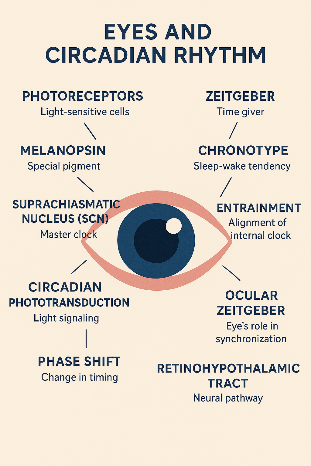
Figure 1: Circadian Influence of Vision
Strategies for Continuous Visual Wellness
1. Vision Training and Simulation Tools
Oculomotor exercises, VR simulations, and neurovisual training are proven to enhance reaction times and tracking accuracy in athletes. (5) These tools are also increasingly being used in other high-stakes professions, including surgery and aviation.
2. Circadian-Friendly Lighting
Smart lighting systems that mirror natural daylight cycles improve visual comfort and alertness. A study demonstrated that such systems reduce cognitive fatigue and stabilise performance during night shifts. (6)
3. Visual Hygiene and Break Schedules
Regular breaks and ergonomic visual setups can mitigate the effects of digital eye strain. Following the 20-20-20 rule every 20 minutes, looking 20 feet away for 20 seconds, reduces accommodative fatigue and improves comfort. (7)
4. Personalised Visual Load Monitoring
Wearable eye-trackers enable real-time monitoring of blink rate, fixation, and pupil response, allowing for early identification of visual fatigue. (8) Tailored training and rest plans can then be developed to optimise performance.
5. Collaborative Vision Care
Integrated vision care teams, including optometrists, coaches, engineers, and occupational therapists, provide customised solutions such as vision task analysis, lighting assessments, and workload mapping. (9)
Conclusion
Visual wellness now transcends conventional work hours. Whether on the field or in front of a screen, optimising vision throughout a 24-hour cycle is essential. Through cutting-edge technology, tailored interventions, and collaborative care, we can protect and enhance visual function, empowering both professionals and athletes to perform at their best, day and night.
References
- Sletten, T. L., Segal, A. Y., Flynn-Evans, E. E., Lockley, S. W., & Rajaratnam, S. M. (2015). Inter-individual differences in neurobehavioural impairment following sleep restriction are associated with circadian rhythm phase. PLOS One, 10(6), e0128273.
- Barnes, R. G. (1999). Simulation and field studies of the circadian status of shift workers. University of Surrey (United Kingdom).
- Laby, D. M., & Appelbaum, L. G. (2021). Vision and on-field performance: a critical review of visual assessment and training studies with athletes. Optometry and Vision Science, 98(7), 723-731.
- Rosenfield, M. (2011). Computer vision syndrome: a review of ocular causes and potential treatments. Ophthalmic and Physiological Optics, 31(5), 502-515.
- Kuhn, G. (2001). Circadian rhythm, shift work, and emergency medicine. Annals of Emergency Medicine, 37(1), 88-98.
- Crnovrsanin, T., Wang, Y., & Ma, K. L. (2014). Stimulating a blink: reduction of eye fatigue with visual stimulus. In SIGCHI Conference on Human Factors in Computing Systems (pp. 2055-2064).
- Kaur, K., Gurnani, B., Nayak, S., Deori, N., Kaur, S., Jethani, J., … & Mishra, D. (2022). Digital eye strain—A comprehensive review. Ophthalmology and Therapy, 11(5), 1655-1680.
- Ellis, E. V., & McEachron, D. L. (2017). Health and Wellness in Today’s Technological Society. In Health and Well-being for Interior Architecture (pp. 94-107). Routledge.
- Vanathi, M. (2023). Vision wellness in occupational safety and health. Indian Journal of Ophthalmology, 71(10), 3273-3274.
Recent Comments