


Rohitha S M (1), M. Optom. Student
Bharghavy S (2), Assistant Professor
Dr. Agarwals Institute of Optometry, Chennai, India
Keywords
predictive coding, neuro-optometry, sensorimotor integration
Declaration of Interest
The blog is written solely for education purpose, and it does not have any financial support and conflict of interest.
Vision was long thought to be a simple feedforward process, signals flowing from retina to brain. Predictive coding overturns this view: the visual system continuously predicts incoming sensory input and checks these predictions against retinal signals, minimising error. For Neuro-optometrists, this matters because vision, oculomotor control and sensorimotor feedback are inseparable. This blog explores how predictive coding shapes dynamic vision and eye movements, and what happens clinically when prediction fails. (1)
Introduction
Imagine a patient recovering from a mild head injury who tells you everything looks slightly delayed, as if her brain is a step behind her eyes. Contemporary Neuroscience shows that perception is not purely feedforward but emerges from constant interplay between bottom-up sensory signals and top-down predictions, allowing efficient interpretation under uncertainty. Many visual disorders reflect disruption not only of ocular structures but of this predictive, sensorimotor system. (2)
How the Brain Predicts
Higher cortical areas generate hypotheses about incoming input, sent downward and compared with actual retinal signals. Any mismatch produces a prediction error, relayed upward to refine the model. Through repeated feedback loops the brain sharpens its internal representation of the world, a principle extending into the broader free-energy framework, which treats all brain function as error minimisation. (3,4)
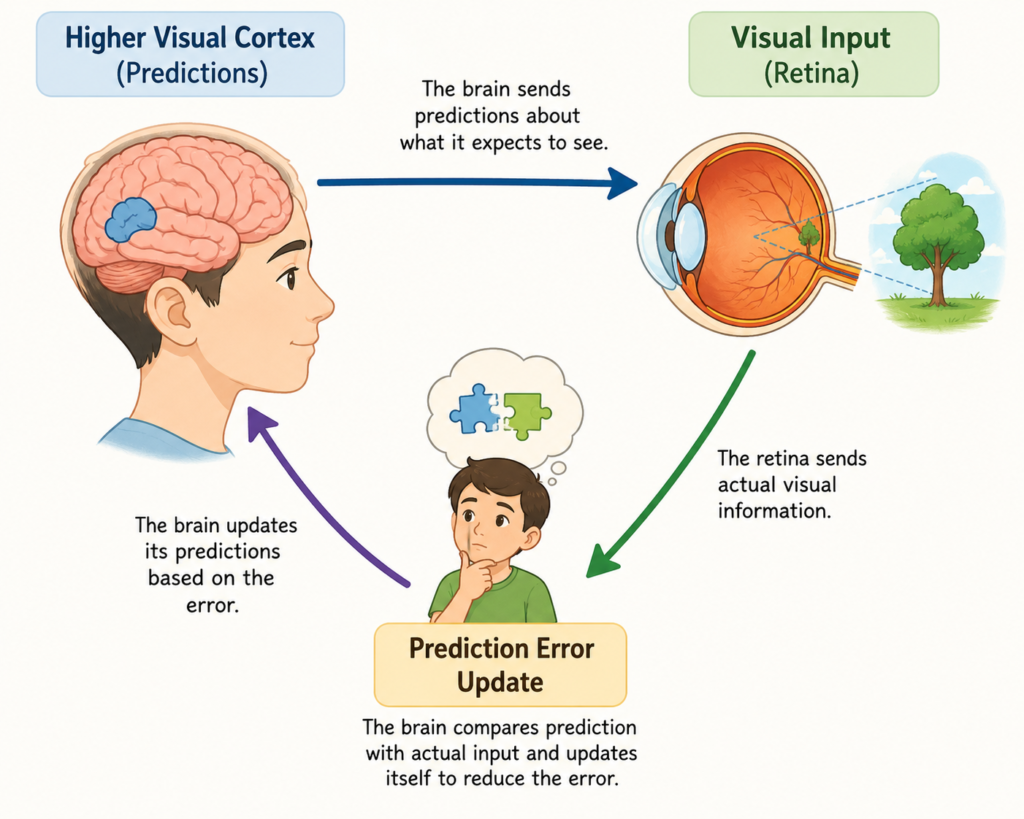

Figure 1. This image shows that predictions flow downward from higher cortical areas while the resulting error signal travels back up, forming a continuous loop rather than a one-way relay.
Image Courtesy: Created by Author
The Pathway Behind the Prediction
The visual system processes information hierarchically. Photoreceptors convert light into neural signals, relayed via bipolar and ganglion cells to the lateral geniculate nucleus (LGN) of the thalamus, then to the primary visual cortex (V1) and higher regions including V2, V4 and the inferotemporal cortex, supporting object recognition, motion perception and spatial awareness. Feedback connections from these areas carry predictions back down the same hierarchy.
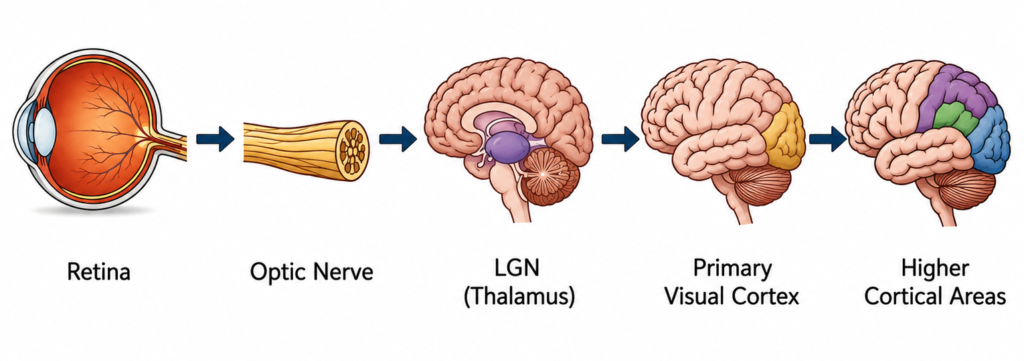

Figure 2. This image shows how visual information ascends from the retina through the LGN, V1, V2, V4 and the inferotemporal cortex; the same hierarchy along which predictions travel back down.
Image Courtesy: Created by Author
Predicting Where Your Eyes Will Look Next
Vision cannot be separated from eye movement. Saccades, smooth pursuit and vergence continuously reposition the fovea. During saccades, the brain predicts the expected post-saccadic scene, keeping perception stable despite rapid retinal shifts.
When Prediction Breaks Down
Predictive coding disruption may underlie Amblyopia, Traumatic Brain Injury-related visual dysfunction, and Binocular Vision anomalies, producing unstable perception or poor eye-vision coordination. Eye tracking offers useful clinical markers here: saccadic latency reflects predictive motor control, and smooth pursuit gain (eye speed relative to target speed) reflects tracking efficiency. A patient with reduced gain visibly lags behind a moving target, eyes catching up in small jerks.
What Comes Next
Future work may explore how predictive coding interacts with ocular growth regulation, attention and multisensory integration. One line examines whether predictive-coding disruption contributes to Myopia progression via dopaminergic signalling; another explores AI-driven adaptive saccadic training that adjusts to a patient’s error patterns. (5)
The Bigger Picture
This is not just theory; it is a different way of understanding vision. Bringing predictive coding into Neuro-optometry could sharpen how we diagnose and treat conditions like Binocular Vision anomalies, through saccadic training, pursuit tracking, and vergence adaptation. (6) The eye exam of tomorrow may say as much about the brain as the eyes.
References
- Clark A. Whatever next? Predictive brains, situated agents, and the future of cognitive science. Behav Brain Sci. 2013;36(3):181–204. https://doi.org/10.1017/S0140525X12000477
- Summerfield C, Egner T. Expectation (and attention) in visual cognition. Trends Cogn Sci. 2009;13(9):403–409. https://doi.org/10.1016/j.tics.2009.06.003
- Rao RPN, Ballard DH. Predictive coding in the visual cortex: a functional interpretation of some extra-classical receptive-field effects. Nat Neurosci. 1999;2(1):79–87. https://doi.org/10.1038/4580
- Friston K. The free-energy principle: a unified brain theory? Nat Rev Neurosci. 2010;11(2):127–138. https://doi.org/10.1038/nrn2787
- Nickla DL, Totonelly K. Dopamine antagonists and brief vision distinguish lens-induced- and form-deprivation-induced myopia. Exp Eye Res. 2011;93(5):782–785. https://doi.org/10.1016/j.exer.2011.08.001
- Rosenfield M. Computer vision syndrome: a review of ocular causes and potential treatments. Ophthalmic Physiol Opt. 2011;31(5):502–515. https://doi.org/10.1111/j.1475-1313.2011.00834.x
About the Author


Rohitha S M
M. Optom Student,
Dr. Agarwals Institute of Optometry, Chennai, India

Bharghavy S
Assistant Professor,