
N. Sindhuja T. Nagarajan, B. Optom Student
Sri Manakula Vinayagar Medical College and Hospital, Pondicherry, India
The World Health Organisation (WHO) defines blindness as “the inability to perform tasks which normally require gross vision without increased reliance on other senses”. The equivalent visual impairment measure for blindness is less than 3/60 or a visual field of less than 10 °.
The WHO defines low vision according to both disability and impairment – moderate low vision is the “ability to reach normal performance with visual aids” and in terms of impairment is (6/18.) (1)
According to WHO, the prevalence of blindness or visual impairment is 2.2 billion people is approximately 26.5% of the worldwide population. A person who is blind or has low vision uses two main capabilities: orientation and mobility. (2) Mobility tools that assist independent travel involve optical aids (e.g., magnifier and telescope), a long white cane, and the use of a guide dog. But travellers with impairment must negotiate progressively complicated and adaptable spaces, involve congested areas, and complicated roads. Approaches to address these enduring obstacles involve environmental accessibility and the use of inclusive technologies. Mainstream smartphones and tablets incorporate built-in assistive technology that can be activated by all users. This article explains how the visual impairment explores the world using smartphone apps.
Overview
Visual impairment makes it hard to do the daily tasks involves reading, moving around, self-care, and interaction. Smartphones become helpful for people with low vision. Many apps on phones can make things bigger, text-to-speech, object identification, and recognise faces. These applications help you do more on your own and feel more confident.
Smartphone Apps for Vision Assistance
Smartphone apps for vision assistance are a relatively new concept in vision rehabilitation. These innovations include digital screen readers, screen magnification software, speech identification, availability features incorporated into computer or mobile operating systems, and device tools, or software that were planned.
Currently Available Vision Assistance Apps
To find relevant mobile apps for visually impaired, In total 290 apps for vision assistance were incorporated. (3) Smartphone apps which are helpful for visually impaired on Android OS. Some of them are represented below:
| Apps | Features |
|---|---|
| AIRA | Interacting with a sighted person virtually through video and/or audio |
| Seeing AI | A multipurpose AI-powered app that helps users read documents, recognize objects, face identifications, and detect emotions. Just point the camera, and it will describe what it sees. |
| Google Maps | A GPS navigation app that provides real-time directions and accessibility info to help users move confidently. |
| Be My Eyes | It connects visually impaired individuals with sighted volunteers for real-time assistance through video calls. Volunteers can help users with tasks like reading labels, identifying colours, and navigating. |
| Talk Back | The native screen reader of Android provides spoken feedback and allows for navigation without looking at the screen. |
| Amazon Alexa & Google Assistance | A voice-controlled AI assistant that sends messages, schedules tasks, and controls smart home devices with just voice commands. |
| Evelity | Designed for indoor navigation, and provides step-by-step audio guidance in museums, universities, and public places. |
Table 1: Table showing apps and the features of the applications.
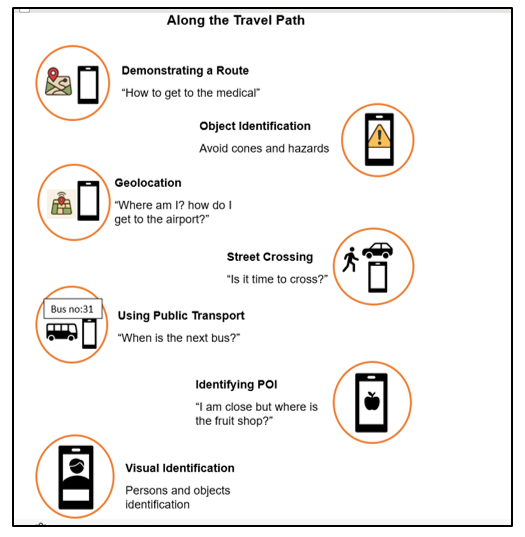
Figure 1: Image demonstrating the navigation tasks along the travel path.
Image Courtesy: Created by the Author
Conclusion
New technology has built to help many people. People who are blind or have low vision use apps that help them to know what is surrounding them. These apps give valuable information that they do not get from a habitual way. To make these apps work well, we should ask blind and low vision users for their ideas. We also need to talk to technology experts and mobility trainers. When we do this, we learn what users need and how to make the apps better in the future.
References
- Leat, S. J., Legge, G. E., & Bullimore, M. A. (1999). What is low vision? A re-evaluation of definitions. Optometry and Vision Science, 76(4), 198-211.
- Bleau, M., Martiniello, N., Gingras-Royer, N., Tardif-Bernier, C., & Nemargut, J. P. (2026). Exploring the use of smartphone applications during navigation-based tasks for individuals who are blind or who have low vision: future directions and priorities. Disability and Rehabilitation: Assistive Technology, 21(2), 840-868.
- Pundlik, S., Shivshanker, P., & Luo, G. (2023). Impact of apps as assistive devices for visually impaired persons. Annual Review of Vision Science, 9(1), 111-130.
About the Author

N. Sinduja T. Nagarajan
B. Optom Student
Recent Comments