
Kulsum Perveen
B. Optom Student, NSHM Knowledge Campus, Kolkata, India
Road traffic accidents are a major cause of injury and mortality worldwide and continue to pose a significant public health challenge. Discussions on road safety often focus on speeding, alcohol consumption, and poor road infrastructure. However, the role of vision in driving safety receives comparatively less attention. Driving is a visually demanding activity that requires the efficient functioning of multiple visual components. Even mild visual impairment can negatively affect driving performance and increase the risk of accidents. This blog highlights vision impairment as a significant yet under-recognised risk factor for road accidents and emphasises the preventive role of optometry. (1)
|
Visual Function
|
Role in Safe Driving
|
Effect of Impairment
|
|
|---|---|---|---|
| Visual Acuity | Identifies road signs, signals, vehicles, and pedestrians | Missed signs and delayed response to hazards | |
| Contrast Sensitivity | Detects objects against the background, especially in low light | Poor hazard detection in fog, rain, or night conditions | |
| Peripheral Vision | Monitors surrounding traffic and unexpected side movements | Increased risk of side-impact and lane-change collisions | |
| Glare Sensitivity | Tolerates headlights and bright light sources | Reduced nighttime driving safety and visual discomfort (4,6) | |
| Depth Perception | Assists in judging distances during overtaking and parking | Misjudgment of distances during overtaking, parking, and intersection navigation |
Table 1: This table shows the visual functions required for safe driving and the potential consequences of their impairment.
Visual Deficits and Crash Risk
Visual impairment increases the risk of road traffic accidents by reducing hazard detection, reaction time, and spatial awareness. Uncorrected refractive errors remain one of the most common and preventable causes of reduced driving vision. Visual deficits such as poor contrast sensitivity, glare sensitivity, and visual field loss may significantly affect driving performance, particularly under night-time or low-visibility conditions. Studies have consistently reported higher crash rates among drivers with untreated or undiagnosed visual impairments. (2,3,6)


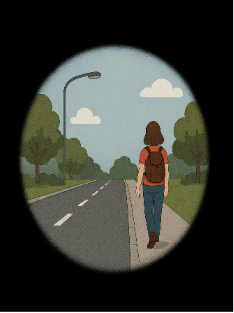
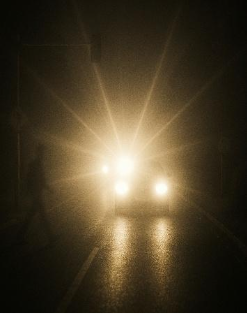
Figure 1: Simulated driving scenes illustrating the impact of common visual impairments – (A) normal vision, (B) reduced contrast sensitivity, (C) visual field loss, and (D) glare sensitivity on hazard perception while driving.
Image Courtesy: Created by the Author

Role of Optometry in Road Safety
Optometrists play a crucial role in improving road safety through comprehensive eye examinations. Early detection and correction of refractive errors can significantly enhance driving vision. In addition to assessing visual acuity, optometrists evaluate contrast sensitivity, visual fields, glare tolerance, and night vision, all of which are essential for safe driving. Patient education regarding regular eye check-ups, appropriate spectacle use, and awareness of visual limitations further contributes to accident prevention. Incorporating vision screening into driving licence issuance and renewal processes may help reduce preventable road accidents. (1,7)
Conclusion
Vision impairment is a frequently overlooked yet significant contributor to road traffic accidents. Safe driving relies on multiple aspects of visual function rather than visual acuity alone. Uncorrected or undiagnosed visual deficits can impair hazard detection, reaction time, and overall driving performance. Regular eye examinations, timely vision correction, and increased awareness of vision-related driving risks can play an important role in enhancing road safety. Recognising the contribution of optometry to accident prevention highlights its importance in public health and community well-being.
References
- World Health Organization. Global Status Report on Road Safety 2018. Geneva: WHO; 2018.
- Owsley C, McGwin G Jr. Vision and driving. Vision Research. 2010;50(23):2348–2361.
- Rubin GS, et al. Visual impairment and driving performance. Investigative Ophthalmology & Visual Science. 2007;48(9):4177–4183.
- Wood JM, et al. Glaucoma and driving: A review. Clinical and Experimental Optometry. 2016;99(5):363–372.
- Higgins KE, Wood JM. Driving performance and glare. Ophthalmic and Physiological Optics. 2005;25(4):295–305.
- McGwin G, Brown DB. Visual impairment and crash risk. Accident Analysis & Prevention. 1999;31(6):683–689.
- Plainis S, Murray IJ. Vision screening and driving. Ophthalmic and Physiological Optics. 2002;22(5):455–464.
About the Author

Kulsum Perveen
B. Optom Student
Recent Comments