
Suraj Kumar Mahato (1), B. Optom Student
Bidisha Bhattacharya (2), Assistant Professor
NSHM college of Management and Technology, Durgapur, India
The solution to “Why are we able to see dreams even when our eyes are closed?” The reason is that when our eyes are closed during sleep, we can still “see” dreams because dreams do not use the eyes at all. They are created inside the brain. It is the mystery behind the brain and vision. (1,3)
Dreams: A Combination of Memory and Imagination
1. Dreams come from the brain, not the eyes
- Vision while awake: Light enters the eyes, travels as an electric signal through the optic nerve to the brain (the visual cortex is the part of the brain that processes sight).
- Vision in dreams: The brain creates images internally, like a movie playing inside our head, and at that time the visual cortex (the same part of the brain that processes sight when you are awake) becomes highly active. (1,3,7)
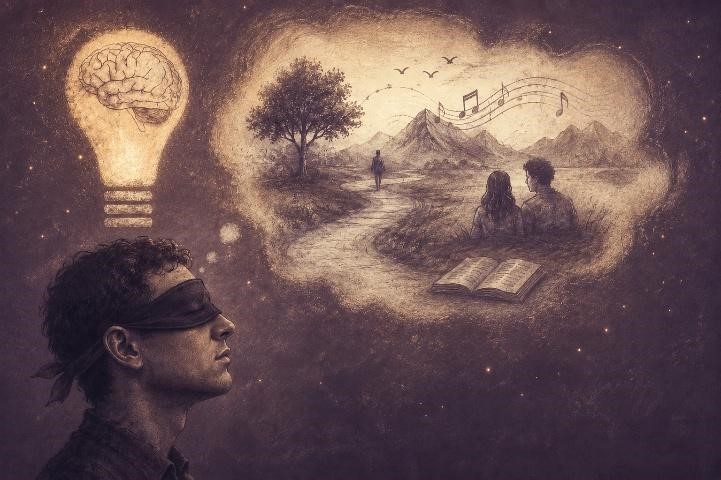
Figure 1: This image shows even in the absence of sight, the mind paints its own universe-where dreams are felt, remembered, and lived beyond vision.
Image Courtesy: Created by the Author
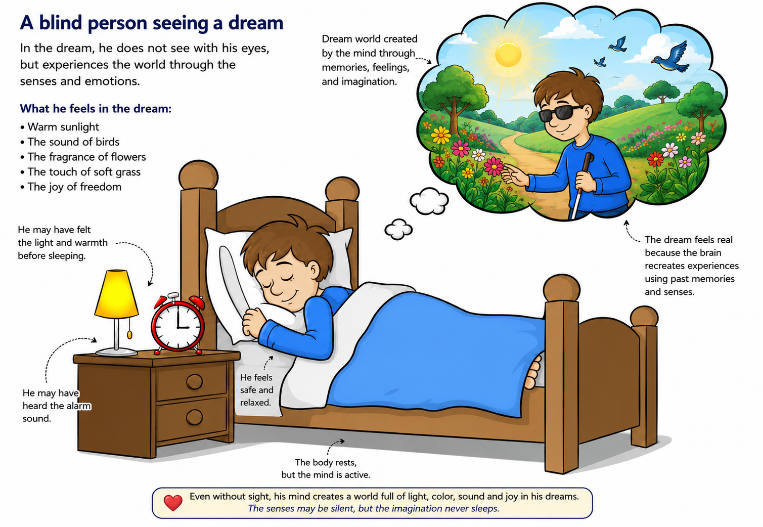
Figure 2: This image shows even in the absence of sight, the mind paints its own universe-where dreams are felt, remembered, and lived beyond vision.
Image Courtesy: Created by the Author
2. The “Dream Stage”
Dreams happen during Rapid Eye Movement (REM) sleep: when the eyes are closed, but they move rapidly under the eyelids. Brain activity is almost like being awake, making our Logical control low, imagination is high, which creates our dreams feel real, colourful, and emotional. (1,4)
3. Dream Images = Memory + Imagination
Our brain creates dreams by mixing them to form dream scenes-even people you do not clearly remember seeing before.
- Memories.
- Faces we have seen.
- Places we visited.
- Emotions and fears.
Now A Question Arises That Are Blind People Also See Dream or Not?
Yes, blind people see dreams, but it depends on different cases how they can see dreams.
Here are the cases:
1. Scenario 1: People who became blind after birth
Yes, they can “see” dreams. Even years after losing sight, the brain can still replay visual images. They already have visual memories stored in the brain, and during rapid eye movement sleep, the visual cortex reactivates those memories. (2,6)
Their dreams may include:
- Faces
- Colours
- Places
- Light and movement
2. Scenario 2: People who are blind from birth
They usually do not see visual images in dreams; their brains never learned “visual language.” (2,6) Instead, they experience different dreams are based on other senses:
- Sounds (voices, music)
- Touch (textures, movement)
- Smell
- Emotions
- Body sensations (walking, falling)
Congenital blindness can also produce dreams, but the reason is unknown according to the literature. While other sensory elements grow, it is less evident whether blind people also retain a strong spatial conception in their dreams. Therefore, one theory is that dream representation moves from the spatial domain, which is more commonly linked to the visual system, to the temporal domain, which is more commonly linked to the auditory system. In fact, blind people primarily represent reality through the aural sensory mode. A deeper comprehension of the connection between imagination, multisensory integration, and sensory perception may assist in explaining the genesis of dreams. (2)
Conclusion
The existence of dream formation despite no eye input proves the impressive capability of the human brain to develop internal perceptions without the use of the eyes. The brain creates dreams not with the help of the eyes but through neural processes in the brain. The brain creates visions using visual memories that were previously created when the person was seeing.
Research about blindness and dreaming shows the adaptability of the human brain in producing dreams despite having limited sensory input due to blindness. People who have been blinded after birth can still have dreams containing visual experiences since visual memories were already formed in the brain. Congenitally blind people, on the other hand, can produce dreams through the use of other senses like hearing, tactile sensations, smell, movement, and emotions. (1,3,6,7)
References
- Hobson, J. A. (2009). REM sleep and dreaming: Towards a theory of protoconsciousness. Nature Reviews Neuroscience, 10(11), 803–813. https://doi.org/10.1038/nrn2716
- Vitali, H., Campus, C., De Giorgis, V., Signorini, S., & Binda, P. (2022). The vision of dreams: From ontogeny to dream engineering in blindness. Journal of Clinical Sleep Medicine, 18(8), 2051–2062. https://doi.org/10.5664/jcsm.10026
- Siclari, F., Baird, B., Perogamvros, L., Bernardi, G., LaRocque, J. J., Riedner, B., Boly, M., Postle, B. R., & Tononi, G. (2017). The neural correlates of dreaming. Nature Neuroscience, 20(6), 872–878. https://doi.org/10.1038/nn.4545
- Dresler, M., Wehrle, R., Spoormaker, V. I., Koch, S. P., Holsboer, F., Steiger, A., Sämann, P. G., & Czisch, M. (2012). Neural correlates of dream lucidity obtained from contrasting lucid versus non-lucid REM sleep: A combined EEG/fMRI case study. Sleep, 35(7), 1017–1020.
- Arnulf, I. (2011). REM sleep behavior disorder: Motor manifestations and pathophysiology. Movement Disorders, 27(6), 677–689.
- Desai, D. (2023). Dreams in blind individuals: A mystery of brain and vision. medRxiv. https://doi.org/10.1101/2023.03.10.23286640
- Nir, Y., & Tononi, G. (2010). Dreaming and the brain: From phenomenology to neurophysiology. Trends in Cognitive Sciences, 14(2), 88–100. https://doi.org/10.1016/j.tics.2009.12.001
- Fosse, M. J., Stickgold, R., & Hobson, J. A. (2001). Brain-mind states: Reciprocal variation in thoughts and hallucinations. Psychological Science, 12(1), 30–36.
About the Author

Suraj Kumar Mahato
B. Optom Student
NSHM college of Management and Technology, Durgapur, India

Bidisha Bhattacharya
Assistant Professor
Recent Comments