
Rajat Chauhan, M. Optom
Assistant Professor (Optometry), APG Shimla University, Shimla, India
Keywords
oculomics, Artificial Intelligence, retinal imaging, systemic disease detection, preventive healthcare
Declaration of Interest
The author has no financial or personal relationships that could have influenced this article.
When a Routine Eye Exam Reveals More Than Vision
A patient visits an eye clinic expecting nothing more than a routine vision check. During examination, an Artificial Intelligence (AI) system notices subtle vascular changes that suggest a high risk of cardiovascular disease without a blood test, Electrocardiogram (ECG) or Computed Tomography (CT) scan. This science fiction is rapidly becoming reality through oculomics, an emerging approach that transforms the eye into a window for understanding the health of the entire body. (1)
The Retina: A Biological Mirror of the Human Body
Oculomics uses the data derived from the eye (particularly retinal imaging) to identify signs of systemic conditions including cardiovascular, metabolic and neurological disorders. (1) High-resolution fundus photographs and Optical Coherence Tomography (OCT) provide a direct view of the microvasculature and neural tissue that cannot be seen elsewhere so easily. When combined with AI, these images can reveal subtle changes caused by inflammation, vascular damage or metabolic stress long before symptoms become clinically apparent. (2)
Studies have demonstrated that quantitative analysis of retinal images can estimate biological age, blood pressure, sex, smoking status and cardiovascular risk factors, highlighting the retina as a powerful, non-invasive biomarker of systemic health. Instead of looking only for classic ocular disease, clinicians can now use the same photographs to gain insight into a patient’s overall physiological state. (3) As AI continues to evolve, the eye is no longer viewed solely as an organ of vision but also as a source of valuable systemic health information.
Beyond Sight: Detecting Diseases Before Symptoms Appear
The most promising applications of oculomics is the early detection of Diabetes and cardiovascular disease. AI-powered retina-based analysis has shown the potential to predict Diabetes risk and estimate cardiovascular health using simple fundus images, offering an accessible and cost-effective screening approach. (2,3) In countries like India, portable retinal cameras deployed in camps or primary-care settings could turn routine vision checks into community screening opportunities, allowing high-risk individuals to be referred early for lifestyle modification or medical treatment.
Another exciting frontier lies in the close relationship between the retina and the brain. Since the retina shares embryological and anatomical characteristics with the central nervous system, researchers are investigating retinal biomarkers as a possible indicator of neurodegenerative diseases. (4)
Endless Possibilities with some responsibilities
“The future of medicine may not begin in a laboratory; it may begin behind the pupil.”
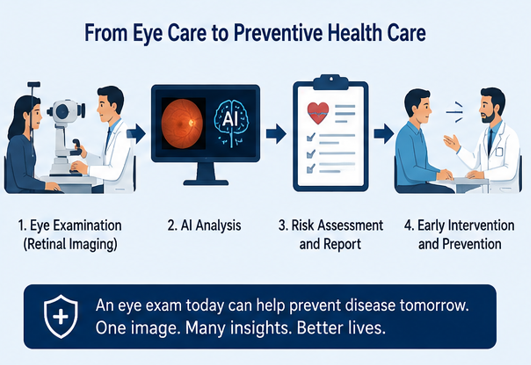
Figure 1: This image shows the workflow of AI-driven oculomics, illustrating how retinal imaging is integrated with AI to generate systemic health risk assessments, enabling early diagnosis, timely intervention, and preventive healthcare.
Image Courtesy: Created by Author
Oculomics faces important challenges despite its immense promises. AI models must become more transparent and reliable across diverse populations. Their performance may vary with ethnicity, age and image quality. Data protection and ethical handling of retinal information are equally important, especially when images reveal sensitive systemic risk. (1,5)
Oculomics provides an inexpensive, repeatable biosensor that supports earlier diagnosis and precise prevention. As AI unlocks the hidden information within retinal images, every eye examination may become an opportunity not only to preserve vision but also to detect systemic disease before it strikes. In the era of oculomics, reading the body through the eye is no longer just a metaphor, it is becoming the future of healthcare. (1)
References
- Wagner SK, Fu DJ, Faes L, Liu X, Huemer J, Khalid H, et al. Insights into Systemic Disease through Retinal Imaging-Based Oculomics. Transl Vis Sci Technol. 2020;9(2). doi:10.1167/TVST.9.2.6 PubMed PMID: 32704412.
- Ting DSW, Pasquale LR, Peng L, Campbell JP, Lee AY, Raman R, et al. Artificial intelligence and deep learning in ophthalmology. British Journal of Ophthalmology. 2019 Feb 1;103(2):167–75. doi:10.1136/BJOPHTHALMOL-2018-313173 PubMed PMID: 30361278.
- Poplin R, Varadarajan A V., Blumer K, Liu Y, McConnell M V., Corrado GS, et al. Prediction of cardiovascular risk factors from retinal fundus photographs via deep learning. Nature Biomedical Engineering 2018 2:3. 2018 Feb 19;2(3):158–64. doi:10.1038/s41551-018-0195-0 PubMed PMID: 31015713.
- Marchesi N, Fahmideh F, Boschi F, Pascale A, Barbieri A. Ocular Neurodegenerative Diseases: Interconnection between Retina and Cortical Areas. Cells. 2021 Sep 1;10(9). doi:10.3390/CELLS10092394 PubMed PMID: 34572041.
- Wong TY, Sabanayagam C. Strategies to Tackle the Global Burden of Diabetic Retinopathy: From Epidemiology to Artificial Intelligence. Ophthalmologica. 2020 Jan 14;243(1):9–20. doi:10.1159/000502387 PubMed PMID: 31408872.
About the Author

Rajat Chauhan
Assistant Professor
Recent Comments