
Agila B, Assistant Professor;
Dr. Raghunath N, Junior Resident
Dhanalakshmi Srinivasan University, Chengalpattu, India
Amblyopia is a neurodevelopmental visual disorder characterised by decreased visual function that cannot be connected with structural abnormalities of the eye. It affects approximately 2–5% of the global population and remains a leading cause of preventable visual impairment. (1) Habitually, Amblyopia has been attributed to abnormal visual experience during early childhood, particularly due to Strabismus, Anisometropia, or form deprivation. However, recent evidence indicates that Amblyopia reflects widespread cortical dysfunction rather than a purely monocular deficit. (2)
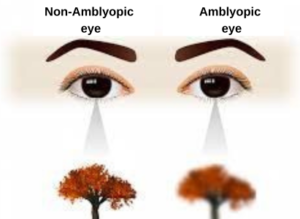
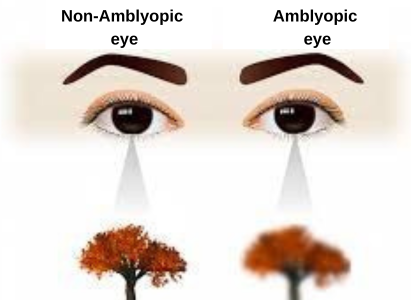
Figure 1: This image shows how amblyopia affects vision compared with that of a healthy eye.
Image Courtesy:
https://nandadeepeyehospital.org/wp-content/uploads/2026/03/Amblyopia-eye.png
Neurodevelopmental Basis of Amblyopia
Balanced binocular input is necessary for normal visual development during the early sensitive stages. Repression of one eye and altered binocular integration are examples of nonadaptive cortical reorganisation brought on by disruption of this input. Studies using neuroimaging show that Amblyopic people have impaired interhemispheric connectivity and aberrant activation in the primary and extrastriate visual cortices. (3)
Amblyopia has been shown to affect contrast sensitivity, motion perception, stereopsis, and visuomotor skill coordination, apart from acuity loss, implicating higher-order vision processing pathways. (4) Apart from this, the latest study has also underscored the role of neurovascular units in the amblyopic cortex, pointing towards the participation of neuronal, glial, and vascular components in generating reduced function. (5)
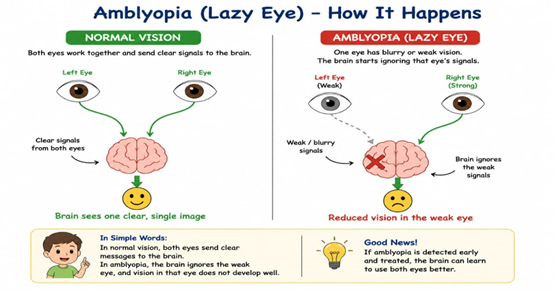
Figure 2: This image shows the simplified illustration of normal vision and Amblyopia (lazy eye).
Image Courtesy: Created by the Author
| Feature | Clinical Relevance |
| Cortical suppression | Reduced binocular integration |
| Contrast sensitivity loss | Functional vision impairment |
| Stereopsis deficit | Impaired depth perception |
| Neural plasticity | Basis for therapeutic recovery |
Table 1: This table shows the neurodevelopmental features of Amblyopia
Limitations of Traditional Diagnostic Approaches
Best-corrected visual acuity and interocular differences. Nevertheless, these metrics fall short of capturing functional vision deficiencies or dysfunction of both eyes. Even with mild acuity loss, patients may still have significant deficiencies in visual performance and depth perception. Consequently, thorough assessment should comprise evaluation of binocular interaction, contrast sensitivity testing, and analysis of suppression. (2)
Rethinking Therapeutic Strategies
The main ways to treat Amblyopia are by covering or blocking the eye. This can be done with a patch or, with eye drops. These methods work well for kids but they do not always help people see properly with both eyes. Neuroplasticity-based treatment, such as digital vision therapy, dichoptic training, and perceptual learning, are highlighted by modern therapeutic paradigms. These methods seek to decrease cortical suppression and rebalance binocular input. Research has shown that even in adults, visual acuity and stereopsis have improved over time, casting doubt on the idea of a strict critical period. (6)
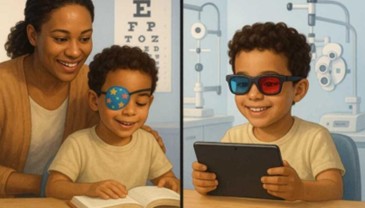 Figure 3: This image shows the traditional patching therapy and binocular digital vision therapy for Amblyopia management.
Image Courtesy: Created by the Author
Clinical Implications
The identification of Amblyopia as a neurodevelopmental condition has changed the way this disease is managed clinically. Besides assessing visual acuity, the assessment of the entire condition should include binocular vision, contrast sensitivity, stereopsis, and cortical vision. There are new methods of rehabilitation involving the use of binocular vision training, perceptual learning, and even virtual reality training, and these have been designed to increase brain plasticity and achieve better visual results (1,2,6)
Conclusion
Amblyopia is currently recognised as being a condition of neurodevelopmental origin, characterised by aberrant cortical activity and binocularity problems as opposed to being a condition with reduced visual acuity. Scientific studies on the subject of neuroscience have proved that neural plasticity exists even in adulthood and thus making the novel approaches to Amblyopia management successful even for a few select adolescents and adults. (1,2,6)
References
- Holmes, J. M., & Clarke, M. P. (2006). Amblyopia. Lancet (London, England), 367(9519), 1343–1351. https://doi.org/10.1016/S0140-6736(06)68581-4
- Levi D. M. (2020). Rethinking amblyopia 2020. Vision research, 176, 118–129. https://doi.org/10.1016/j.visres.2020.07.014
- Birch E. E. (2013). Amblyopia and binocular vision. Progress in retinal and eye research, 33, 67–84. https://doi.org/10.1016/j.preteyeres.2012.11.001
- Hess, R. F., & Thompson, B. (2015). Amblyopia and the binocular approach to its therapy. Vision research, 114, 4–16. https://doi.org/10.1016/j.visres.2015.02.009
- Acar, K., Kiorpes, L., Movshon, J. A., & Smith, M. A. (2019). Altered functional interactions between neurons in primary visual cortex of macaque monkeys with experimental amblyopia. Journal of neurophysiology, 122(6), 2243–2258. https://doi.org/10.1152/jn.00232.2019
- Levi, D. M., & Li, R. W. (2009). Perceptual learning as a potential treatment for amblyopia: a mini-review. Vision research, 49(21), 2535–2549. https://doi.org/10.1016/j.visres.2009.02.010
About the Author

Agila B
Assistant Professor,
Dhanalakshmi Srinivasan University, Chengalpattu, India

Dr. Raghunath N
Junior Resident,
Trackbacks/Pingbacks