
Madhavan Suresh, B. Optom
Consultant Optometrist, The Voluntary Health Services, Chennai, India
Stroke-related visual impairment is often overlooked when visual acuity remains normal. Patients may read the chart well yet struggle with navigation and object detection. This report describes a recurrent occipital stroke causing severe visual field loss and highlights the value of neuro-optometric rehabilitation. (1,2)
Case Presentation
A 43-year-old security guard presented with progressive peripheral vision loss, impaired colour perception, difficulty recognising currency notes, and repeated collisions while walking. He had a history of posterior circulation stroke in 2021, causing right homonymous hemianopia. Following a second stroke, his visual difficulties worsened significantly.
Clinical Findings
Despite these complaints, visual acuity remained 6/6 in both eyes. Ocular examination was unremarkable. Ishihara testing revealed severe Colour Vision Impairment (CVI). Humphrey Visual Field (HVF) testing demonstrated dense bilateral peripheral field loss with preservation of only the central 10° of vision. (4)
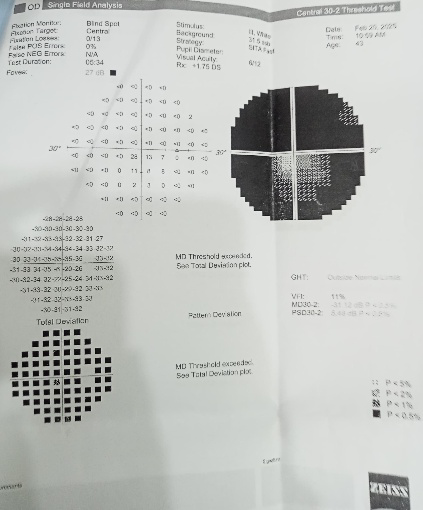
Figure 1: This image shows the HVF 30-2 (Right Eye) showing severe peripheral visual field loss with preservation of the central 10° of vision.
Image Courtesy: Captured by the Author
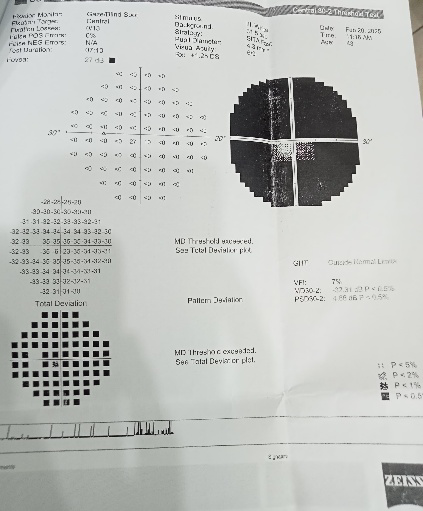
Figure 2: This image shows HVF 30-2 (Left Eye) showing dense peripheral visual field loss with central island sparing.
Image Courtesy: Captured by the Author
Occipital stroke may preserve central vision while causing severe peripheral field loss. Associated Colour Vision deficits suggest cortical involvement, explaining the discrepancy between normal eye findings and functional impairment. Visual field testing is important when stroke patients report mobility difficulties. (4)
Neuro Optometric Rehabilitation
Rehabilitation focused on improving functional independence. Peripheral Fresnel prism segments were prescribed to increase environmental awareness, while a +1.50 D near addition assisted reading and currency identification. Structured scanning training and family counselling supported adaptation and safety. (2,3)
Outcome and Follow-up
Within weeks, prism adaptation improved, and collision frequency decreased. Mobility confidence increased, and family members reported greater independence in activities of daily life. Although colour discrimination remained limited, overall functional performance improved significantly.
Conclusion
This case highlights that recurrent strokes affecting the back part of the brain can cause significant visual difficulties even when eyesight appears normal on routine testing. A severely restricted visual field can have a major impact on mobility, safety, and everyday activities. Comprehensive neuro-optometric assessment, visual field testing, and structured rehabilitation strategies are essential for identifying these challenges and improving functional outcomes. Interventions such as prism therapy and scanning training can help patients regain confidence, independence, and a better quality of life. (2,3,4)
References
- Pambakian, A. L. M., & Kennard, C. (1997). Can visual function be restored in patients with homonymous hemianopia?. British Journal of Ophthalmology, 81(4), 324-328.
- Kerkhoff, G. (2000). Neurovisual rehabilitation: Recent developments and future directions. Journal of Neurology, Neurosurgery & Psychiatry, 68(6), 691–706.
- Bowers, A. R., Keeney, K., & Peli, E. (2008). Community-based trial of a peripheral prism visual field expansion device for hemianopia. Archives of Ophthalmology, 126(5), 657–664.
- Rowe, F. J., Wright, D., Brand, D., Jackson, C., Harrison, S., Maan, T., Scott, C., Vogwell, L., Peel, S., Akerman, N., Dodridge, C., Howard, C., Shipman, T., Sperring, U., MacDiarmid, S., & Freeman, C. (2013). A prospective profile of visual field loss following stroke: Prevalence, type, rehabilitation, and outcome. BioMed Research International, 2013, 719096.
About the Author

Madhavan Suresh
Consultant Optometrist
Recent Comments