
Niladri Pyne, B. Optom Student
Debapriyo Chatterjee, Assistant Professor
NSHM College of Management and Technology, Durgapur, India
In the dimly lit lanes of our clinics, the rhythmic “click-clack” of the phoropter has been the heartbeat of optometry for decades. However, a new sound has recently entered the room: the silent hum of algorithms. As Artificial Intelligence (AI) conquers fields from radiology to retinal screening, a provocative question looms over our profession: Can the algorithmic eye truly replace the art of subjective refraction?
Smart Sight: The Evolution of the Refraction Exam
AI is no longer just a futuristic concept in eye care; it is here, and it is remarkably accurate. By analysing thousands of tiny details about the eye in a heartbeat, these algorithms can predict a prescription just as well as a human specialist. It is a significant advance in making vision care faster and more precise for everyone.
Unlike traditional autorefractors, which often falter with accommodation or media opacities, modern AI models “learn” from vast datasets of fundus images and historical prescriptions. They do not just measure light; they recognise patterns. A study published highlighted that AI sensitivity in detecting refractive errors has surpassed 94%, offering a speed and consistency that a human on a busy Monday morning might struggle to match. (1)
The “Subjective” Paradox
However, refraction is not merely physics; it is psychophysics. This is where the “algorithmic eye” begins to blink.
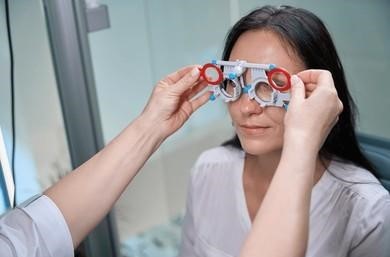
Image 1: This image demonstrates subjective refraction being performed on a patient.
Image Courtesy: https://www.shutterstock.com/image-photo/professional-oculist-conducting-binocular-subjective-260nw-2368366981.jpg

Subjective refraction is inherently subjective. It relies on the perception of patients, which is filtered through their psychology, neural adaptation, and visual history. An AI might calculate that a patient needs a -2.50 DC cylinder to correct their optics perfectly. But if that patient has been happily wearing -1.00 DC for ten years, the “perfect” AI prescription will feel distorted and unwearable. (2)
While AI can predict the optical endpoint, it cannot yet negotiate the prescribing endpoint. As noted in recent reviews on AI in optometry, the technology acts as a “liability sink” if unchecked – it cannot explain why it chose a prescription, leaving the clinician to manage the potential of intolerance of the patient. (3)
The Future: The “Super-Phoropter”
- The “Human” Factor: A computer can calculate a prescription, but it cannot ask how you feel after a long day at your desk or understand your lifestyle needs.
- Precision and Speed: AI cuts through the “Is it better one… or two?” guesswork, getting to the right answer faster.
- Better Outcomes: When doctors have better data, they can make better decisions.
We are moving toward a model of “Augmented Refraction.” Imagine a Phoropter that does not just hold lenses but uses AI to pre-calculate the “starting point” with 99% accuracy, cutting the exam time in half. This allows us, the clinicians, to spend those saved minutes on what machines cannot do: counselling, managing binocular vision anomalies, and fine-tuning the prescription for the lifestyle of patients. (4)
Conclusion
For us students, the rise of AI is not a signal to abandon our retinoscopes, but a call to upgrade our mindset. The “Algorithmic Eye” is sharp, fast, and precise, but it lacks the empathy to ask, “How does that feel?” AI will likely replace the tedium of refraction, but it will not replace the clinician. The prize-winning optometrist of the future will be the one who knows how to wield the algorithm as a tool, ensuring that while the eye is measured by a machine, the vision is cared for by a human.
References
- Buckmaster, F., van Staden, D., & Coetzee, L. (2026). Attitudes and Knowledge Levels of Optometry Students and Educators Towards Artificial Intelligence in Optometric Practice: An Online Cross-Sectional Survey. Ophthalmic and Physiological Optics, 1-10.
- Majithia, S., & Thakur, S. (2024). Artificial Intelligence and Optometry: Transforming Practice and Patient Care. In Current Advances in Optometry (pp. 139-148). Singapore: Springer Nature Singapore.
- Grzybowski, A. (2024). Artificial intelligence in cataract and refractive surgery. Acta Ophthalmologica, 102.
- Gangwar, Mr & Yadav, Mrs & Shukla, Mr & Gupta, Dr. (2025). THE FUTURE OF EYE HEALTH: INTEGRATION OF AI IN OPTOMETRIC PRACTICE. EPRA International Journal of Research & Development (IJRD). 624-632. 10.36713/epra22770.
About the Author

Niladri Pyne
B. Optom Student
NSHM College of Management and Technology, Durgapur, India

Debapriyo Chatterjee
Assistant Professor
Recent Comments