
Lalita Sharma, B. Optom Student,
Noida International University, Greater Noida, India
Keywords
amblyopia, video games, dichoptic.
Declaration of Interest
The blog is written solely for educational purposes, and it does not have any financial support and conflict of interest.
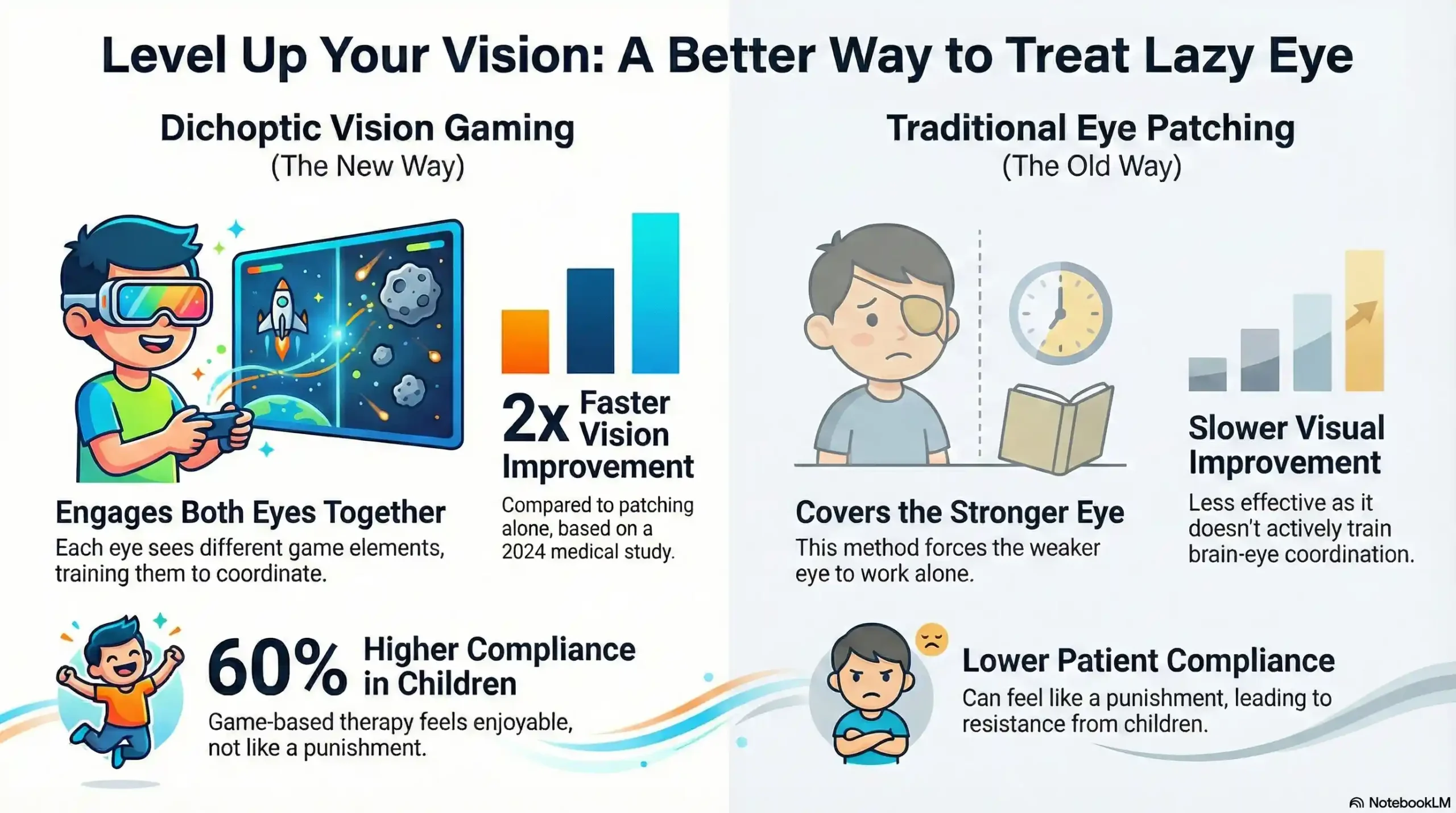
Amblyopia is a visual impairment in which one of the eyes has significantly lower visual acuity than the other eye. A traditional method for the treatment of Amblyopia involves patching the healthy eye to force the Amblyopic eye to work during normal daily activities; however, this technique is limited due to low compliance. In contrast, fast-paced action video games can be exceptionally captivating and have demonstrated significant enhancements in vision and attention in adults with Amblyopia. (1,2)
Why Should We Use Video Games?
Video games are employed in Amblyopia therapy because they increase patient adherence by making treatment more entertaining. Commercial action video games improve visual functions like attention, motion processing, and contrast sensitivity, while also giving constant feedback that promotes learning and brain plasticity. According to studies, adults with Amblyopia improve significantly in visual acuity and other visual skills, making video games an excellent rehabilitation technique. (2)
Types of Video Games
Monocular and dichoptic video games have been used to treat Amblyopia. Monocular video game therapy involves playing visually demanding games like Medal of Honour or SimCity with the amblyopic eye while the fellow eye is patched, which has been found to improve visual acuity and contrast sensitivity. More recent approaches concentrate on dichoptic video games (Tetris), which emerged after binocular gameplay was found to be superior to monocular play in terms of visual acuity and stereopsis. These games have a therapeutic effect by providing different visuals to each eye and rewarding the patient only when both eyes work together. (3)
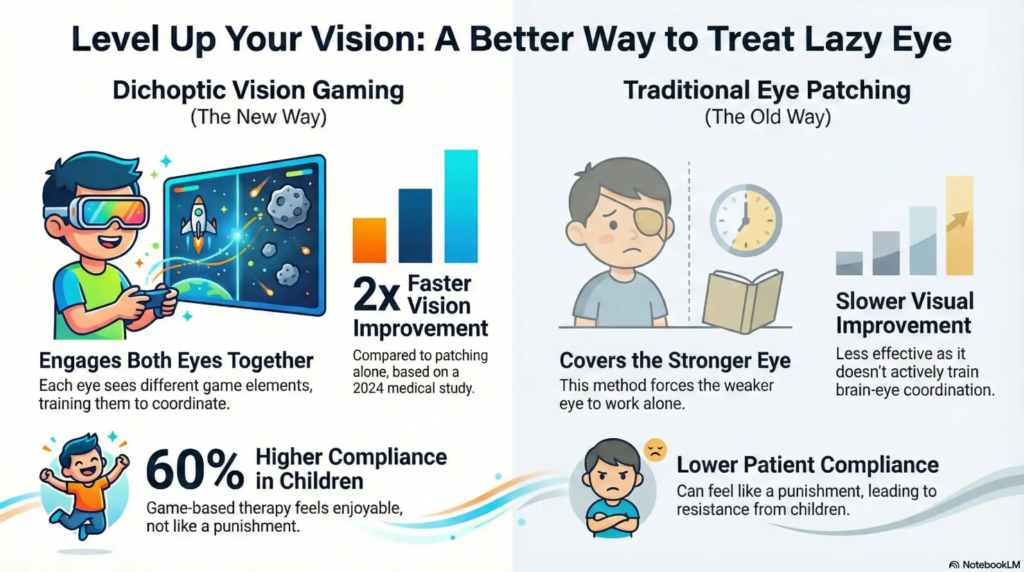
Figure 1: This image illustrates an example of vision therapy as video games.
Image Courtesy: https://www.cookvisiontherapy.com/wp-content/uploads/2026/01/unnamed-4-scaled.webp
Mechanism of Action
Video games have a therapeutic effect in Amblyopia by using the elements that make them enjoyable to play. Their appealing graphics and diverse visual activities necessitate continual visual discrimination, which stimulates the visual pathways more strongly than standard patching alone. Immediate feedback and rewards during gameplay aid to reinforce visual learning and sustain visual attention, enabling the amblyopic eye to be used repeatedly and consistently. Importantly, video games have been demonstrated to improve visual functions such as contrast sensitivity, that is commonly compromised in Amblyopia. (4) This improvement can be long-lasting and indicative of induced brain plasticity. These modifications indicate that video games can help in brain adaptation and improve visual processing across a variety of visual functions, potentially more effectively and quickly than traditional therapies alone. (3)
Conclusion
In conclusion, the use of video games in the treatment of Amblyopia represents a promising shift from passive and compliance-dependent therapies to engaging, neuroscience-driven vision rehabilitation. By harnessing visual stimulation, feedback, and brain plasticity, video game–based therapy not only improves visual acuity and contrast sensitivity but also enhances binocular cooperation in a more enjoyable and sustainable manner. As research continues to evolve, video games may emerge as an effective adjunct or alternative to conventional Amblyopia treatments, marking a new era of patient-friendly and evidence-based vision therapy.
References
- Fu, E., Wang, T., Li, J., Yu, M., & Yan, X. (2022). Video game treatment of Amblyopia . Survey of Ophthalmology, 67(3), 830-841.
- Gambacorta, C., Nahum, M., Vedamurthy, I., Bayliss, J., Jordan, J., Bavelier, D., & Levi, D. M. (2018). An action video game for the treatment of Amblyopia in children: a feasibility study. Vision research, 148, 1-14.
- Xu, C. S., Chen, J. S., & Adelman, R. A. (2015). Video game use in the treatment of Amblyopia : weighing the risks of addiction. The Yale journal of biology and medicine, 88(3), 309.
- Li, R., Polat, U., Makous, W., & Bavelier, D. (2009). Enhancing the contrast sensitivity function through action video game training. Nature neuroscience, 12(5), 549-551.
About the Author

Lalita Sharma
B. Optom Student,
Recent Comments