
Priyadharshini S, M. Optom. Student ,
Bharghavy S, Assistant Professor
Dr. Agarwals Institute of Optometry, Chennai, India
Keywords
retinal dopamine, myopia, emmetropisation, outdoor light, axial elongation
Declaration of Interest
The blog is written solely for educational purposes, and it does not have any financial support and conflict of interest.
Overview
Imagine two children of the same age, one spends several hours playing outdoors, while the other spends most of the day indoors. Beyond lifestyle differences, their exposure to light may influence an important retinal chemical dopamine which is involved in regulating eye growth and Myopia. Dopamine acts as a neuromodulator in retinal neurons, influencing visual processing and eye growth. (1,4) Evidence suggests it supports emmetropisation, where the eye adjusts axial length for clear focus through light-dependent retinal signalling. (1,4,5) Reduced dopamine activity has been linked to excessive axial elongation and Myopia development. (2,3) Studies in chick models show bright light increases retinal dopamine and suppresses Myopia progression, supported by human studies showing outdoor activity lowers Myopia risk. (3)
Introduction
The retina is a specialised neural tissue that converts light into electrical signals for the brain. Besides phototransduction, retinal neurons release neurotransmitters involved in visual processing and ocular development. (4) Dopamine is a key neurotransmitter regulating retinal adaptation and eye growth. (1,4) Recent research indicates dopamine signalling may contribute to the increasing global prevalence of Myopia, (2) especially among children and adolescents in urban populations, through its influence on refractive development and axial eye growth.
Dopamine in the Retina
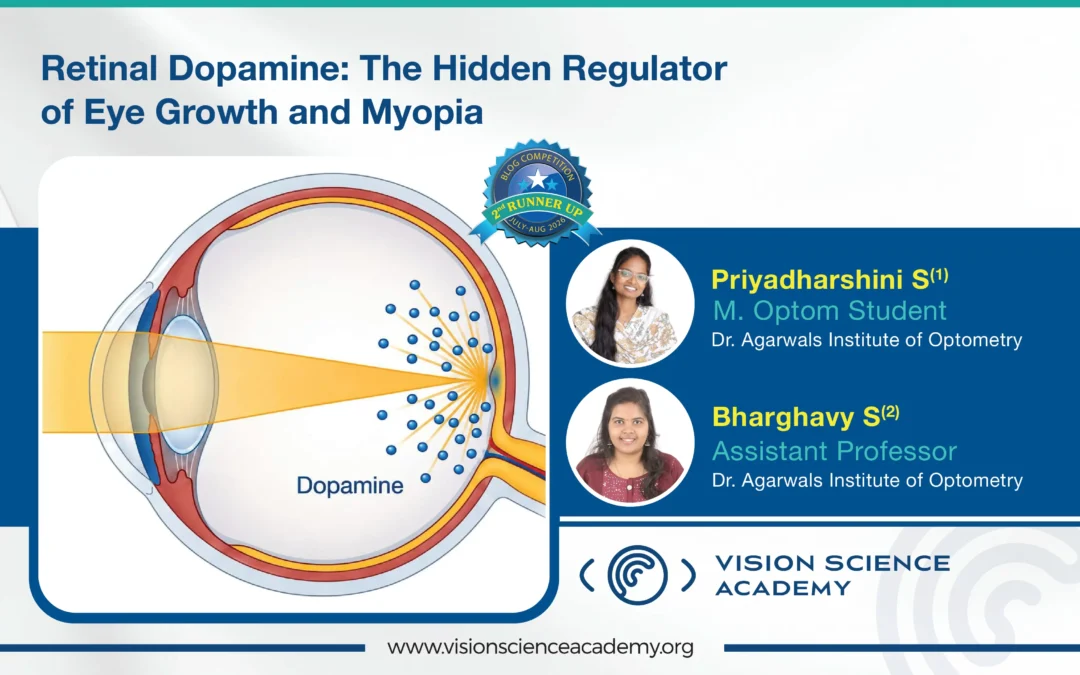
Dopamine in the retina is mainly released by dopaminergic amacrine cells located in the inner nuclear layer (INL), acting through D1 and D2 receptors. These cells interact with bipolar and ganglion cells to regulate retinal neural signalling. (4) Dopamine regulates light adaptation, circadian rhythm, and retinal neuronal communication. (1,4)
Neural Signalling Mechanism
Light exposure stimulates dopamine release, while darkness or dim light reduces dopamine activity. (1) In darkness, reduced signalling from photoreceptors lowers activation of bipolar and dopaminergic amacrine cells. As a result, dopamine levels remain lower at night and increase during daylight. (1,4,5) Photoreceptors transmit visual signals to bipolar cells, which then activate dopaminergic amacrine cells. The released dopamine supports retinal communication and visual adaptation
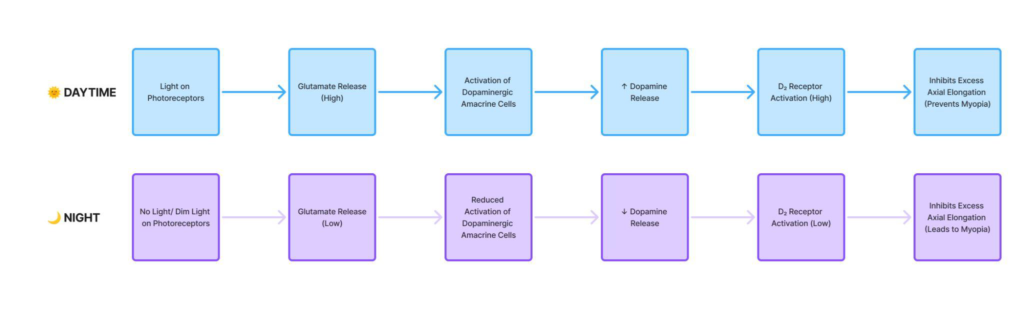
Figure 1: This image shows the proposed retinal dopamine signalling mechanism during daylight and darkness
Image Courtesy: Created by Author
Role in Regulating Eye Growth
Dopamine functions as an inhibitory signal, through D2 receptor activation, that helps prevent excessive ocular elongation during emmetropisation. (3) The eye adjusts axial length to maintain proper retinal focus. Dopamine-mediated retinal signalling regulates axial growth by processing retinal defocus signals: hyperopic defocus lowers dopamine release and promotes elongation, whereas myopic defocus increases dopamine activity and suppresses growth. (1,3,5)
Dopamine Deficiency and Myopia Development
Experimental studies show that reduced dopamine activity can cause abnormal eye growth. (1,3) Low-light conditions and limited outdoor exposure decrease retinal dopamine levels, which may contribute to Myopia progression. (2) Reduced sunlight exposure is an important contributor to increasing Myopia prevalence worldwide. (2)
Clinical Implications
Dopamine-related Myopia prevention strategies emphasise increased outdoor activity and sunlight exposure. (2) Studies including the Sydney Myopia Study and Singapore Cohort reported that children spending more than two hours outdoors daily showed reduced Myopia onset and slower progression. Outdoor light increases retinal dopamine activity and may protect against excessive eye growth. (1,2)
Conclusion
Current Myopia management strategies include increased outdoor activity, low-dose atropine, multifocal contact lenses, orthokeratology lenses, and Myopia-control spectacle lenses. (1,2) Although these approaches may slow Myopia progression, challenges such as side effects, treatment duration, and accessibility still remain. Further research is needed to improve the long-term safety and effectiveness of Myopia management in children.
References
- Feldkaemper M, Schaeffel F. An updated view on the role of dopamine in myopia. Exp Eye Res. 2013;114:106-119.
- Morgan IG, Ohno-Matsui K, Saw SM. Myopia. Lancet. 2012;379(9827):1739-1748.
- Nickla DL, Totonelly K. Dopamine antagonists and brief vision distinguish lens-induced- and formdeprivation-induced myopia. Exp Eye Res. 2011;93(5):782-785.
- Zhou X, Pardue MT, Iuvone PM, Qu J. Dopamine signalling and myopia development: What are the key challenges. Prog Retin Eye Res. 2017;61:60-71.
- Norton TT, Siegwart JT Jr. Light levels, refractive development, and myopia – a speculative review. Exp Eye Res. 2013;114:48-57.
About the Authors

Priyadharshini S
M. Optom Student ,
Dr. Agarwals Institute of Optometry, Chennai, India

Bharghavy S
Assistant Professor ,
Recent Comments