
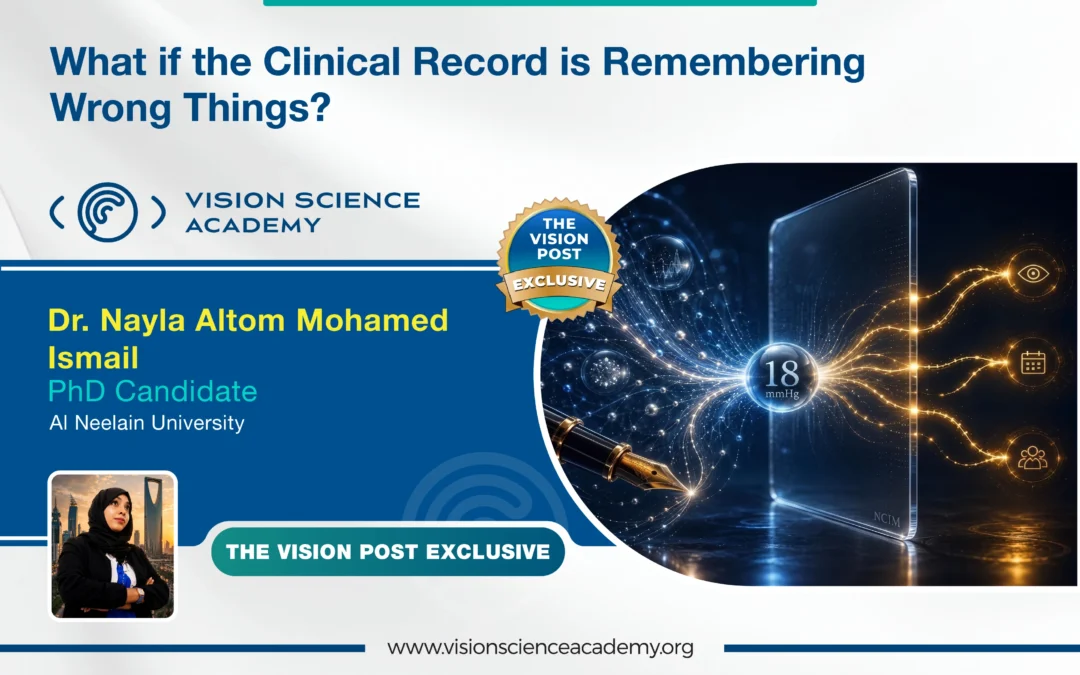
Dr. Nayla Altom Mohamed Ismail, M. Optom,
PhD Candidate, Al Neelain University, Khartoum, Sudan
Beyond Data Capture: Rethinking What Clinical Intelligence Should Preserve
Healthcare has become remarkably good at remembering. Electronic health records now preserve years of diagnoses, medications, laboratory results, imaging, referrals, procedures, and encounters. Artificial Intelligence (AI) can search, summarise, and name patterns across this expanding clinical memory. Yet the ability to preserve information is fundamentally different from the ability to preserve its clinical meaning. (1)
But there is a more fundamental question we rarely ask: Are we remembering the right things?
A clinical record may remember that a patient’s intraocular pressure was 18 mmHg. It may preserve visual acuity, medications, and earlier diagnoses. But does it remember why 18 mmHg mattered, or did not matter, for that particular patient at that particular moment? Does it preserve which possibilities the clinician considered but rejected? Does it remember how uncertain the clinician was? Does it preserve the risk that changed the threshold for action? These are not questions about data storage. They are questions about the difference between clinical memory and clinical intelligence. (2)
We Digitised the Record, Not the Reasoning
For decades, healthcare digitisation has captured what happened: observations, diagnoses, orders, and outcomes. This was necessary. But a clinical decision is rarely the product of a single data point. The same measurement carries different meanings in different patients. Clinical reasoning does not ask: What does the record have? It asks: What does this information mean in this context, how uncertain are we, and what should happen next?
Much of that intellectual pathway disappears once the encounter is reduced to its final documentation. The record remembers the destination. It does not remember the journey that made the destination defensible. (3)
The Missing Layer
This distinction becomes critical as AI enters clinical environments. If an AI system learns from records that preserve observations and final decisions but not the reasoning between them, we must ask what exactly the system is learning. More data alone does not solve this problem. Scaling an incomplete representation does not make it complete. When key history is missing, AI models often do not recognise uncertainty, they confidently reason over an incomplete record. (1)
The challenge for the next generation of clinical systems is fundamentally different. The question may no longer be simple: How do we capture more clinical information? It must become: How do we preserve the meaning that connects information to decisions? That means thinking beyond diagnoses and measurements toward context, hypotheses, uncertainty, risk, and the relationships between them. (4)

Figure 1: This image is a conceptual representation of the gap between multidimensional clinical information and its representation in recorded data for clinical decision-making.
Image Courtesy: AI-generated image created by the author using OpenAI
The Diagnosis Is Not the Decision
A diagnosis is a name. A decision is a responsibility. Between them lies one of the most important, and least preserved, spaces in clinical systems: reasoning under uncertainty. Two patients may carry the same diagnosis and require different decisions. Two clinicians may see the same data and reasonably reach different conclusions, not because one is wrong, but because clinical meaning appears from relationships, not isolated data points.
Diagnostic uncertainty commonly arises when clinical notes lack sufficient evidence for a definitive diagnosis. Studies confirm that missing clinical information is prevalent across primary care and emergency settings, increasing the risk of misdiagnosis. (5)
A Finding Has No Meaning Alone
Consider an intraocular pressure of 18 mmHg. The number is correct. From a data integrity perspective, nothing is missing. Clinically, almost everything that decides its significance may be absent. What was the patient’s earlier pressure? What is the optic nerve appearance? Is there asymmetry? What would be the consequence of waiting if the current interpretation were wrong?
The number 18 has not changed. Its clinical meaning has. The absence of context is not a minor limitation, it is the dominant reason AI systems cannot decide what a finding truly means. Missing critical clinical features and conflicting features account for the vast majority of uncertain AI responses. (6)
Intelligence Lives Between Things
Much of digital medicine is organised around entities: symptoms, diagnoses, lab results, images, medications. These are necessary. But intelligence does not live primarily inside them. It lives between them. Between today’s observation and yesterday’s. Between a finding and the absence of another expected finding. Between probability and consequence. Between uncertainty and the threshold for action.
Clinical intelligence is not the accumulation of facts. It is the preservation of the relationships that give those facts meaning. Medicine is not a catalogue of facts; it is a continuous interpretation of relationships. (2)
Uncertainty Is Not Missing Data
Digital systems treat uncertainty as a gap to be eliminated. Clinical practice teaches otherwise. Sometimes uncertainty itself is information. A clinician may not know what a finding is yet knows that it cannot safely be ignored. Sometimes the most intelligent representation is: We do not know yet, but we know what cannot be missed.
Large language models stay poorly calibrated to real-world clinical probabilities and struggle to manage evolving information. Models that prioritise final exam-style answers miss the core clinical work of uncertainty management. (7,8)
Risk Changes the Meaning of Uncertainty
Uncertainty alone does not decide action. Risk does. Two hypotheses may be equally unlikely. One carries little consequence if reassessment is delayed. The other carries the possibility of irreversible harm. Their clinical significance is not equivalent. The consequence of being wrong changes the threshold for action.
Clinical intelligence must ask more than: What is most likely? It must ask: What is most dangerous to miss? And then: What action is justified given both? This is the transition from prediction to responsibility. (9)
The Decision is a Moment; Reasoning is a Path
A referral is a decision. So is observation. But the last action tells us little about the reasoning that produced it. If we preserve only the decision, future systems may know what happened without understanding why it was reasonable at the time. Medicine is practiced forward but often judged backward. A decision that appears incorrect retrospectively may have been entirely defensible given the information available at that moment.
Outcome alone cannot reconstruct reasoning. Evaluating AI reasoning on clinical notes reveals that structured reasoning failures, confirmation bias, anchoring, and omission errors, are strongly linked to potentially harmful outputs. Endpoint accuracy alone masks clinically meaningful reasoning failures. (10)
AI Should Not Become More Certain Than the Medicine
Intelligent systems are built to produce answers. Medicine sometimes needs restraint. A clinically responsible system should recognise when evidence does not support certainty. It should not convert ambiguity into confidence simply because an output is expected. Intelligence should never become more certain than medicine allows.
The Clinical Uncertainty Risk Alignment (CURA) framework addresses this by training clinical language models to calibrate their uncertainty estimates, reducing overconfidence and assigning higher uncertainty to difficult high-risk cases to prioritise clinician review. (9)
When AI Inherits the Record, It Inherits Its Blind Spots
AI inherits our records. It learns from the labels we assigned and the decisions we chose to preserve. If the clinical record preserves only part of clinical reality, AI may inherit not only our knowledge, but also the structure of what we did not preserve. The data may be entirely correct and still represent an incomplete clinical reality.
Misinterpretation of complex clinical data is the leading risk when AI runs without oversight. This misinterpretation starts long before AI, it begins when clinical data is documented, translated, and entered into different systems, losing details at each step. (11) Furthermore, “Clinical Model Autophagy” describes a systemic degradation where recursive AI models trained on incomplete data regress toward statistical means, erasing rare pathological variances and homogenising complex diseases.(12) The open real-world data needed to measure these blind spots often does not exist. (12)
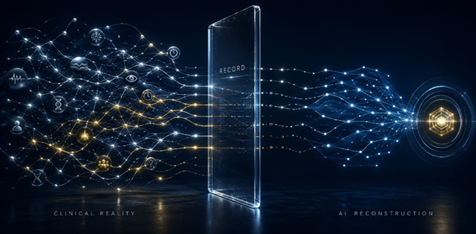
Figure 2: This image is a conceptual representation of how AI reconstruction of clinical reality may inherit the representational limitations of the clinical record.
Image Courtesy: AI-generated image created by the author using OpenAI
From Artificial Intelligence to Accountable Intelligence
The ultimate goal may not be an AI that always knows. It may be an intelligence that distinguishes what was seen from what was inferred, what is still uncertain, what could cause serious harm, and why a threshold for action was crossed. Such a system would preserve the clinical logic that makes its recommendations interpretable.
That moves us from AI toward something more demanding: accountable clinical intelligence, not intelligence measured only by reaching the right answer, but by preserving the conditions under which its answer deserves to be trusted. (2)
The Patient Must Not Disappear Inside the Intelligence
Perhaps this is the boundary clinical intelligence must never cross: The patient must never become secondary to the model designed to understand them. The purpose of intelligent healthcare is not to make the patient fit the system. It is to build systems disciplined enough to remain answerable to the patient.
This article draws on principles from the ongoing development of the NILOFAR Clinical Intelligence Model (NCIM).
References
- IKS Health. AI in Healthcare Has a Data, Not Intelligence, Problem. IKS Health Insights. 2026.
- CARE-ACE Framework. Engineering Agentic Context for Trustworthy Clinical Autonomy. Communications of the ACM. 2026.
- Tao G, Wang S, Xue Y, et al. Operation-Mechanism Alignment for Reliable Clinical Reasoning over Electronic Health Records. BioNLP, ACL Anthology. 2026.
- Yi I, Brown G, Aldogom S, et al. Beyond Prediction: Longitudinal Reasoning in EHR-Integrated Clinical AI. arXiv. 2026.
- Zhou S, Wang J, Xu Z, et al. Uncertainty-Aware Large Language Models for Explainable Disease Diagnosis. npj Digital Medicine. 2025; 8:690.
- Zhou S, Wang J, Xu Z, et al. Uncertainty-Aware Large Language Models for Explainable Disease Diagnosis. npj Digital Medicine. 2025; 8:690.
- Kaltwasser J. Overcoming the Overconfidence Problem. Managed Healthcare Executive. 2026. (managedhealthcareexecutive.com)
- Grounding Large Language Models in Clinical Diagnostics. Nature Communications. 2026. (Nature)
- Wang S, Xu Z, Najjuuko C, Alba C, Lu C. CURA: Clinical Uncertainty Risk Alignment for Language Model-Based Risk Prediction. arXiv. 2026.
- Kenaston MW, Ayub U, Parmar M, et al. Structured Reasoning Failures Compromise LLM Interpretation of Clinical Oncology Notes. npj Digital Medicine. 2026. doi:10.1038/s41746-026-02951-5.
- Dover B. Clinical Data Fidelity: The Real Blindspot in Healthcare AI Strategy. HIT Consultant. 2026.
- Shih PF. Clinical Model Autophagy: The Risk of Interpretative Drift in Recursive Medical AI. JMIR Medical Informatics. 2026;14: e94813. doi:10.2196/94813.
- Stummer FO. Invisible at the Edges: The Unborn and the Family in Clinical-AI Data. Cambridge Open Engage. Working Paper. 2026. doi:10.33774/coe-2026-6gs8x. (ResearchGate)
Recent Comments