
Naina Jawed, B. Optom Student
Manipal Academy of Higher Education, Jamshedpur, India
Myopia has become a major public health concern with long-term visual and ocular effects due to its global rise. (1) With the goal to predict future refractive outcomes and guide care choices, Myopia risk calculators and progression prediction tools have become more widely used in clinical settings. Although these tools provide structured, data-driven insights, their application to realistic clinical decision-making needs to be carefully re-evaluated.
What Myopia Risk Calculators Aim to Do?
Myopia risk calculators are designed to determine the likelihood and rate of Myopia progression based on traits such as age, baseline refractive error, parental history, and environmental factors. (2) Clinicians may utilise these techniques to help improve risk assessment, patient counselling, and early interventions including optical or pharmaceutical control methods. Theoretically, these calculators will improve uniformity and objectivity. However, in realistic terms, the outcome often indicates predictive estimations rather than conclusions that may be used in therapeutic settings.
The disparity between statistical risk estimation and personalised patient management underlines the limits of relying entirely on predictive models (see Figure 1).
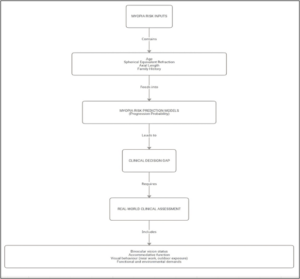
Figure 1: This image shows the gap between Myopia risk prediction models and real-world clinical decision-making.
Limitations In Real-World Clinical Use
The reliance of Myopia risk calculators on population-based data is a primary disadvantage. Individual variations in visual behaviour, accommodation patterns, binocular vision status, or adherence to suggested therapies may not be appropriately taken into account by predictions made from averaged datasets. In addition, calculators often overlook functional visual factors including contrast sensitivity, visual comfort, and near work performance in favour of refractive advancement as the primary objective. These elements are crucial in determining the actual visual experience of a patient and may have an impact on treatment satisfaction and compliance. Another risk is the possibility for over-reliance on numerical findings. Risk assessments may unknowingly overpower clinical judgement when viewed in isolation, leading to rigid decision-making rather than individualised care.
Moving Towards a Balanced Approach
Instead of rejecting Myopia risk calculators, their best application is merging. Combining predictive technology with thorough clinical evaluation, patient education, and regular monitoring can improve decision-making while maintaining individualised care.
This is further supported by the International Myopia Institute (IMI) 2023 update, whichpromotes treatment selection that takes into account patient specific lifestyle factors, practitioner skill, and numerical risk. (3)
Conclusion
Myopia risk calculators can be beneficial for understanding progression patterns, specifically in light of the expanding global burden of Myopia. However, their limitations emphasise the necessity of clinician-led interpretation. Effective Myopia management expands beyond numerical forecasts and needs a balanced approach which includes data-driven methods, accurate clinical judgement, and patient-centred attention.
References
- Holden, B. A., Fricke, T. R., Wilson, D. A., Jong, M., Naidoo, K. S., Sankaridurg, P., … & Resnikoff, S. (2016). Global prevalence of Myopia and high Myopia and temporal trends from 2000 through 2050. Ophthalmology, 123(5), 1036-1042.
- Chua, S. Y., Sabanayagam, C., Cheung, Y. B., Chia, A., Valenzuela, R. K., Tan, D., … & Saw, S. M. (2016). Age of onset of Myopia predicts risk of high Myopia in later childhood in myopic Singapore children. Ophthalmic and Physiological Optics, 36(4), 388-394.
- Sankaridurg, P., Berntsen, D. A., Bullimore, M. A., Cho, P., Flitcroft, I., Gawne, T. J., … & Wolffsohn, J. S. (2023). IMI 2023 digest. Investigative Ophthalmology & Visual Science, 64(6), 7-7.
About the Author

Naina Jawed
Optom Student,
Recent Comments