
Dannon Boluwatife Rebecca, Doctor of Optometry Student
600-Level Doctor of Optometry Student, University of Ilorin, Ilorin, Nigeria
Think about how hard it would be to catch a ball, walk downstairs, or pour water if everything looked flat. We do not usually notice it. Depth perception affects almost everything we do. Even though the images on our retinas are flat, our brains turn them into a three-dimensional world.
How Does This Happen?
Depth perception is an impressive feature of our visual system. It helps us judge how far away things are, where they are, and how they are arranged. This lets us move around safely and connect with our surroundings. Even though our eyes only get flat images, the brain works constantly to turn this information into a sense of depth and space. This relies on the teamwork of our eyes, visual pathways, and higher brain centres. (1)
Learning how depth perception works helps us understand binocular vision, how our vision develops, and many eye conditions seen in vision care.
Why Two Eyes Are Better Than One
Human beings possess two front-facing eyes separated by approximately 6 centimeters. This arrangement provides overlapping visual fields and allows each eye to view the same object from a slightly different angle. (7)
Since each eye sees from a slightly different spot, the images on our retinas are not the same. This is called retinal disparity or binocular disparity. Instead of causing confusion, the brain uses these small differences to figure out depth. (3, 4)
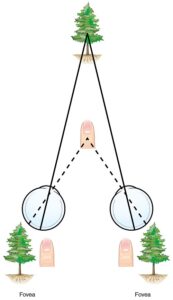
Figure 1: This image shows the Illustration of retinal disparity showing how a near object (finger) and a distant object (tree) are projected onto different retinal locations in the two eyes.
Image Courtesy: https://upload.wikimedia.org/wikipedia/commons/thumb/7/79/1423_Retinal_Disparity.jpg/500px-1423_Retinal_Disparity.jpg

Both eyes send visual information to the visual cortex. Special brain cells there compare the images. The brain merges these two images into one. It figures out distance and location simultaneously. This sense of depth from binocular disparity is called stereopsis. (3, 4)
Stereopsis: The Depth Calculator of the Brain
Stereopsis represents the highest level of binocular vision and is often regarded as the gold standard for depth perception. (2)
Objects at different distances create different amounts of retinal disparity. Close objects cause bigger differences, while far objects cause smaller ones. Neurons in the visual cortex can spot these differences and turn them into useful information about space. (3, 4)
Studies show that some neurons in the primary visual cortex and other brain areas are sensitive to disparity. These neurons respond to certain levels of binocular disparity, helping the brain build an accurate Three-Dimensional (3D) picture of the world. (3)
Human stereopsis is very precise. In perfect conditions, people can notice tiny differences in depth, measured in seconds of arc. This sensitivity lets us perform tasks that require fine depth judgment, like threading a needle, catching something, performing surgery, or playing sports. (5)
Beyond Stereopsis: Other Depth Cues
Stereopsis gives us strong depth information, but it is not the only way the brain judges depth. Our brains use many visual cues together to build a clear sense of space. (6)
Monocular depth cues also help, even if you are using just one eye. These cues include relative size, linear perspective, overlapping objects, changes in texture, light and shadow, and motion parallax. (6)
For example, train tracks seem to come together in the distance, even though they are parallel. Also, when you move, nearby objects seem to move faster across your view than faraway ones. The brain uses these cues to judge depth and distance.

Figure 2: This image shows the railway tracks illustrate linear perspective, a monocular depth cue in which parallel lines appear to converge in the distance.
Image courtesy: https://unsplash.com/@schxndr
These monocular cues are especially important for people with weak stereopsis or vision in only one eye. Many people who lose binocular vision learn to depend on these other cues to get around safely.
Development of Depth Perception
We are not born with depth-perception, it develops as our visual system matures. Stereopsis usually begins to appear in the first few months of life and continues to improve during childhood. (2, 7)
For normal development, both eyes need to send clear and balanced images to the brain during key growth periods. Problems such as strabismus, anisometropia, and amblyopia can disrupt this process and lead to reduced or lost stereopsis. (7)
The developing visual system is very adaptable, so neural connections can get stronger with the right visual experiences. That is why early diagnosis and treatment of binocular vision problems are so important for keeping good stereopsis and the best possible vision.
When Depth Perception Fails
Problems with binocular vision can make daily life much harder. People with poor stereopsis commonly struggle to judge distances, move around new places, play sports, or do tasks that need good hand eye coordination. (8)
People with strabismus might ignore input from one eye to avoid seeing double, which lowers their stereopsis. In the same way, Amblyopia can impair binocular vision even if treatment improves visual acuity. (7)
The effects of poor depth perception go beyond what tests can measure. Reduced stereopsis can impact driving, work, getting around, and overall quality of life. This shows why thorough binocular vision checks are so important in Optometry. (2)
Clinical Assessment of Stereopsis
Testing stereopsis remains an important part of assessing binocular vision. There are several clinical tests to measure stereoacuity and see how well binocular vision is working.
Some common tests are the Titmus Fly Test, Randot Stereo Test, TNO Stereo Test, and Frisby Stereo Test. These tests assess how well a person can detect binocular disparity and the smallest depth difference they can perceive. (2)
Measuring stereoacuity gives useful information about binocular vision and can help diagnose and manage conditions like Amblyopia, strabismus, convergence insufficiency, and other binocular vision problems. (2, 7)
Since stereopsis depends on both eyes working together, it is a good sign of overall binocular visual health.
Advances in Understanding Three-Dimensional Vision
Recent advances in neuroscience and imaging are helping us better understand how the brain processes depth. Brain scans show that several brain areas are involved in stereoscopic processing, so depth perception relies on a network rather than a single visual centre. (3)
Virtual reality and augmented reality now let us study binocular vision in controlled ways. These tools are being used more in research and clinics to look at visual perception, rehabilitation, and training. (9,10)
New research is exploring how stereopsis, visual attention, perceptual learning, and neural plasticity interact to shape visual performance throughout life. (9)
Conclusion
Depth perception is a fascinating aspect of visual processing that often goes unnoticed in our daily experiences. Think about it: when you reach for your coffee cup, step off a curb, or dodge a flying ball, your brain is already calculating various cues like retinal disparity without you even realising it.
This seamless operation is precisely why it is so vital to recognise. For individuals encountering challenges with stereopsis, whether it be from conditions like strabismus or amblyopia, or even the inevitable effects of aging, the struggle is far beyond what appears on a visual acuity chart. They are faced with a world that requires a conscious level of effort for tasks that many of us carry out instinctively.
As research advances in understanding the interplay between disparity, attention, and learning within the brain (9),
we can anticipate improvements in the clinical tools available for assessing and enhancing depth perception. But for now, it is crucial to take a moment to appreciate the remarkable feat your brain achieves every time you gauge the distance to an object. This ability may seem trivial, yet it is one of the most extraordinary functions your brain performs tirelessly throughout the day.
References
- Read JCA. Early computational processing in binocular vision and depth perception. Prog Biophys Mol Biol. 2005;87(1):77–108.
- O’Connor AR, Tidbury LP. Stereopsis: Are we assessing it in enough depth? Clin Exp Optom. 2018;101(4):485–494.
- Cumming BG, DeAngelis GC. The physiology of stereopsis. Annu Rev Neurosci. 2001; 24:203–238.
- Qian N. Binocular disparity and the perception of depth. Neuron. 1997;18(3):359–368.
- McKee SP, Taylor DG. The precision of binocular and monocular depth judgments in natural settings. J Vis. 2010;10(10):5.
- Doran M, et al. The perception of depth. In: Webvision: The Organization of the Retina and Visual System. Salt Lake City: University of Utah Health Sciences Center; 2005.
- Bhola R. Binocular Vision Tutorial. Department of Ophthalmology and Visual Sciences, University of Iowa; 2006 [cited 2026 Jun 13]
- Howard IP, Rogers BJ. Seeing in Depth. Vol. 2. Toronto: I. Porteous; 2002.
- Railo H, Saastamoinen J, Kylmälä S, Peltola A. Binocular disparity can augment the capacity of vision without affecting subjective experience of depth. Sci Rep. 2018;8:15798.
- Guo M, Yue K, Hu H, Lu K, Han Y, Chen S, Liu Y. Neural research on depth perception and stereoscopic visual fatigue in virtual reality. Brain Sci. 2022;12(9):1231.
About the Author

Dannon Boluwatife Rebecca
600-Level Doctor of Optometry Student,
Recent Comments