
Kamesh M, B. Optom Student ,
IIVM College of Optometry, Coimbatore, India
Keywords
prescription, vision, contrast, tear film
Declaration of Interest
The blog is written solely for education purposes, and it does not have any financial support and conflict of interest.
Introduction
Two patients can receive the same refractive prescription and achieve similar visual acuity, yet describe very different visual experiences. One may report effortless, comfortable vision, while the other may notice eyestrain, fluctuating clarity or difficulty during visually demanding tasks. This is because a prescription corrects refractive defocus, but it does not fully describe visual function or the quality of the retinal image.
A Prescription Is Not the Whole Story
Visual acuity mainly measures the ability to resolve high-contrast detail under defined test conditions. Functional vision is broader and depends on how the eyes focus and work together. Accommodative and binocular vision disorders can occur alongside refractive errors, meaning that clear distance acuity does not necessarily exclude difficulty with near visual tasks. (1)
What Can Make the Experience Different?
| Factor | What may differ | Possible visual effect |
| Binocular and accommodative function | Accommodation, vergence and fusional control | Eyestrain or difficulty sustaining near work |
| Contrast sensitivity | Ability to detect low-contrast detail | Reduced performance in low-contrast conditions |
| Ocular optical quality | Higher-order aberrations and pupil-related effects | Changes in retinal image quality despite corrected defocus |
| Tear-film stability | Surface regularity and tear-film quality | Fluctuating vision, glare or visual discomfort |
Table 1: Factors that can contribute to different visual experiences despite the same refractive prescription.
Binocular and accommodative function: A clinical population study found accommodative and/or non-strabismic binocular dysfunctions in 32% of non-presbyopic patients, showing why refraction alone may not explain near-vision complaints. (1)
Contrast sensitivity: Two patients with comparable high-contrast acuity may not have identical ability to detect subtle luminance differences. Contrast sensitivity therefore adds information about functional vision that a standard acuity chart cannot provide. (2)
Ocular optical quality: Higher-order aberrations can affect retinal image quality even after conventional spherical and cylindrical errors are corrected. Accommodation can also alter higher-order aberrations and retinal image quality. (3)
Tear-film stability: The tear film is part of the eye’s optical system. Research in computer users has demonstrated relationships among tear-film quality, ocular aberrations, visual performance and visual symptoms, illustrating how visual quality can vary even when the refractive prescription remains unchanged. (4)
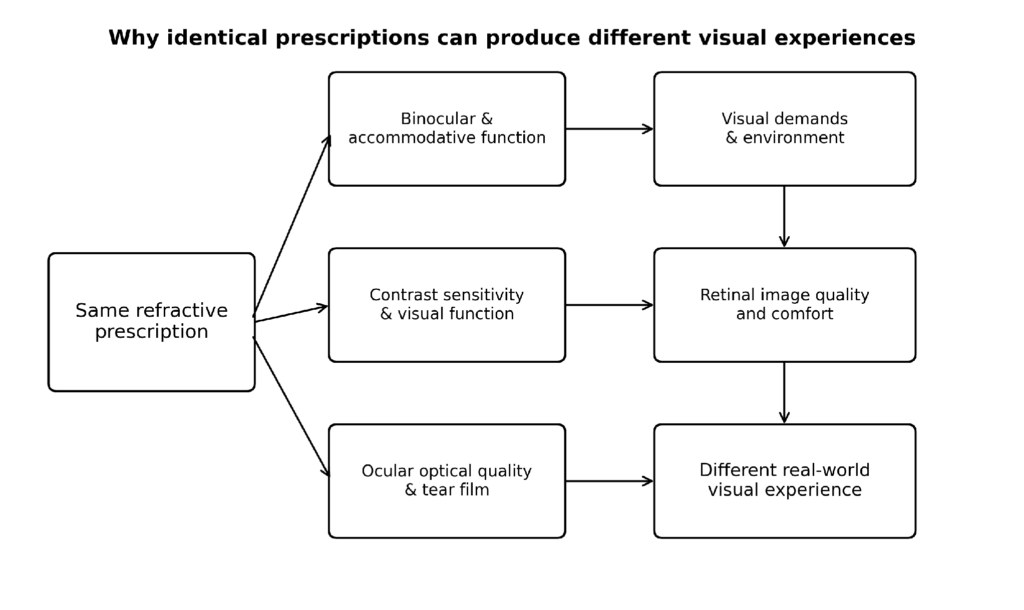
Figure 1: Conceptual overview of how the same refractive prescription can be associated with different visual experiences through differences in visual function, ocular optical quality and visual demands. Original figure prepared for this article.
Image Courtesy: Created by Author
Why This Matters in Optometric Practice
When a patient reports that vision is “not quite right” despite a seemingly satisfactory refraction, the next step need not be another change in spherical or cylindrical power alone. The optometrist should consider the patient’s symptoms, binocular and accommodative function, contrast performance, ocular surface and the visual demands of daily activities. This broader assessment can help explain why two patients with the same prescription may not experience vision in the same way.
Conclusion
A refractive prescription tells us how to correct optical defocus, not how a person experiences vision. Differences in binocular function, contrast sensitivity, ocular optical quality and tear-film stability can all influence functional vision. Moving beyond the prescription and considering the patient’s visual needs can therefore make optometric care more individualised and clinically meaningful.
References
- Franco S, Moreira A, Fernandes A, Baptista A. Accommodative and binocular vision dysfunctions in a Portuguese clinical population. Journal of optometry. 2022 Oct 1;15(4):271-7.
- Zhuang X. More than 20/20: the contrast sensitivity function. Annals of Eye Science. 2022 Dec 15;7(1):32-.
- Hughes RP, Read SA, Collins MJ, Vincent SJ. Higher order aberrations and retinal image quality during short-term accommodation in myopic and non-myopic children. Ophthalmic and Physiological Optics. 2023 Jul;43(4):827-41.
- Talens‐Estarelles C, Mechó‐García M, McAlinden C, Cerviño A, García‐Lázaro S, González‐Méijome JM. Changes in visual function and optical and tear film quality in computer users. Ophthalmic and Physiological Optics. 2023 Jul;43(4):885-97.
About the Author

Kamesh M
B. Optom Student,
Recent Comments