
Lalita Sharma, B. Optom Student
Noida International University, Greater Noida, India
Three-Dimensional (3D) display technologies, including optical see-through near-eye displays, are becoming increasingly popular in vision research, remote device operation, medical imaging and treatment, surgical training, scientific visualisation, education, tourism, entertainment, and virtual prototyping. These technologies strive to improve depth perception and create immersive visual experiences that closely match real-world viewing situations. However, most traditional 3D, Virtual Reality (VR), and Augmented Reality (AR) systems use fixed focal plane optics, which deviate from natural visual perception. As a result, continuous use of such displays puts additional strain on the binocular visual system, perhaps leading to visual discomfort. One of the most significant visual issues connected with immersive 3D displays is Vergence-Accommodation Conflict (VAC), which results from a mismatch between eye convergence and accommodating responses. (1,2)
Science Behind VAC
In the real world, focus cues such as accommodation and retinal blur vary with object depth, allowing the visual system to estimate 3D architecture.
Three dimensional display need the eyes to decouple vergence and accommodation, i.e., to converge the eyes to the simulated depth while retaining accommodation at the presentation plane, resulting in the so-called VAC.This conflict between accommodative demands and vergence requirements frequently reduces the ability to fuse binocular stimuli and contributes to visual discomfort, fatigue, and perceptual distortions, because the visual system must constantly counteract neural coupling between accommodation and vergence that typically occur in natural viewing. (1-3)
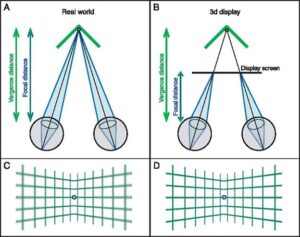
Figure 1: This image shows the Vergence-Accommodation Conflict.
Image Courtesy: https://miro.medium.com/v2/resize:fit:1400/format:webp/1*BRB4QLpT7bxA5QZN3d2xrA.jpeg

Mitigation of Vergence-Accommodation Conflict
Numerous strategies have been suggested to mitigate VAC in immersive displays.
- By increasing the viewing distance and aligning the display focal plane with simulated depth, the disparity between vergence and accommodation can be mitigated. However, the influence of conflicting focus signals is reduced by maximising other depth cues, such as motion parallax. (1)
- When the display distance cannot be changed, corrective lenses can be used. (1)
- Advanced methods that go beyond single focal plane displays involve varifocal or multifocal systems, which ensure that accommodation more closely matches vergence demand. (2)
- In addition, the current trend in the management of VAC in next-generation near-eye displays is the integration of hardware and software solutions. (4)
Conclusion
VAC is a significant difficulty in 3D, AR, and VR displays, causing eye strain and discomfort. Methods such as matching focus with vergence, improving depth cues, and employing varifocal or multifocal displays can all help reduce VAC. Emerging display technologies offer more comfortable and immersive experiences in education, healthcare, and entertainment. As technology advances, mitigating VAC will become critical to providing fully smooth and comfortable immersive experiences for all.
References
- Hoffman, D. M., Girshick, A. R., Akeley, K., & Banks, M. S. (2008). Vergence–accommodation conflicts hinder visual performance and cause visual fatigue. Journal of vision, 8(3), 33-33.
- Zhou, Y., Zhang, J., & Fang, F. (2021). Vergence-accommodation conflict in optical see-through display: Review and prospect. Results in Optics, 5, 100160.
- Kim, J., Kane, D., & Banks, M. S. (2014). The rate of change of vergence–accommodation conflict affects visual discomfort. Vision research, 105, 159-165.
- Zabels, R., Osmanis, K., Narels, M., Gertners, U., Ozols, A., Rūtenbergs, K., & Osmanis, I. (2019). AR displays: Next-generation technologies to solve the vergence–accommodation conflict. Applied Sciences, 9(15), 3147.
About the Author

Lalita Sharma
B. Optom Student,
Recent Comments