
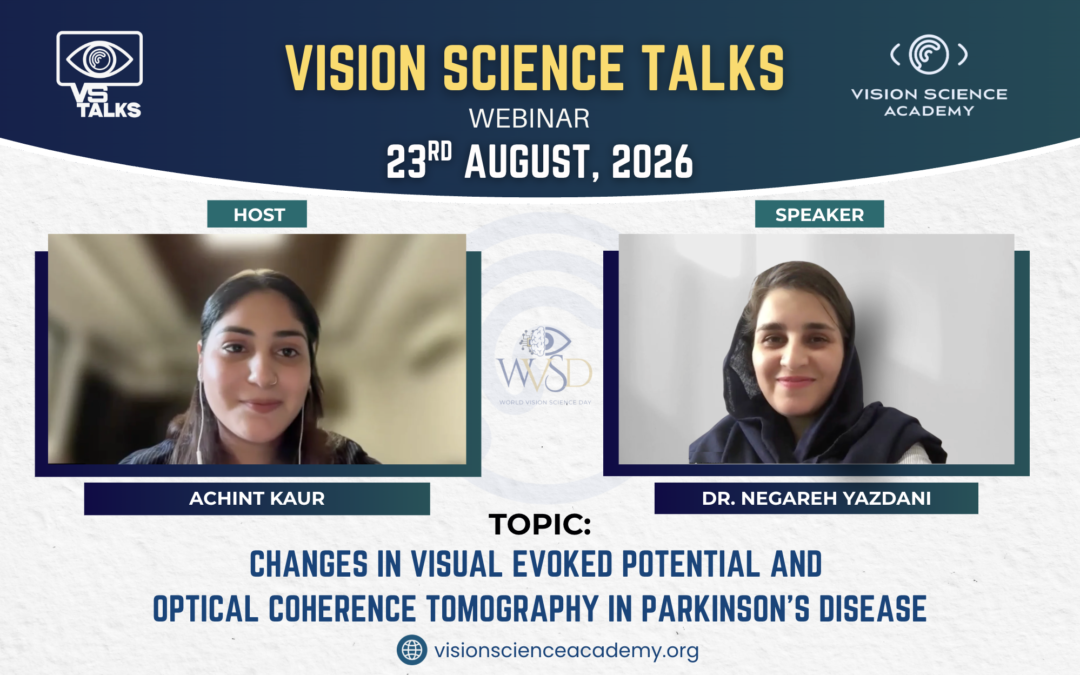
Event Overview
London, UK – August 23, 2026 – The Vision Science Talks August featured an expert lecture exploring the relationship between Parkinson’s disease and visual function, with a particular focus on Visual Evoked Potential (VEP) and Optical Coherence Tomography (OCT).
| Date: | 23 August 2026 |
| Speaker: | Dr. Negareh Yazdani |
| Designation: | Assistant Professor and Researcher |
| Affiliation: | Mazandaran University of Medical Sciences, Iran |
| Topic: | Changes in Visual Evoked Potential and Optical Coherence Tomography in Parkinson’s Disease |
Executive Summary
The session examined the functional and structural changes that may occur within the visual system in Parkinson’s disease. Dr. Yazdani presented evidence from a systematic review and meta-analysis examining VEP and OCT findings in individuals with Parkinson’s disease.
Key Areas Covered
Parkinson’s Disease and Vision
- Role of dopaminergic dysfunction in visual processing.
- Visual manifestations of Parkinson’s disease and their potential occurrence before motor symptoms.
- Potential of ocular structure and visual function as biomarkers for disease evaluation.
Visual Evoked Potential
- P100 amplitude: No statistically significant difference between Parkinson’s disease and healthy subjects.
- P100 latency: Higher in Parkinson’s disease patients.
- N75 latency: Significantly higher in Parkinson’s disease patients.
- Disease-duration analysis demonstrated significant differences in P100 latency.
Optical Coherence Tomography
- Foveal thickness: Lower in Parkinson’s disease, but not statistically significant.
- RNFL thickness: Significantly thinner in Parkinson’s disease compared with healthy subjects.
- RNFL differences remained significant across disease-duration subgroups.
Key Takeaways
- Parkinson’s disease may involve both functional visual pathway changes and retinal structural alterations.
- Increased VEP latency and reduced RNFL thickness emerged as important findings.
- VEP and OCT may provide complementary information when investigating visual and neurodegenerative changes.
- The session highlighted the growing intersection between vision science and neuroscience.
Speaking on the event’s success, Kristi Sharma, Senior Manager for Advanced Education and Partnerships, shared her gratitude:
“The Vision Science Talks continues to create a valuable platform for bringing emerging research and interdisciplinary perspectives to the global vision science community.
Dr. Negareh Yazdani’s presentation offered an insightful look at how visual electrophysiology and retinal imaging can contribute to our understanding of Parkinson’s disease. Sessions such as this reinforce the importance of connecting optometry, ophthalmology, neuroscience and research, while encouraging professionals to look beyond traditional boundaries of vision care.”

Figure: A Clip from the Q&A Session
Conclusion and Future Outlook
The session reinforced the potential value of combining functional assessments such as VEP with structural imaging such as OCT in neurodegenerative disease research. While further research is required to establish their clinical biomarker potential, the findings presented provide an encouraging foundation for future interdisciplinary research at the intersection of vision, brain health and neurodegeneration.
Vision Science Academy looks forward to continuing The Vision Science Talks as a platform for sharing contemporary research and fostering meaningful academic exchange across the global vision science community.
Recent Comments