
Niyati Arun Keni, M. Optom
Faculty, ITM Skills University, Navi Mumbai, India
Optometry education has always depended on a strong mix of classroom teaching, practical training, and real patient interaction. From understanding optics and visual physiology to developing clinical decision-making skills, the journey from student to clinician requires time, guidance, and experience. In recent years, Artificial Intelligence (AI) has begun to influence this process, especially in the way Optometry is taught and learned. (1)
AI is often discussed in relation to diagnostics or retinal image analysis, but its role in Optometry education is becoming equally important. In simple terms, AI refers to computer systems that can learn from data and adapt their responses. (7) When applied to teaching, AI helps make learning more flexible, interactive, and student-focused without replacing teachers or clinical mentors. (3) One of the biggest advantages of AI in Optometry education is personalised learning. (6) Every Optometry classroom has students with different learning speeds and strengths. Some students quickly understand refraction, while others need more time with optics or binocular vision concepts. AI-based learning platforms can track student performance and adjust learning materials accordingly. Students who struggle can receive extra explanations and practice, while those who perform well can be challenged with advanced clinical cases. This reduces academic pressure and improves understanding. (1)
AI also plays a significant role in clinical skill development. Clinical exposure is essential, but patient availability and case variety are often limited. AI-powered virtual simulations allow students to practice history taking, clinical reasoning, and management planning in a safe environment. Making mistakes in a simulated setting helps students learn without risking patient safety. As a result, students enter clinics with better confidence and clearer clinical thinking. (2)
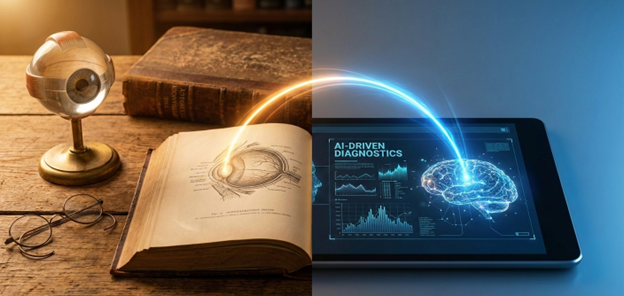
Figure 1: This image shows the integration of Artificial Intelligence into Optometry education.
Image Courtesy: Created by the Author
Assessment is another area where AI is proving useful. Traditional exams often test memory rather than clinical understanding. (6) AI-supported assessment tools can analyse answers, identify common mistakes, and track progress over time. This helps educators understand where students struggle and adjust their teaching methods. For students, it provides quicker and more meaningful feedback. (1)
AI is also helpful for educators. By assisting with routine tasks such as assessment analysis and content development, AI allows teachers to focus more on mentoring, discussion, and hands-on training. However, AI must be used carefully. Over-dependence on technology, concerns about data privacy, and lack of faculty training are real challenges that institutions must address. (4)
Overall, AI should be seen as a supportive teaching tool, not a replacement for traditional education. When used responsibly, it can strengthen Optometry training and better prepare students for modern clinical practice. (3)
Role of Artificial Intelligence in Optometry Education
| Area of Education | Traditional Approach | AI-Supported Approach |
| Learning style | Same content for all students | Personalised learning paths |
| Clinical training | Limited patient exposure | Virtual patient simulations |
| Feedback | Delayed and manual | Immediate and data-based |
| Assessment | Exam-focused | Continuous performance tracking |
| Faculty role | Content delivery | Mentor and clinical guide |
Table 1: This table shows five key areas of Optometry education.
Conclusion
Artificial Intelligence is reshaping Optometry education by providing personalised learning experiences, improving clinical training through simulation, and supporting educators with efficient assessment and feedback tools. Rather than replacing conventional teaching methods, AI serves as a valuable complement that enhances student engagement, clinical reasoning, and evidence-based decision-making. As AI technologies continue to evolve, their responsible integration into Optometry curricula will require appropriate faculty training, ethical governance, and protection of student data. When implemented thoughtfully, AI has the potential to produce competent, confident, and technologically proficient Optometrists who are better prepared to meet the demands of modern eye care.
References
- Cook, D. A. (2020). Artificial intelligence in medical education: A systematic review. Medical Education, 54(1), 1–10. https://doi.org/10.1111/medu.14131
- Esteva, A., Robicquet, A., Ramsundar, B., et al. (2019). A guide to deep learning in healthcare. Nature Medicine, 25(1), 24–29. https://doi.org/10.1038/s41591-018-0316-z
- Topol, E. (2019). Deep medicine: how artificial intelligence can make healthcare human again. Hachette UK.
- Ethics and governance of artificial intelligence for health (2021). World Health Organization. WHO Press.
- Li, Z., Wang, L., Wu, X., Jiang, J., Qiang, W., Xie, H., Zhou, H., Wu, S., Shao, Y., & Chen, W. (2023). Artificial intelligence in ophthalmology: The path to the real-world clinic. Cell reports. Medicine, 4(7), 101095. https://doi.org/10.1016/j.xcrm.2023.101095
- Wang, S., Ji, Y., Bai, W., Ji, Y., Li, J., Yao, Y., Zhang, Z., Jiang, Q., & Li, K. (2023). Advances in artificial intelligence models and algorithms in the field of optometry. Frontiers in cell and developmental biology, 11, 1170068. https://doi.org/10.3389/fcell.2023.1170068
- Krishnan, A., Dutta, A., Srivastava, A., Konda, N., & Prakasam, R. K. (2025). Artificial Intelligence in Optometry: Current and Future Perspectives. Clinical optometry, 17, 83–114.
- Schmidt-Erfurth, U., Sadeghipour, A., Gerendas, B. S., Waldstein, S. M., & Bogunović, H. (2018). Artificial intelligence in retina. Progress in retinal and eye research, 67, 1-29.
About the Author

Niyati Arun Keni
Faculty,
Recent Comments